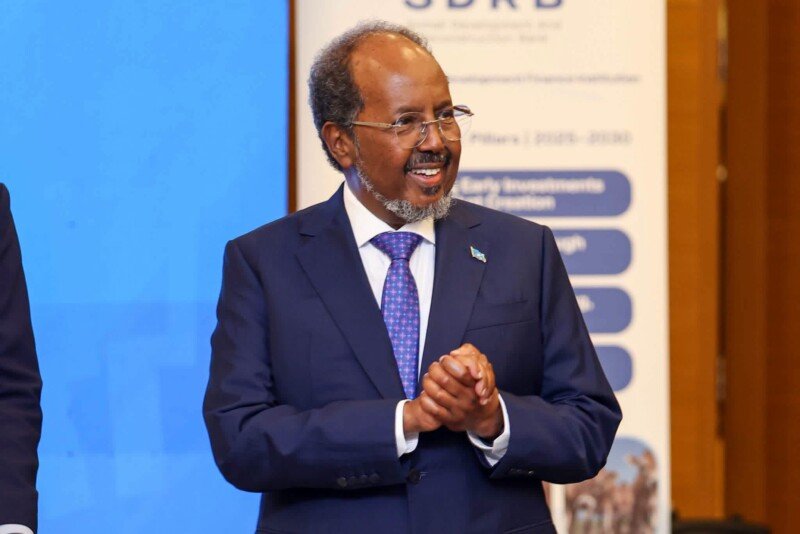
MOGADISHU — President Hassan Sheikh Mohamud announced on Saturday that uranium, lithium and cobalt deposits have been confirmed in Somalia, speaking at the opening of the Somalia Development Finance Forum in Mogadishu.
The President said Somalia possesses diverse natural resources including underground minerals, fisheries, livestock and agriculture, but requires expertise, investment and international cooperation to exploit them.
“Today the world is greatly interested in minerals, especially what are known as rare earths. Whether it is uranium, lithium, cobalt and many others that the world is now seeking, it has been confirmed that they are in Somalia,” President Hassan Sheikh said.
The announcement did not include details on the volume of reserves, precise locations, or a timeline for exploitation. No commercially recoverable estimates for lithium or cobalt were made public, and no specific mining project was identified for either metal.
Investment Climate and Institutional Gaps
On investment, the President said the government is focused on creating a favourable environment for Somali and international investors to return, with the aim of expanding economic opportunities.
He noted that investor confidence depends on stability, clear laws and institutions capable of functioning effectively. He linked these factors to industrial development, economic enablers and systems that facilitate trade.
The Somalia Development Finance Forum presented plans the government says are aimed at expanding economic growth, increasing investment and building economic foundations that lead to sustainable development.
According to the U.S. State Department’s 2026 Fiscal Transparency Report, Somalia has specified in law the criteria and procedures for awarding natural resource extraction contracts and licenses, but a lack of transparency, particularly related to hydrocarbon agreements, makes it difficult to assess if those regulations were followed in practice. The report also noted that the government made basic information on some natural resource extraction agreements publicly available but did not publish accessible information on public procurement contracts.
Known Estimates and Ongoing Exploration
While the President’s announcement did not cite specific figures, prior assessments have identified potential reserves. According to International Atomic Energy Agency and OECD Nuclear Energy Agency data, Somalia holds an estimated 10,200 tons of uranium resources, including around 7,600 tons considered potentially commercially recoverable. Surveys have also identified deposits of lithium, copper, titanium, gold and rare earth elements, though much of Somalia remains underexplored after decades of instability.
The government is simultaneously pursuing offshore hydrocarbon exploration. In April 2026, President Hassan Sheikh presided over the arrival of the Turkish drilling vessel Çağrı Bey, marking the start of Somalia’s first deep-sea petroleum exploration activities.
The country has also been actively courting international investment in the mining sector. In January 2026, Deputy Minister of Petroleum and Mineral Resources Abdiwahab Abdi Omar attended the Future Minerals Forum in Riyadh, presenting Somalia as a destination for extractive industry investment.
Critical Note
The President’s announcement that uranium, lithium and cobalt have been “confirmed” in Somalia is significant, but the absence of reserve estimates, locations, or timelines means it functions more as a political statement than a technical one. The distinction matters: confirming the presence of minerals is not the same as confirming commercially viable deposits.
Somalia’s mining governance framework remains incomplete. The current Mining Code dates from 1984, and a modern mining bill drafted in 2023 still awaits enactment. A 2025 assessment by the International Institute for Sustainable Development found that Somalia lacks a comprehensive mining cadaster, has no national inventory of mineral resources, and does not have a consistent geological survey programme in operation. The federal government does not control all mining operations, with sub-national entities granting concessions that create legal ambiguity.
These institutional gaps are the real barrier to translating confirmed mineral presence into revenue and development. The President acknowledged that investor confidence requires stability, clear laws and functional institutions. The question is whether those conditions exist at a level sufficient to attract the capital needed to move from announcement to extraction.
Recommended Reading On ftlsomalia.com
- Somalia Seeks Global Investment at Arab Mining Forum in Riyadh
- Somalia and Türkiye Sign Landmark Oil and Gas Agreement
- Turkish Drilling Vessel Arrives in Somalia for Offshore Exploration
- Somalia Approves Ratification of Africa Minerals Strategy Group Charter
- Somalia, Kenya, and Tanzania Forge Tripartite Mining Cooperation in Cape Town
- US Report Urges Somalia to Improve Fiscal Transparency in Natural Resource Management