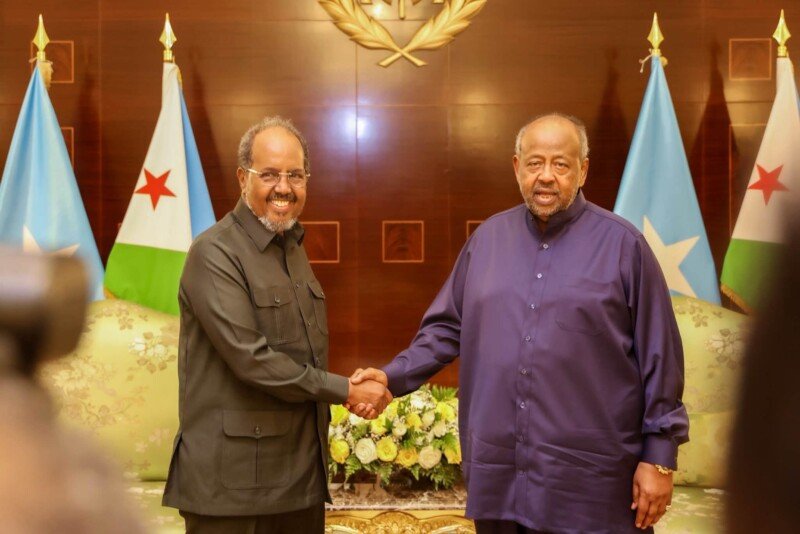
DJIBOUTI CITY — Somali President Hassan Sheikh Mohamud held talks with Djibouti’s President Ismail Omar Guelleh on Wednesday during a working visit focused on strengthening ties between the neighbouring countries, according to a statement from the Somali presidency.
The two presidents discussed what Somalia described as longstanding relations and cooperation between the two countries, with particular attention to security, economic and political cooperation. They also discussed peace, stability and security in the Horn of Africa, though the presidency did not provide further details on specific agreements reached during the meeting.
The visit is part of Hassan Sheikh’s regional diplomatic tour aimed at strengthening Somalia’s relations and cooperation with neighbouring countries. It followed a one-day working trip to Ethiopia on Tuesday, where he held talks with Prime Minister Abiy Ahmed.
A Deepening Strategic Alliance
The talks are the latest in a series of high-level engagements between Mogadishu and Djibouti. In March 2026, President Mohamud travelled to Djibouti for a strategic working visit, holding talks with President Guelleh on security, trade and economic partnership, as reported in FTL Somalia’s coverage of Somalia-Djibouti relations.
The two countries have signed a Memorandum of Understanding on political consultations, establishing a framework for regular dialogue between the two governments on pressing political, economic and security matters, as detailed in FTL Somalia’s coverage of the diplomatic engagement. They have also reached an agreement to enhance defence and security cooperation, a development officials say will bolster Somalia’s stabilisation initiatives and improve regional coordination against common threats, as reported in FTL Somalia’s coverage of the security agreement.
Djibouti’s Role in Somalia’s Security
Djibouti has remained one of Somalia’s closest security partners. Djiboutian forces have participated in international and African Union security operations in Somalia, including deployments in Hiiraan, where the contingent became known locally as “Hiil-Walaal” (brothers in arms).
A new contingent of Djibouti troops participating in AUSSOM arrived in Beledweyne earlier this year to assume security responsibilities in the city and surrounding areas, including Buulo Burde. The newly deployed 13th battalion replaced the 11th battalion, which had concluded its operational tour covering Beledweyne, Dhuusamareeb and Buulo Burde.
Djibouti also hosted the Arta Peace Conference in 2000, which established the Transitional National Government and is widely regarded as a defining moment in Somalia’s modern political history. President Mohamud has previously bestowed Somalia’s National Honor Medal upon President Guelleh in recognition of his enduring solidarity and contributions to Somalia’s stability, as detailed in FTL Somalia’s coverage of the President’s engagement with Djibouti.
Regional Diplomatic Tour
The Djibouti visit comes amid heightened political and security tensions across the Horn of Africa, including renewed fighting in northern Ethiopia and continuing political disputes within Somalia.
President Mohamud is also expected to travel to Egypt as part of his regional diplomatic engagements, according to Somali officials. The meetings bring him into consultations with three countries that play significant roles in the political and security dynamics of the Horn of Africa and the Red Sea.
Critical Note
President Mohamud’s visit to Djibouti is a continuation of Somalia’s sustained diplomatic engagement with its neighbours amid a complex regional environment. Djibouti has been a consistent security partner, contributing troops to African Union missions and hosting the Arta peace process that helped restore Somali statehood. The signing of agreements on political consultations and defence cooperation reflects a relationship that has moved beyond symbolic gestures.
However, the visit also highlights the limits of Somalia’s regional diplomacy. The meetings in Addis Ababa and Djibouti are taking place while Ethiopia faces renewed internal conflict and Somalia itself continues to grapple with political disputes and security challenges. The Somali presidency has not disclosed the substance of the discussions on Ethiopia’s role in AUSSOM or the future of Ethiopian forces in Somalia, leaving key questions about the security transition unanswered.
For Somalia, maintaining close relations with Djibouti is important, but the more consequential relationship in the region remains with Ethiopia, a country that provides thousands of troops to the AU mission and whose stability directly affects Somalia’s own security. The Djibouti talks are a necessary part of the diplomatic tour, but they are not the main event. The question is whether the broader regional tour can produce a coherent framework for managing the competing interests that shape Somalia’s security environment.
Recommended Reading On ftlsomalia.com
- Prime Minister Hamza Meets Djibouti Ambassador and Police Commander to Strengthen Bilateral Ties
- Djibouti’s New Ambassador to Somalia Welcomed in Mogadishu
- Somalia–Djibouti Partnership Advances on Security Matters
- Federal Government Delegation Attends Djibouti’s 49th Independence Anniversary in Beledweyne