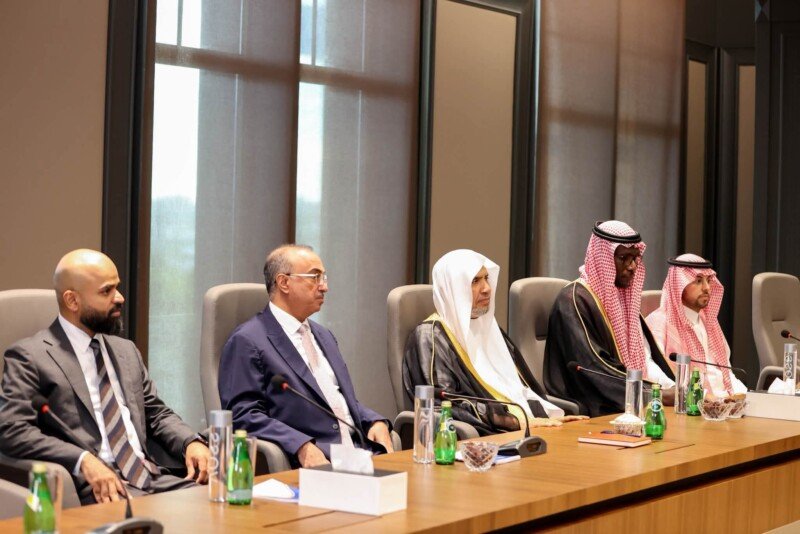
MOGADISHU — President Hassan Sheikh Mohamud received the Secretary-General of the Muslim World League and Chairman of the Muslim Scholars Association, Dr. Mohammed bin Abdulkarim Al-Issa, at the Presidential Palace in Mogadishu on Friday to discuss strengthening cooperation in countering extremist ideology and protecting Somali youth from radicalization.
The talks focused on promoting a better understanding of Islam and advancing messages of moderation and centrism, while addressing extremist and radical ideas that seek to influence young people. The meeting comes as Somalia continues its long-running campaign against Al-Shabaab, whose insurgency has combined armed attacks with an ideology rooted in an extremist interpretation of Islam.
President Mohamud said Somalia needed stronger efforts to promote a correct understanding of Islam while confronting extremist interpretations and attempts to mislead young people. He thanked the organization for its support for Somalia’s unity and sovereignty and for its role in social development.
A Dual Approach to Counterterrorism
The discussions highlight Somalia’s broader strategy of complementing military operations against Al-Shabaab with efforts to challenge the group’s ideology at the community level. Somalia’s Defence Minister Ahmed Moallim Fiqi reached an agreement with the Islamic Military Counter Terrorism Coalition (IMCTC) in February 2026 to enhance cooperation in combating extremist ideology and strengthening national security capabilities, with discussions centering on improving intelligence exchange, training programs, and strategic coordination.
The IMCTC has also launched a series of projects in Somalia, beginning with a three-day training programme for journalists and social media influencers focused on media and peace, drawing representatives from 43 countries and more than 20 international embassies. Defence Minister Fiqi said the government has adopted a national approach to countering terrorism that links the military, security, ideological, media and economic fields while strengthening state institutions.
President Mohamud has previously hosted a state banquet for prominent Islamic scholars attending the 3rd National Conference of Somali Scholars, where he announced that scholars had been integrated into the Somali National Armed Forces for the first time to provide ethical direction and spiritual backing to soldiers.
The Minister of Religious and Islamic Affairs, Mukhtar Robow Abu Mansoor, has expressed appreciation for President Mohamud and Prime Minister Hamza Abdi Barre’s dedication to advancing religious matters, highlighting their commitment to fostering unity and supporting Somali scholars through various religious initiatives, including the Daarul Fatwa Center.
Ongoing Humanitarian Partnership
The Muslim World League has maintained a sustained humanitarian presence in Somalia, implementing projects across multiple sectors. In the Puntland region, the organization implemented a food assistance project for an orphanage in Galkayo, providing daily, nutritionally balanced meals in direct coordination with relevant government authorities. Annual allocations have also been distributed to over 10,000 orphaned children affiliated with the Muslim World League in Somalia and Djibouti, in cooperation with local governments.
In response to climate-related challenges, the Muslim World League has worked on projects aimed at turning climate challenges into opportunities for safety and development, including canal restoration efforts in Beledweyne that have restored safety to millions and brought growth back to the land.
Critical Note
The meeting between President Mohamud and the Muslim World League Secretary-General reflects a recognition that military operations alone cannot defeat Al-Shabaab. The group’s ability to recruit and regenerate is rooted in ideological narratives that require a counter-narrative grounded in credible religious scholarship. Engaging institutions like the Muslim World League provides the government with access to influential religious voices that can challenge extremist interpretations.
However, the effectiveness of this approach depends on whether religious engagement is implemented as a genuine long-term strategy or merely as a rhetorical complement to military operations. Somalia’s counter-extremism efforts have at times been criticized for lacking a coherent ideological component, with military campaigns prioritized over community-based prevention. The government must ensure that partnerships with religious institutions translate into sustained programs that address the underlying drivers of radicalization, including poverty, lack of opportunity, and weak governance.
There are also concerns about the politicization of religious discourse. The government must be careful to avoid using religious institutions to advance narrow political agendas or to silence legitimate dissent. A credible counter-extremism strategy requires that religious engagement be authentic, inclusive, and grounded in the principles of moderation and tolerance that the Muslim World League claims to promote.
Recommended Reading On ftlsomalia.com
- Somali Defense Minister Meets IMCTC Leadership in Saudi Arabia
- Islamic Military Coalition Launches ‘Peace Journalists’ Programme in Mogadishu
- President Mohamud Hosts Banquet for Somali Scholars
- Somali President and PM Hailed for Prioritizing Religious Issues
- Somali Minister Meets Chairman of Muslim Scholars Association