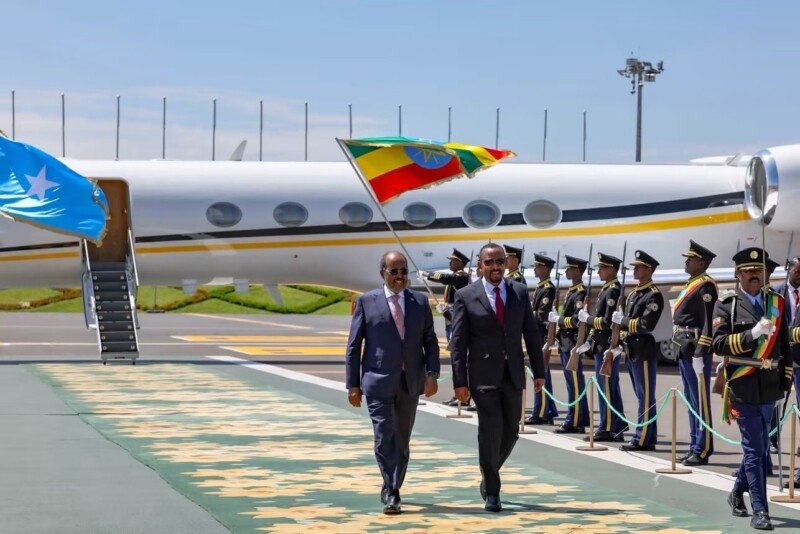
ADDIS ABABA — Ethiopian Prime Minister Abiy Ahmed welcomed Somali President Hassan Sheikh Mohamud at Bole International Airport on Tuesday morning, as the two leaders prepare for high-level talks on bilateral and regional issues.
The visit, described as an official one-day working trip, comes amid renewed fighting in northern Ethiopia between federal forces and Tigrayan forces, raising fresh concerns over regional stability.
The two leaders are expected to discuss bilateral relations, security cooperation, economic ties and regional stability in the Horn of Africa.
A Relationship Rebuilt After Crisis
The visit is the latest in a series of high-level engagements between Addis Ababa and Mogadishu following a period of diplomatic tension. Relations between the two countries were strained in early 2024 after Ethiopia signed a memorandum of understanding with Somaliland to secure sea access, a move Mogadishu condemned as a violation of its sovereignty.
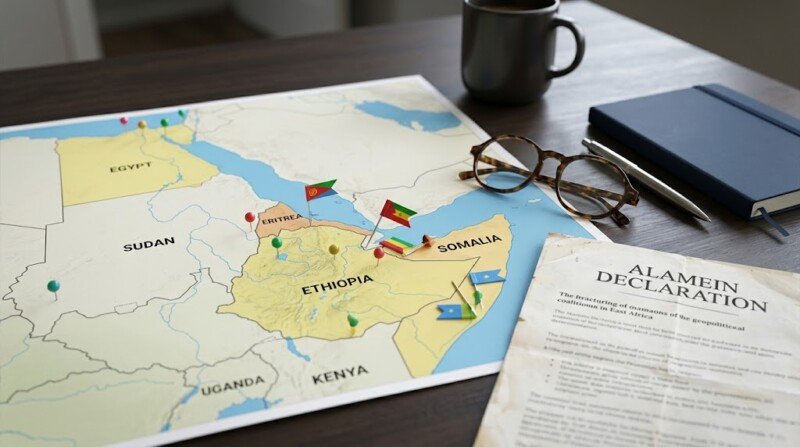
The crisis was defused through Turkish mediation, leading to the Ankara Declaration in December 2024, in which both countries reaffirmed respect for each other’s sovereignty, unity, independence and territorial integrity. Technical negotiations on Ethiopia’s sea access began in February 2025.
President Mohamud has visited Ethiopia several times this year, including for the inauguration of the Aysha-II Wind Power Project in January and the 39th African Union Summit in February. Prime Minister Abiy and President Mohamud held bilateral discussions in Addis Ababa in June on economic ties, security and regional stability.
The Egypt Factor: A Strategic Friction
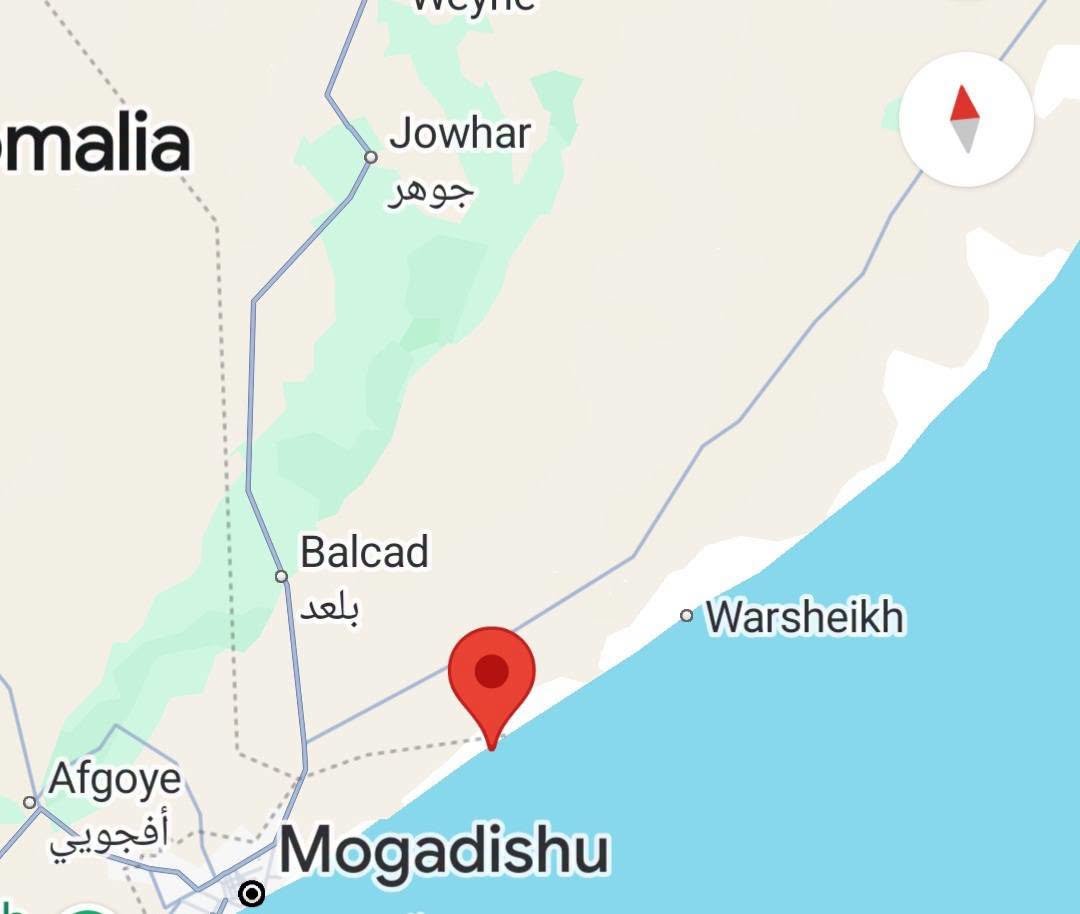
At the same time as the Addis Ababa talks, Somalia’s deepening military relationship with Egypt remains a source of friction with Ethiopia. Egyptian military officials arrived in Mogadishu today, deploying to the coastal area of El-Adde near the Isiley airstrip in the Middle Shabelle region, where the Somali government stationed a unit of the Somali National Army a day earlier. The site is intended to serve as a military base for training Somali forces.
As reported in FTL Somalia’s coverage of the Egyptian deployment, Egypt has pledged approximately 1,091 troops to the African Union Support and Stabilization Mission in Somalia (AUSSOM), with Egyptian Foreign Minister Badr Abdelatty confirming the contingent would be stationed in the Middle Shabelle region. The deployment marks Cairo’s most visible military engagement in the Horn of Africa in decades.
Ethiopia views Egypt’s military presence in Somalia with deep suspicion. As detailed in FTL Somalia’s analysis of Somalia-Egypt relations, Cairo’s engagement in Somalia is closely tied to its broader rivalry with Ethiopia over the Grand Ethiopian Renaissance Dam and Red Sea influence. Analysts have noted that Egypt’s military support in Somalia may be intended to either combat or create a psychological threat to Ethiopia.
The Egyptian deployment has also drawn public opposition within Somalia. In September 2026, hundreds of Somalis protested in Mogadishu, Kismayo and other cities over a Turkish airstrike, with some demonstrators burning Turkish flags and trampling on Egyptian flags to express opposition to foreign military involvement.
Ethiopia’s Internal Conflict and the Rebel Alliance
The Addis Ababa talks also come as Ethiopia faces a significant internal security challenge. On 20 September 2026, seven armed groups announced the formation of a coalition called the Ethiopian Peoples’ Forces Alliance for Survival, aimed at removing Prime Minister Abiy Ahmed’s government.
The alliance brings together the Fano militia in Amhara, the Oromo Liberation Army (OLA), the Tigray People’s Liberation Front (TPLF) and four other smaller groupings. The groups accuse the government of presiding over “war, genocide, mass destruction and utter poverty,” claiming Ethiopia is at risk of disintegration.
As reported in FTL Somalia’s coverage of the rebel alliance, the coalition spans half of Ethiopia’s twelve regional states. The announcement came three days before Tigrayan forces seized airports in Mekelle, Axum and Shire, prompting Ethiopian Airlines to suspend flights to all three cities.
The Ogaden National Liberation Front (ONLF) has denied joining the alliance, saying its name was used without authorization. The group reaffirmed its commitment to a 2018 peace agreement with Ethiopia’s federal government.
Regional analysts have noted that while the groups have previously fought against each other, the formation of a coordinated alliance could force Ethiopian government forces to fight on multiple fronts simultaneously.
Critical Note
President Mohamud’s visit to Addis Ababa is a diplomatic balancing act. On one hand, Somalia needs to maintain stable relations with its largest neighbour, particularly given Ethiopia’s role as a major troop contributor to the African Union mission. On the other, Somalia’s deepening military partnership with Egypt, Ethiopia’s principal regional rival, creates unavoidable friction.
The timing is particularly delicate. Ethiopia is grappling with a renewed rebel alliance that includes the TPLF, which fought a devastating two-year war against federal forces from 2020 to 2022. If the coalition translates into coordinated military action across multiple fronts, Ethiopia could be forced to redirect resources away from its commitments in Somalia. Any drawdown of Ethiopian forces would create security gaps that Somali forces and other AUSSOM contributors would need to fill, complicating an already strained mission.
For Somalia, the challenge is to manage its relationships with both Ethiopia and Egypt without becoming a proxy battleground in their rivalry. The Egyptian military base at El-Adde is a tangible expression of Cairo’s expanding footprint, but it also risks fuelling public resentment over foreign military presence and complicating the political calculus with Addis Ababa. Whether the Addis Ababa talks can produce a framework for managing these competing pressures remains to be seen. What is clear is that Somalia’s diplomatic room for manoeuvre is narrowing as regional rivalries intensify.