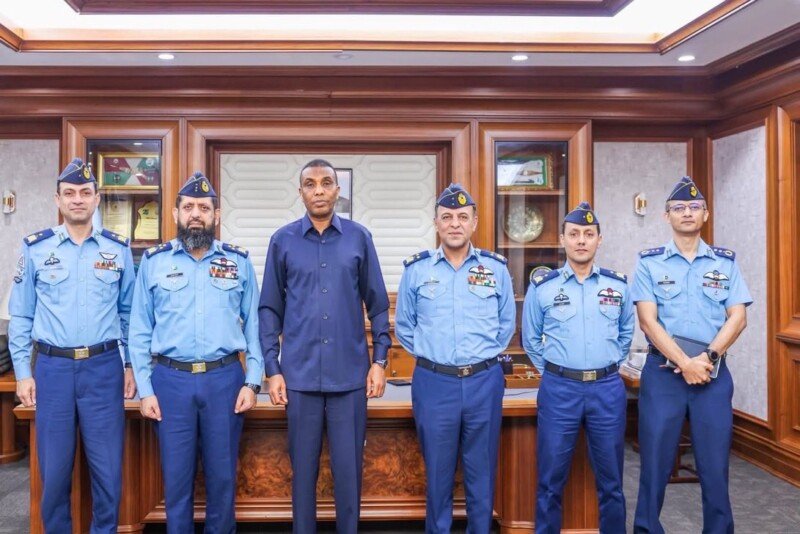
MOGADISHU — Prime Minister Hamza Abdi Barre met with a Pakistani delegation led by Air Marshal Muhammad Sarfraz on Monday to discuss strengthening Somalia-Pakistan defence cooperation, with particular focus on the development of the Somali Air Force, training, and enhancing the capabilities of Somali security institutions.
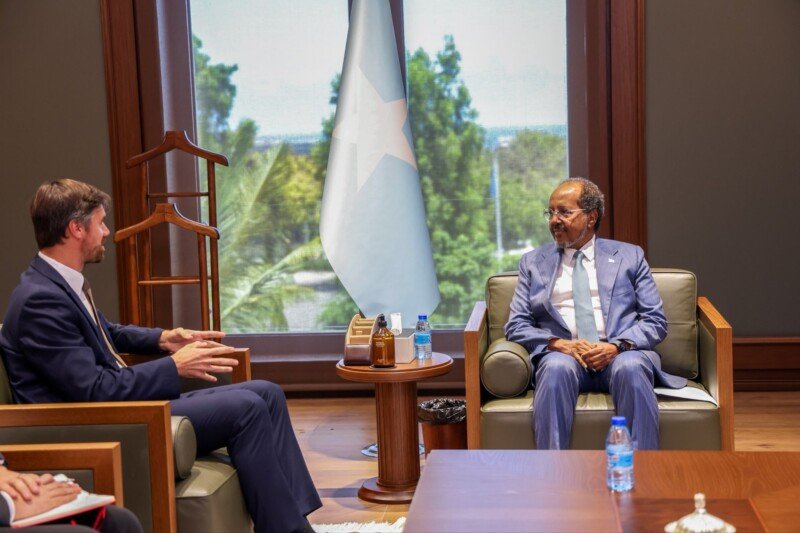
The meeting followed the delegation’s arrival in Mogadishu on Saturday and President Hassan Sheikh Mohamud’s reception of the same delegation at the Presidential Palace on Sunday. The talks focused on accelerating the development of the Somali Air Force, including improving operational capabilities and advancing the training and professional development of personnel.
Prime Minister Barre said Somalia was committed to building and equipping its armed forces and strengthening their ability to take greater responsibility for national security.
A Framework Already in Place
The visit follows a Memorandum of Understanding on defence cooperation signed in Islamabad in August 2026 by Defence Minister Ahmed Moallim Fiqi and Pakistan’s Minister of Defence Khawaja Muhammad Asif. The agreement covers counterterrorism, military training, the exchange of expertise, defence capacity building, and broader security collaboration, as detailed in FTL Somalia’s report on the Islamabad meetings.
Somalia is also in advanced negotiations with Pakistan to purchase up to 24 JF-17 Thunder fighter jets in a potential $900 million agreement, as outlined in FTL Somalia’s reporting on the fighter jet negotiations. The JF-17 Block III is a multirole fighter equipped with an active electronically scanned array radar and beyond-visual-range missile capabilities.
Pakistan Air Force officials have emphasised that the cooperation extends beyond hardware. Retired Group Captain Sultan M. Hali told Sputnik Africa that Somalia needs not only aircraft but also the human capital to operate and maintain an air force, noting Pakistan’s decades of experience training pilots, technicians and aviation engineers.
Critical Note
The Prime Minister’s meeting with the Pakistani delegation represents another step in implementing the August defence agreement. The focus on training and institutional capacity carries weight given Somalia’s long-standing lack of sovereign air capability and its reliance on external partners for aerial surveillance and strikes against Al-Shabaab.
The potential acquisition of JF-17 fighters would represent Somalia’s most ambitious military procurement in decades, but financing arrangements remain unclear, and the reported $900 million value far exceeds Somalia’s current defence budget. Analysts have suggested that partners such as Saudi Arabia and Türkiye may play a role in facilitating the acquisition.
The practical challenge is not simply acquiring aircraft. Sustaining a modern air force requires pilot training pipelines, maintenance infrastructure, radar coverage, and airfield development. Pakistan’s engagement in Somalia fits a broader pattern of building institutional access in the western Indian Ocean without committing to a permanent overseas military presence. Whether this translates into a self-sustaining Somali air capability remains an open question.
Recommended Reading On ftlsomalia.com
- Pakistan Air Force Delegation Arrives in Mogadishu for Air Defence Talks
- President Hassan Sheikh Receives Senior Pakistan Air Force Delegation at Villa Somalia
- Defence Minister Fiqi Visits Pakistan’s Air and Naval Headquarters to Strengthen Bilateral Cooperation
- Somalia Advances $900M Deal for Pakistani JF-17 Fighter Jets to Rebuild Air Force
- Somali and Chinese Defence Ministers Hold High-Level Talks in Beijing
- Somali Pilots Execute Historic Aerial Display Following Bilateral Defense Support From Turkey