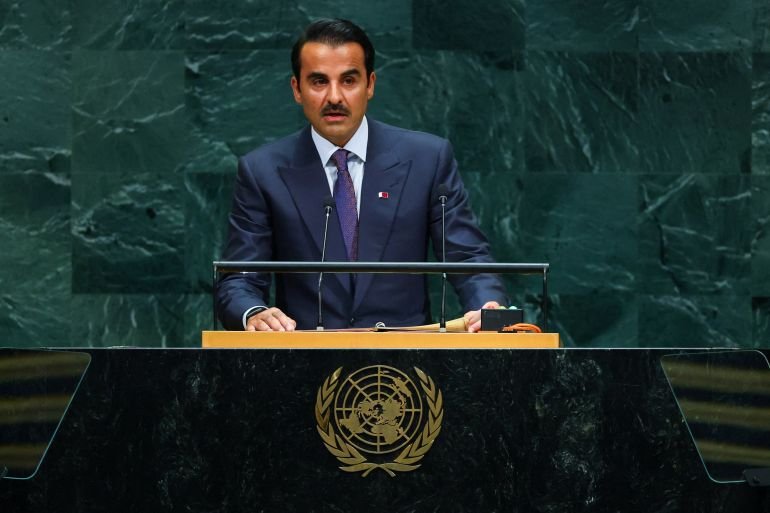
NEW YORK — Qatar’s Emir, Sheikh Tamim bin Hamad Al Thani, reaffirmed his country’s support for Somalia’s sovereignty, unity, and territorial integrity during his address at the opening of the 81st session of the United Nations General Assembly.
In his speech, the Emir described Somalia as a brotherly nation and stated clearly that Qatar firmly supports Somalia’s independence, unity, and territorial integrity. The remarks came as world leaders gathered in New York for the annual General Debate, which runs from 22 to 28 September 2026.
The Emir’s address focused on the importance of respecting state sovereignty, territorial integrity, and resolving disputes through dialogue and diplomacy. He highlighted Qatar’s consistent position on supporting regional states and specifically affirmed Doha’s backing for Somalia.
A Consistent Position Against Recognition
Qatar’s reaffirmation at the UN follows a pattern of strong opposition to any recognition of Somaliland. In January 2026, Qatar participated in an extraordinary meeting of the Organisation of Islamic Cooperation (OIC) Council of Foreign Ministers in Jeddah, where Minister of State for Foreign Affairs Sultan bin Saad Al Muraikhi reiterated Qatar’s “vehement condemnation” of Israel’s recognition of Somaliland.
Al Muraikhi stressed that the move constituted a unilateral measure contravening international law and undermining Somalia’s sovereignty, national unity, territorial integrity, and internationally recognized borders. He stated clearly that the “Somaliland” region is part and parcel of the Federal Republic of Somalia, that it has no international legal status, and that any attempt to recognize its secession is “null and void” under international law.
In December 2025, Qatar’s Ministry of Foreign Affairs expressed its firm rejection of the joint declaration between Israel and Somaliland, stressing that the step was a “dangerous precedent” and reaffirming its full support for legitimate Somali state institutions.
Rival Delegations Converge on the United States
The Emir’s speech came as both Somalia and Somaliland conducted parallel diplomatic campaigns in the United States. Somaliland President Abdirahman Mohamed Abdullahi (Irro) arrived in Washington on 5 September for a visit focused on diplomatic, security and economic cooperation, as well as the breakaway region’s campaign for broader international recognition.
During his visit, Irro addressed an event at the Hudson Institute, presenting Somaliland as a strategic partner in the Horn of Africa, and met Senator Ted Cruz on Capitol Hill. Cruz, who has become one of the leading voices in Washington calling for Somaliland’s recognition, said after the meeting that Somaliland had established itself as a “reliable partner” for the United States on counterterrorism and protecting shipping around the Horn of Africa.
Somaliland’s representative to the United States, Ambassador Bashir Goth, also called on Somalilanders to gather in New York on Wednesday, 23 September, for a rally seeking wider international recognition. The demonstration is scheduled to take place at Dag Hammarskjöld Plaza, near United Nations headquarters, on the second day of the UN General Assembly’s high-level General Debate.
Mogadishu responded by dispatching its own senior delegation to Washington, led by Deputy Prime Minister Salah Ahmed Jama and including State Minister for Foreign Affairs Ali Omar ‘Balcad’ and other officials from the presidential office. Foreign Minister of Somalia also joined the delegation, despite earlier reports indicating that he had been excluded from the trip. The delegation’s objective was to reinforce Somalia’s position on territorial integrity and counter what officials described as an increasingly sophisticated lobbying effort by Hargeisa, as reported in FTL Somalia’s coverage of Mogadishu’s counter-campaign.
Washington Unmoved
Despite the lobbying efforts, the United States has given no indication that it is preparing to recognize Somaliland. A State Department report to Congress in June 2026 reaffirmed that Washington recognizes “the sovereignty and territorial integrity” of the Federal Republic of Somalia, including Somaliland.
The report identified maritime security, counterterrorism, trade and investment as areas where Washington could expand practical engagement with Somaliland, but placed that engagement firmly within Somalia’s internationally recognized borders. A congressional source told Middle East Eye there had “never” been a sign that President Trump would move ahead with recognition.
AFRICOM Commander General Dagvin Anderson also stated in July 2026 that the United States has no plans to recognize Somaliland, reaffirming Washington’s policy based on respect for Somalia’s sovereignty and territorial integrity.
Meanwhile, Hargeisa faces growing internal challenges to its territorial claims. Somaliland has imposed a sweeping weapons ban in Awdal and Salal, where political movements are openly demanding secession from Somaliland and alignment with Somalia’s federal system. The crisis in Awdal, which follows the path of the North Eastern State, undercuts Hargeisa’s argument that it exercises uncontested authority over its territory.
Critical Note
Qatar’s reaffirmation of support for Somalia’s sovereignty at the UN General Assembly carries diplomatic weight, particularly given the ongoing debate over Somaliland’s recognition. The Emir’s statement reinforces the position held by the Arab League, the Organisation of Islamic Cooperation, and other regional bodies that have rejected any unilateral recognition of Somaliland.
The timing is notable. As Irro conducted his lobbying campaign in Washington and prepared for a public rally outside UN headquarters, Qatar used the world’s most prominent diplomatic stage to publicly back Somalia’s territorial integrity. The contrast underscores the competing diplomatic narratives at play: Somaliland presenting itself as a strategic partner deserving recognition, and Somalia’s allies reaffirming the principle of territorial integrity that recognition would breach.
However, diplomatic statements of support, while welcome, do not in themselves alter the situation on the ground. The real test of Qatar’s support, and that of other allies, lies in whether it translates into tangible political and security backing that strengthens Somali institutions. Qatar’s deepening defence relationship with Somalia, formalised through the January 2026 agreement, suggests that Doha is willing to back its diplomatic support with practical cooperation.
Recommended Reading On ftlsomalia.com
- Israel Officially Recognizes Somaliland as Independent Sovereign State
- Somaliland President Pitches Strategic Partnership to Washington at Hudson Institute
- U.S. Congressional Report Reaffirms Somalia’s Sovereignty While Outlining Deeper Security and Trade Engagement with Somaliland
- Mogadishu Counters Israel-UAE Campaign to Secure International Recognition for Somaliland
- Somaliland Bans Armed Mobilisation in Awdal and Salal as Tensions Persist
- US Sanctions Move Elevates Eritrea as Strategic Red Sea Partner, Marginalizing Somaliland’s Recognition Pitch