MOGADISHU — Somalia’s National Intelligence and Security Agency (NISA) issued a rare public statement on Saturday accusing armed militias loyal to former President Sharif Sheikh Ahmed of attacking its forces in Mogadishu, capping days of escalating tensions that now threaten to erupt into sustained violence in the capital.
The statement, released on 11 October 2026, said armed men had attempted to draw NISA’s Ilaalada Shacabka (People’s Protection) forces into an armed confrontation at the First Branch of the General Daa’uud Division in Wadajir district. NISA claimed the militias were equipped with AK-47s, PKM machine guns, and RPGs, and had forcibly entered homes in the Tiintiinley neighbourhood of Wadajir district.
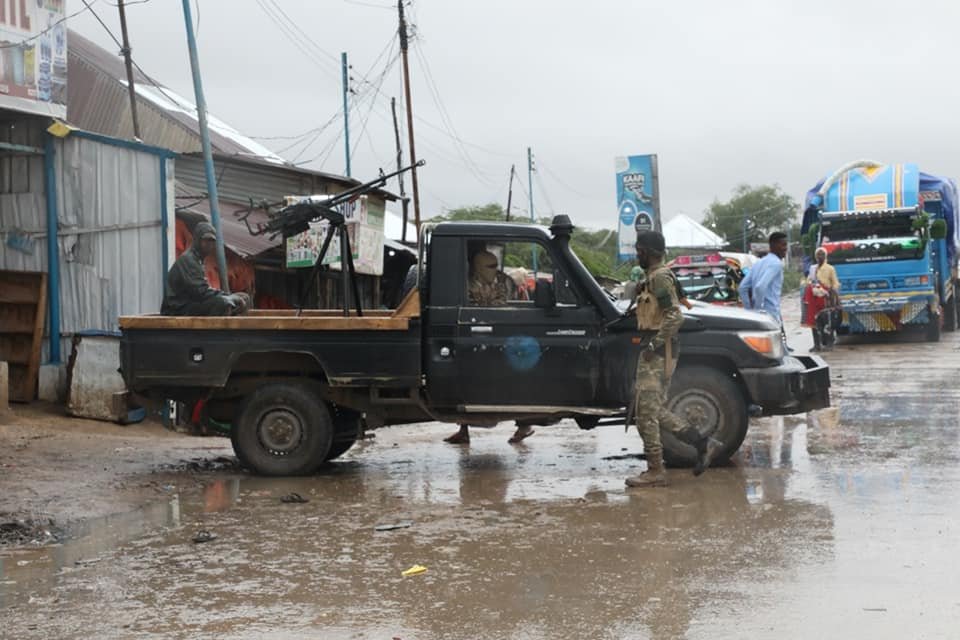
The escalation follows a pattern that has been building for days. Opposition figures and their supporters have accused government security forces of closing in on the homes of former President Sharif Sheikh Ahmed and former Prime Minister Hassan Ali Khaire, interrogating individuals entering and leaving meetings with the two officials. Local reports on 10 October indicated that the Somali government had intensified the deployment of troops and military equipment near the homes of prominent opposition leaders, simultaneously tightening security measures in the capital. Large numbers of military vehicles and forces were reportedly moved to the vicinity of Mogadishu’s heavily guarded international airport around midnight.
Government forces reportedly closed roads and streets connecting the Boolo Hubey and Hubey areas toward the residences of Sharif and Khaire. Photos published by residents showed security forces closing entrances to commercial areas and warning civilians against using streets near the homes of opposition leaders.
Defence Minister’s Accusations
The escalation comes amid a sustained campaign by Defence Minister Ahmed Moallim Fiqi to link opposition figures to foreign interference. In a statement posted on social media on 1 October, Fiqi accused opposition politicians of meeting with representatives linked to Sudan’s Rapid Support Forces (RSF) in Abu Dhabi, claiming the gatherings were part of a plot against Somali statehood. He alleged the politicians were “learning methods of organising militias and warfare from the RSF” and warned they would return with plans to “mobilise militias and revive warlord-style politics.”
As reported in FTL Somalia’s coverage of Fiqi’s statement, the minister described the RSF as a force hired to destroy Sudan and said it was “unfortunate that Somali politicians and the RSF were being brought together in the same place.” Reports circulating in Somali political circles indicated that several prominent opposition figures were in Abu Dhabi for talks, including Sharif, Puntland President Said Abdullahi Deni, Jubaland President Ahmed Mohamed Islam (Ahmed Madobe), and MP Abdullahi Mohamed Sanbalashe.
Fiqi has a history of making such accusations. As detailed in Garowe Online’s coverage of the June 2026 clashes, after armed confrontations in Mogadishu, Fiqi accused Khaire and Sharif of orchestrating an armed coup attempt, likening their forces to the RSF’s “Somali wing.” He claimed without providing evidence that some politicians were “hired by the United Arab Emirates.”
Sharif has denied the allegations. In an interview in July 2026, he said he has lived in the UAE for nearly a decade with his family but does not have a political relationship with the Abu Dhabi government. “My family and I were welcomed, and I am grateful for that,” Sharif said. “But we do not have a political relationship.”
The Marinayo Standoff and the 2021 Precedent
The NISA statement and the reported troop movements come amid an ongoing standoff involving Sharif, who has positioned himself in the Marinayo area of Abdiaziz district. The location holds deep political symbolism. As detailed in FTL Somalia’s coverage of the Marinayo standoff, the neighbourhood was the headquarters of the Badbaado Qaran (National Salvation) movement in 2021, when then-opposition leader Hassan Sheikh Mohamud organized forces against former President Mohamed Abdullahi Farmaajo’s attempt to extend his term without elections. Sharif’s decision to position himself in the same area has led many Somalis to label the current crisis “Marinayo 2.0.”
The June 2026 clashes provide a grim precedent for what could unfold. As reported in FTL Somalia’s coverage of the June de-escalation, for more than 20 hours, federal forces loyal to President Mohamud encircled and shelled the residences of Sharif and Khaire, plunging the capital into fighting across dense residential districts. Khaire described a “sustained and indiscriminate military assault” that deployed heavy weaponry “more commonly associated with conventional battlefield operations than densely populated urban areas, including anti-tank weapons, drones, and other military assets.”
The African Union and United Nations called for restraint. The United States embassy called the violence “reckless.” The standoff was eventually defused through mediation involving elders, NISA Director Mahad Mohamed Salad, and international pressure, with both Sharif and Khaire withdrawing from their strategic positions. But the underlying political disputes were never resolved.
A Crisis Building for Days
The current escalation has been building since at least 7 October, when Sharif issued a formal statement warning that Somalia’s political crisis could not be resolved through force or unilateral measures. As reported in FTL Somalia’s coverage of Sharif’s statement, the former president said “political disagreement is not a crime” and warned that “the use of state institutions or security forces to exert pressure on political opponents risks undermining Somalia’s unity and stability.”
Just three days later, NISA issued a statement directly accusing Sharif’s militias of attacking its forces. The gap between Sharif’s call for dialogue and the government’s escalation illustrates the depth of the political impasse.
Critical Note
The trajectory of the past week points toward a dangerous conclusion: the government of President Hassan Sheikh Mohamud appears determined to force Sharif Sheikh Ahmed and Hassan Ali Khaire out of Mogadishu, using the full weight of its security apparatus to achieve a political objective. The NISA statement, the troop deployments around opposition homes, the road closures, and the Defence Minister’s accusations of foreign collusion are not isolated events. They form a coherent pattern of pressure designed to isolate and intimidate the opposition’s most prominent figures.
The June 2026 precedent is instructive, and alarming. During that standoff, government forces shelled opposition residences for over 20 hours in densely populated areas, deploying weaponry intended for the fight against Al-Shabaab against political rivals. The international community condemned the violence as “reckless” but did not prevent it. The de-escalation that followed was achieved through mediation, not accountability, and the underlying disputes remained unresolved.
This time, the government’s posture appears even more confrontational. Fiqi’s accusations that opposition figures are working for the UAE and learning militia tactics from Sudan’s RSF are unsubstantiated by any public evidence, but they serve a clear political purpose: to frame the opposition as agents of foreign powers rather than legitimate political actors. Once that framing is accepted, the use of force against them becomes not a political act but a security imperative.
The risk of renewed and sustained violence in Mogadishu in the coming hours and days is high. The government has shown a willingness to deploy heavy weaponry in civilian areas. The opposition has shown a willingness to resist. The international community, which intervened last time, has not yet signalled whether it will do so again. And the underlying constitutional dispute over President Mohamud’s mandate and the electoral framework remains unresolved.
If the government succeeds in forcing Sharif and Khaire out of Mogadishu, it will have won a tactical victory. But it will have done so by militarizing Somali politics further and by demonstrating that the state’s coercive apparatus can be used against any political opponent. That is not a foundation for stability. It is a recipe for the next crisis.
Share your story. FTL Somalia is continuing to investigate the political crisis in Mogadishu and the role of security agencies in political disputes. If you have information or insights to share, contact us at info@ftlsomalia.com. Your identity will be protected.
Recommended Reading On ftlsomalia.com
- Former Somali President Warns Against Force in Political Crisis, Calls for National Dialogue
- From Badbaado Qaran to Marinayo 2.0: Somalia’s Never-Ending Cycle of Term Disputes and Electoral Violence Returns to Mogadishu
- Fiqi Links Opposition Meetings in Abu Dhabi to RSF, Warns of Militia Mobilisation
- Khaire Returns to Jayga Home as Former President Sharif’s Marinayo 2.0 Standoff Continues