MOGADISHU — The Shabelle River at Jowhar remains above its high flood-risk level and is likely to reach bankfull this week, as a new rise moves downstream from Belet Weyne, according to the latest weekly weather forecast from FAO-SWALIM.
The report, covering the period 15 to 21 October 2026, states that Jowhar stood at 5.36 metres, just 14 centimetres below bankfull, and has been above its high flood-risk level since 13 October. A new rise is moving downstream: Deefow has risen 2.21 metres in four days and Belet Weyne 1.30 metres in three days. This water is expected to reach Bulo Burti and Jalalaqsi in the coming days and Jowhar later in the week, making it likely that Jowhar will reach bankfull during the forecast period.
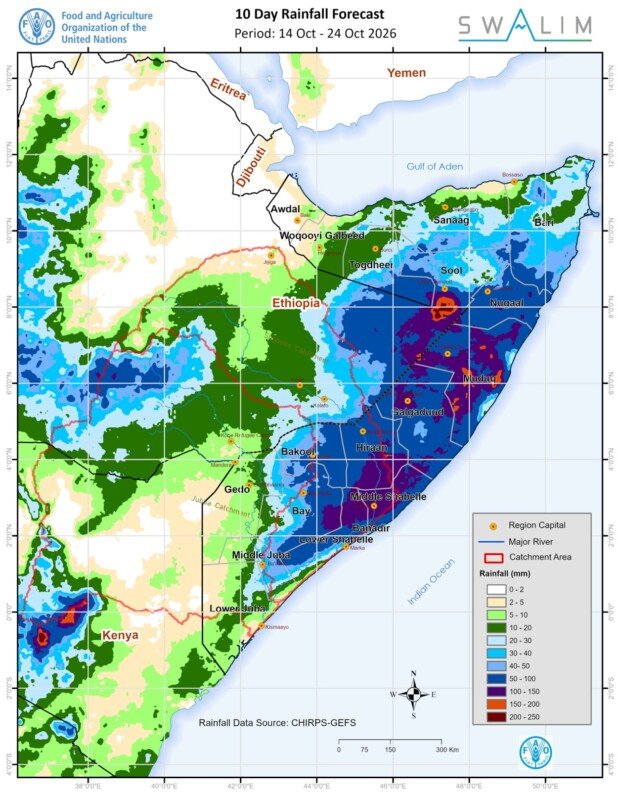
Flooding through open river breakages between Jowhar and Balcad is likely to continue and to spread into nearby farms and villages. As reported in FTL Somalia’s coverage of the Shabelle River levels, the 10-day forecast indicates heavy rainfall of 100-150 millimetres over Bulo Burto, Jalalaqsi and the Jowhar catchment by 24 October. If this materialises, local runoff would add to river flows while Jowhar is at or near bankfull, raising the risk of overbank flooding in Jowhar and Balcad districts towards the end of the period.
Record-Breaking Deyr Rains
The forecast follows a week of exceptionally heavy rainfall across central and southern Somalia. Baidoa recorded 146.5 millimetres in four days, Bardheere 115.5 millimetres, Qansax Dheere 107.6 millimetres, Sheikh 100 millimetres and Hargeisa 86 millimetres in a single day.
By 12 October, 16 stations had already exceeded their October normal, including Baidoa at 163 percent, Bardheere at 255 percent, Galkacyo at 260 percent and Hargeisa at 318 percent of the monthly average. Satellite estimates show 100 to 500 millimetres of rain over central and southern Somalia since 1 October, more than four to six times the normal for the period.
The rains have had a mixed impact. Communities in Bay, Lower Shabelle and Kismayo have reported good rain and crop planting, while callers in Galgaduud, Mudug, Sanaag and Dollow continued to report drought, heat and livestock losses in early October. However, station and satellite data show that Galkacyo and much of Mudug and Galgaduud have since received well above normal rain, so community reports of drought there are expected to ease in the coming weeks. As reported in FTL Somalia’s coverage of the FAOSWALIM report, 388 sites along the Shabelle River have been identified as having flood-related conditions, including 150 sites where water is overflowing the riverbanks.
Flash Flood Risk in Mudug, Nugaal and Galgaduud
The heaviest rains this week are forecast over Mudug, Nugaal and Galgaduud, easing drought conditions but bringing a risk of flash flooding. Moderate rainfall of 50-100 millimetres is forecast over Xarardheere, Burtinle and Jariiban districts, with localized heavy rainfall of 100-150 millimetres near the coast in Xarardheere. The 10-day forecast extends this risk to Galgaduud and to Galkacyo and Hobyo districts, where heavy rainfall of 100-150 millimetres is indicated.
Communities in these areas are advised not to cross flowing seasonal watercourses or shelter in dry riverbeds, and displacement sites should be protected from flooding. Herders are advised to protect weak animals from cold, wet conditions.
Climate Drivers Point to More Rain
The positive Indian Ocean Dipole, one of the strongest drivers of wet Deyr seasons in Somalia, was recorded at +0.88°C for the week ending 11 October, well above the positive threshold. The Madden-Julian Oscillation is forecast to strengthen again in phase 3 by the end of October, typically enhancing rainfall over East Africa, pointing to renewed heavy rains and rising river inflows in late October and early November.
Gedo, Juba Valley and Lower Juba Remain Dry and Hot
In contrast to the central regions, Gedo, the Juba valley and Lower Juba are forecast dry and hot conditions. Daytime maxima of 40-45°C are expected over parts of Middle Juba, Lower Juba and Sablaale, with warm nights of 20-25°C. Combined with dry conditions, this heat is expected to speed up the drying of surface water and pasture and to increase human and livestock water demand.
Water stress is expected to persist along the Awdal coast, where drought was extreme in September, and in Gedo, where callers reported a lack of rain and livestock losses. Riverine communities along the Juba are advised to keep livestock, food stocks and farm equipment away from riverbanks and to check and reinforce weak riverbanks and canal intakes.
Ongoing Flood Risk in Jowhar
The Jowhar Offstream Storage Programme, implemented by the Federal Government with FAO and partners, is restoring the Jowhar offstream reservoir, river embankments, the barrage and the irrigation canal network to reduce flood and drought risk. With Jowhar above its high flood-risk level and a new rise on its way, embankment sections and construction sites close to the river are exposed to high river flows. Implementing partners are advised to move equipment and materials away from the river and to avoid working on exposed embankments while levels are high.
As reported in FTL Somalia’s coverage of the SoDMA-WFP agreement, SoDMA has signed a two-year cooperation agreement with the World Food Programme to strengthen disaster preparedness and early warning systems. However, the response faces severe funding constraints, with the 2026 Somalia Humanitarian Needs and Response Plan only 15.2 percent funded.
Critical Note
The SWALIM forecast confirms that Somalia is now in the midst of one of the wettest Deyr seasons on record. The Shabelle River at Jowhar is at its highest level in years and is likely to breach its banks this week. The Jowhar-Balcad reach is the most flood-prone section of the river, and the ongoing JOSP rehabilitation works, while critical for long-term flood management, are themselves exposed to the very flooding they are designed to prevent.
The forecast also reveals a starkly uneven picture across the country. While central regions face record rainfall and flash flood risk, Gedo, the Juba valley and Lower Juba remain dry and hot, with temperatures reaching 45°C. This is not a uniform disaster; it is a patchwork of extremes, and the humanitarian response must be tailored accordingly.
What is clear is that the rains are not over. The positive IOD and the forecast strengthening of the MJO point to renewed heavy rainfall in late October and early November. The window for anticipatory action is narrowing. Communities in Jowhar and Balcad should prepare for evacuation; those in Mudug and Nugaal should prepare for flash floods; and those in Gedo and the Juba valley should prepare for continued water scarcity. The forecasts are precise. The question is whether the resources and coordination are in place to act on them.
Share your story. FTL Somalia is continues to cover flood preparedness and response across Somalia. If you have information or insights to share, contact us at info@ftlsomalia.com. Your identity will be protected.
Recommended Reading On ftlsomalia.com
- Shabelle River Nears Flood Alert Level at Jowhar as El Niño Rains Intensify
- Over 300 Sites on Shabelle River Identified as Flood-Prone, FAOSWALIM Reports
- SoDMA and WFP Sign Two-Year Deal to Strengthen Somalia’s Disaster Preparedness
- SoDMA Urges 29 Districts Across 14 Regions to Prepare for Super El Niño Flooding