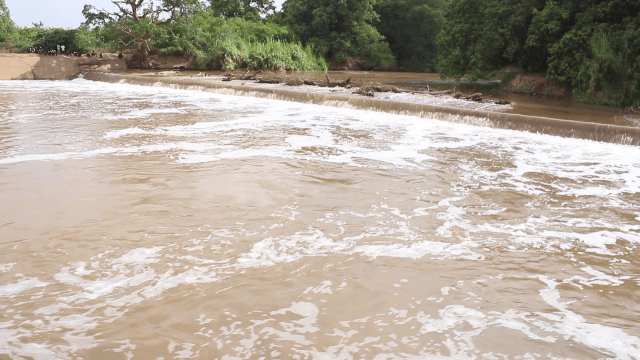
MOGADISHU — Water levels in the Shabelle River at Jowhar have risen sharply over the past week, approaching the moderate flood-risk threshold, as the October-to-December Deyr rainy season begins under heightened El Niño conditions.
According to the latest weekly forecast from FAO-SWALIM, the river at Jowhar rose from 2.48 metres to 4.70 metres over the past week, an increase of 2.22 metres. The current level is just 30 centimetres below the moderate flood-risk threshold of 5 metres and 55 centimetres below the high-risk level of 5.25 metres.
The pace of the rise has slowed, however, from approximately half a metre on 4 October to 20 centimetres on 7 October.
Upstream Rainfall Raises Concerns
FAO-SWALIM has warned that moderate to heavy rainfall is forecast across parts of Somalia and the Ethiopian highlands. Rainfall in the Ethiopian highlands is particularly significant because it can raise the Shabelle and Juba rivers in Somalia even when local rainfall is limited. Flood waves generated by heavy rain in Ethiopia can reach Somalia later, and FAO has urged authorities to monitor both upstream rainfall and river levels closely.
The latest forecast projects moderate to heavy rainfall over much of Somaliland, Bay, Bakool and Hiiraan, as well as inland central Somalia.
At other monitoring stations along the Shabelle, levels remained below flood thresholds. At Beledweyne, the river stood at 4 metres, well below the moderate flood-risk threshold of 6.50 metres. Bulo Burti recorded a rise of 62 centimetres during the week to 3.20 metres, still 3.30 metres below the moderate threshold.
Conditions along the Juba River were comparatively stable. At Dollow, the river rose from 2.54 metres to 2.64 metres, remaining 1.86 metres below its moderate flood threshold. At Luuq, levels were virtually unchanged at 2.36 metres.
El Niño and the Deyr Season
The rising river levels come as Somalia enters the Deyr season under an El Niño event that forecasters say is on track to rank among the strongest on record. FAO warned in June 2026 that there is a greater than 90 percent likelihood of El Niño conditions during the October-December season, with above-normal rainfall expected across the region.
As detailed in FTL Somalia’s coverage of SoDMA’s flood preparedness warnings, the Somali Disaster Management Agency has identified 29 districts across 14 regions for heightened preparedness, including Jowhar. The agency has urged communities in vulnerable areas to clear drainage channels and prepare for possible displacement.
FAO has pointed to 1997 and 2023 as analogue years with similar climate conditions. Both years brought severe flooding to Somalia. The 1997 floods killed more than 2,300 people, while the 2023 Deyr caused widespread displacement, damaged infrastructure, and destroyed crops and livestock.
The risk would be further amplified if a positive Indian Ocean Dipole develops, as the combined influence of El Niño and a positive IOD is often associated with enhanced rainfall over the Horn of Africa.
Humanitarian Impact and Preparedness
Jowhar, the capital of Hirshabelle State and Middle Shabelle region, is particularly vulnerable to flooding. The town sits along the Shabelle River in a low-lying agricultural area, and previous floods have displaced thousands of residents and destroyed farmland. Radio Ergo feedback from May 2026 recorded callers in Jowhar reporting that the river had flooded and requesting assistance.
FAO has recommended priority actions including updating riverine flood preparedness and evacuation plans, inspecting and repairing weak embankments along the Juba and Shabelle rivers, identifying safe higher-ground locations, pre-positioning critical supplies in flood-prone districts, and strengthening community early warning systems.
The agency has emphasised that preparedness should begin now, not when the rains start. With the Shabelle already approaching moderate flood-risk levels at Jowhar and heavy rains forecast upstream, the window for anticipatory action is narrowing.
Critical Note
The rapid rise of the Shabelle River at Jowhar is a concrete early warning of the flood risk that forecasters have warned about for months. The river has climbed 2.22 metres in a week and is now within 30 centimetres of the moderate flood threshold. The El Niño conditions driving this rise are not a forecast anymore; they are present.
The critical variable in the coming weeks will be upstream rainfall in the Ethiopian highlands. The Shabelle and Juba rivers originate in Ethiopia, and heavy rain there can send flood waves into Somalia even when local conditions are dry. This makes monitoring upstream conditions essential, and it places a premium on regional coordination that has historically been difficult to sustain.
For Jowhar’s residents, the immediate question is whether embankments will hold, whether evacuation routes are prepared, and whether early warning information reaches those who need it. Hirshabelle authorities and humanitarian agencies have had months of warning. Whether that warning translates into action will determine whether this becomes a manageable high-water event or another displacement crisis. The river is rising. The time for preparation is now.