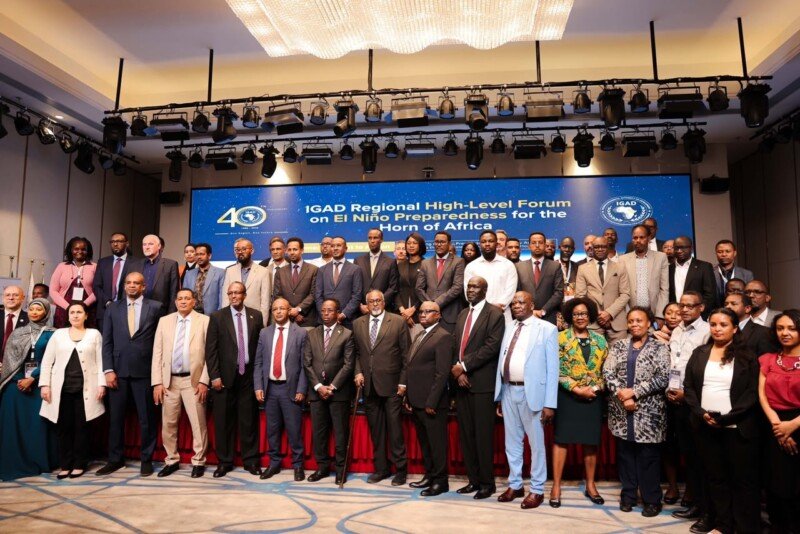
ADDIS ABABA — The Commissioner of the Somali Disaster Management Agency (SoDMA), Mohamud Moallim Abdulle, led a delegation to the IGAD High-Level Ministerial Forum on El Niño Preparedness in the Horn of Africa, held in Addis Ababa from September 15 to 17, 2026.
The three-day forum brought together ministers, government representatives, technical experts, and partners from IGAD member states to assess regional preparedness for the anticipated El Niño event during the October-December 2026 Deyr season.
Commissioner Abdulle presented Somalia’s preparations and efforts to reduce the potential consequences of intense rainfall and flooding across vulnerable parts of the country. He called for stronger regional coordination, including sharing weather information and improving joint responses when disasters threaten communities across national boundaries.
“Early warnings, timely action and regional cooperation will be crucial as communities prepare for potentially hazardous weather conditions,” Abdulle said
Regional Coordination and Anticipatory Action
The forum focused on early warning systems and measures that could allow governments to act before floods and heavy rainfall cause widespread disruption. Participants reviewed El Niño forecasts and preparedness requirements, highlighting the need for countries to coordinate efforts before potential weather-related emergencies unfold.
The meeting was part of a broader regional effort to translate available climate and risk information into preparedness and anticipatory action. The forum aimed to assess national and regional preparedness, identify priority risks and actions, strengthen cross-border coordination, and advance anticipatory financing.
Mohamed Abdi Ware, Deputy Executive Secretary of IGAD, emphasized that the available forecasts offer the region an opportunity to act before risks turn into crisis. He called on member states to activate their preparedness plans, preposition necessary supplies, and strengthen cross-border alert sharing.
“We cannot stop the rain, but we can decide what it will find when it arrives,” Ware said, recalling the consequences of previous episodes, including the 2023 floods that killed at least 352 people in Ethiopia, Kenya and Somalia and displaced more than 2.4 million people.
Somalia’s Preparedness Measures
SoDMA has been actively coordinating with international partners on Super El Niño preparedness, including a meeting between Commissioner Abdulle and UN Humanitarian Coordinator George Conway to review flood preparedness and plan a joint field mission.
Somalia has launched a Multi-Hazard Early Warning System under the global Early Warnings for All framework, in collaboration with UNDP and the Green Climate Fund, aiming to reduce disaster-related fatalities by 42 percent by 2030 and extend early warning coverage from 20 percent to full national coverage.
The country has also adopted an Anticipatory Action Strategy aimed at strengthening early warning systems and enabling faster, more targeted responses to natural and man-made crises
SoDMA has also launched a World Bank-backed project to strengthen disaster preparedness, with tech-driven early warning systems to protect communities from recurring natural disasters.
Critical Note
The IGAD forum reflects a growing recognition that El Niño preparedness requires coordinated regional action, not just national responses. Somalia’s participation demonstrates its commitment to engaging with regional mechanisms, and the country has made notable progress in developing early warning systems and anticipatory action frameworks.
However, the scale of the anticipated event raises questions about whether current preparedness measures are sufficient. Forecasts indicate a 97 to 100 percent probability of El Niño conditions persisting through the Deyr season, with a credible risk of severe flooding in the Juba and Shabelle river corridors [citation:6]. The humanitarian response plan is only 29.7 percent funded, leaving a significant shortfall as the rains approach [citation:18].
For Somalia, the challenge is to translate the commitments made in Addis Ababa into concrete action on the ground. Early warning systems and anticipatory action frameworks are only as effective as the resources and coordination behind them. Without adequate funding and sustained investment in preparedness, the region risks repeating the cycle of crisis and response that has defined past El Niño events.