
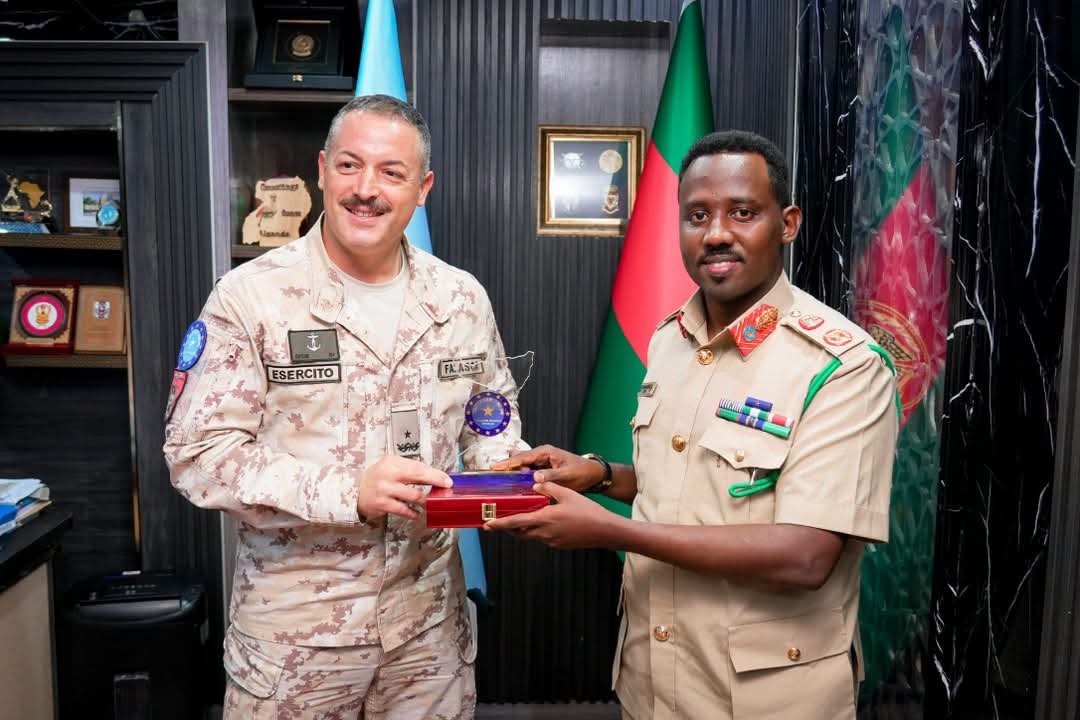
MOGADISHU, The Commander of the Somali National Army, Brigadier General Ibrahim Mohamed Mahmoud, met with the newly appointed Commander of the European Union Training Mission in Somalia (EUTM-Somalia), Brigadier General Ivan Falasca, on Thursday to discuss strengthening military training cooperation and improving the quality of instruction for Somali soldiers and officers.
The meeting focused on enhancing collaboration in military training, developing the knowledge and skills of SNA personnel, and elevating the standards of training programmes to build a professional, prepared national force capable of responding to the country’s security obligations. Both sides emphasized the importance of continued cooperation and support to improve the quality, capacity, and capability of the Somali National Army.
A New Commander for a Longstanding Mission
General Falasca’s appointment marks the latest leadership transition for EUTM-Somalia, which has operated since 2010 and remains one of the EU’s most enduring military engagements in Africa. He succeeded Brigadier General Elio Manes, who had led the mission since January 2026, as reported in FTL Somalia’s coverage of the EUTM leadership transition.
During his tenure, General Manes oversaw training programmes for SNA officers and maintained regular engagement with Somali military leadership, including a May 2026 meeting with General Mahmoud to discuss capacity building and sustainable security, as reported in FTL Somalia’s coverage of EUTM’s engagement with Somali forces. The mission has also supported advanced training for senior SNA officers at the Dhagabadan Military School, with Manes personally attending graduation ceremonies.
General Falasca inherits a mission that has trained thousands of Somali soldiers over nearly two decades, but whose role is evolving as Somalia prepares to assume full responsibility for its own security. The EU has approved €75 million for the AU mission in Somalia, and EU-funded initiatives such as the SNA III Project under the European Peace Facility are designed to professionalize the Somali National Armed Forces through structured training, operational planning support, and logistical capacity-building, as reported in FTL Somalia’s coverage of the security transition.
Italy’s Dual Role in Somali Training
General Falasca’s command of EUTM-Somalia coincides with Italy’s deepening bilateral defense engagement with Mogadishu. In October 2026, the Commander of the SNA’s Training and Doctrine Command, Major General Ahmed Isse Ahmed, visited Italy’s Training and Doctrine Command headquarters in Turin and the Italian Special Forces School to discuss expanding Italy’s support for Somali military training.
Italy is the largest contributor to EUTM-Somalia and also leads the Bilateral Training Mission for Somali and Djiboutian Police Forces (MIADIT Somalia) through the Carabinieri. This dual-track approach, combining EU mission leadership with bilateral training initiatives, gives Rome a uniquely comprehensive role in Somalia’s security sector reform.
The SNA has also pursued training partnerships beyond Europe. General Mahmoud has presided over Danab Special Forces graduation ceremonies at the Balidoogle military base, where U.S.-supported training resumed in June 2026 after a suspension following a ration-diversion scandal, as reported in FTL Somalia’s coverage of the Danab training programme. The elite unit has been described by AFRICOM commanders as one of the most capable forces on the continent.
Critical Note
The meeting between General Mahmoud and General Falasca is a routine engagement between a host nation’s military leadership and the commander of a training mission that has operated in the country for over a decade. It signals continuity in the EU-Somalia security partnership at a moment when that partnership faces significant questions about its endgame.
EUTM-Somalia has trained thousands of Somali soldiers. It has supported the development of military institutions, from the Dhagabadan Military School to the Training and Doctrine Command that General Ahmed heads. These are tangible contributions. But the mission’s ultimate purpose, to build a Somali army capable of securing the country without external support, remains unfulfilled. The SNA continues to depend on international partners for training, equipment, logistics, and pay. EUTM’s mandate has been extended repeatedly, not because Somalia is ready for independence, but because the conditions for a full handover have not yet been met.
The appointment of a new commander is an opportunity to reassess. General Falasca inherits a mission that is well-intentioned and well-resourced, but whose impact on the SNA’s operational effectiveness is difficult to measure. Training is necessary. It is not sufficient. The gap between the number of soldiers trained and the number of soldiers who remain in service, properly equipped and led, is the gap that determines whether EUTM’s work produces a lasting force or a revolving door. The new commander’s tenure will be judged by whether that gap narrows.
Recommended Reading On ftlsomalia.com
- Somalia, Italy Discuss Expanding Military Training as Army Delegation Visits Turin
- EU Reaffirms Support for Somali Security Forces During Training Centre Visit
- Somali Army Chief Reviews Security Transition
- Elite Danab Commandos Complete Advanced Training as SNA Chief Praises U.S. Partnership
- Senior SNA Officers Complete Advanced Training at Dhagabadan Military School