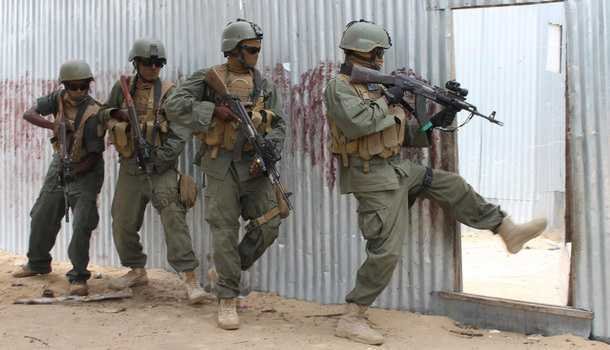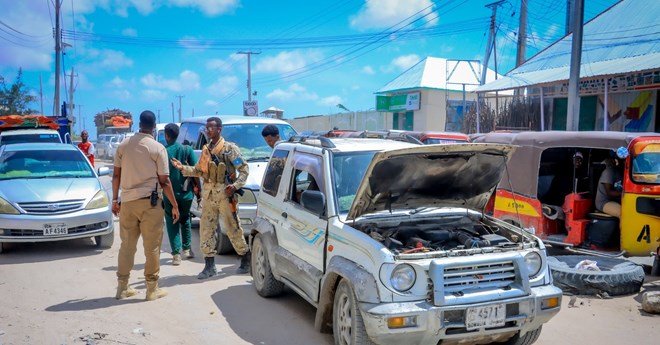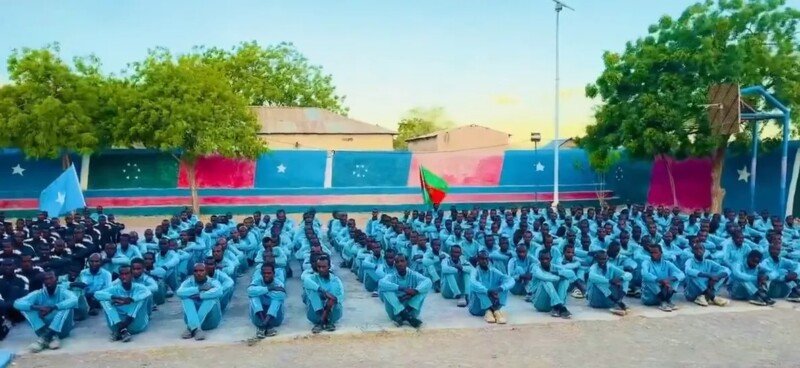
WAJID — The Somali National Army has begun training local recruits in Wajid district of the Bakool region, part of preparations for a future transfer of security responsibilities as African Union forces reduce their presence in Somalia.
The recruits are being prepared to support security operations in Wajid and surrounding areas, working alongside the Somali National Army and South West State Darwish forces. Their expected duties include protecting key installations, helping prevent attacks, and supporting security operations in and around the strategic town.
The training has been linked to preparations for a future security transition as troops serving under the African Union Support and Stabilisation Mission in Somalia (AUSSOM) reduce or transfer responsibilities to Somali forces. However, no official timetable has been announced for the withdrawal of AUSSOM troops specifically from Wajid, making it unclear when the newly trained personnel could assume additional security responsibilities.
Strategic Significance of Wajid
Wajid is strategically important for movement and supply routes across Bakool, a region where Al-Shabaab maintains a presence and has repeatedly sought to disrupt road links between government-controlled towns. Several urban centres in parts of Bakool and neighbouring Bay have for years depended heavily on air transport and protected supply routes because of insecurity along major roads, making control of towns such as Wajid important to both government forces and Al-Shabaab.
Somali National Army forces have previously conducted precision operations in Bakool, eliminating a senior Al-Shabaab commander in Abal village near Hudur in November 2025. The commander, Mohamed Abdi Goofow, had been responsible for planning and executing attacks across Bakool and neighbouring regions.
In February 2026, SNA forces from the 9th Battalion of the 60th Division executed a coordinated operation in the Moorigaabey area near Hudur, targeting a militant commander responsible for widespread fear among local residents.
Coordinated operations by the Somali National Army and Macawisley fighters in Bakool and Mudug have eliminated multiple militant cells and recovered weapons and communication devices, demonstrating the effectiveness of collaboration between national forces and local fighters.
Uncertainty Over AUSSOM’s Future
The security transition is unfolding against a backdrop of a chronic funding crisis for AUSSOM. The mission, which replaced ATMIS in January 2025, currently fields nearly 12,000 personnel under a reduced mandate focused on training, advising, and institutional capacity building. The United States has warned it will oppose any support for the continuation of AUSSOM beyond its current mandate, which is set to expire in early 2027.
AUSSOM has reaffirmed its dedication to Somalia’s peacebuilding and stabilization initiatives, emphasizing the value of African unity and collective action in promoting peace and security. The mission has honored Somali security forces and AU personnel for their contributions to establishing stability in the country.
The European Union has approved €75 million in funding for AUSSOM, with the EU noting that strengthening security in Somalia remains critical for regional stability and reaffirming its commitment to African-led peace operations.
The federal government has previously pledged that South West Darwish forces would receive rights equal to those of the national army following their reintegration, a process overseen by the Director of the National Intelligence and Security Agency, Mahad Mohamed Salad, and the Commander of the Somali Police Force, Gen. Asad Osman Abdullahi.
South West State President Sheikh Aadan Mohamed Nur (Madoobe) has been working to build a new administration following his election in June 2026, with a focus on accelerating public services, strengthening security, economic development, and good governance.
Critical Note
The training of local forces in Wajid reflects the practical reality of Somalia’s security transition. As AUSSOM gradually reduces its footprint, Somali authorities must fill the gaps left behind or risk allowing Al-Shabaab to exploit the vacuum. Wajid’s strategic location along supply routes in Bakool makes it a critical test case for whether locally recruited and trained forces can effectively secure territory that international troops have helped protect.
The lack of transparency about the new force is a concern. Basic questions about numbers, command structure, equipment, and deployment remain unanswered, making it difficult to assess whether this initiative will produce a capable security force or simply another fragmented militia. Somalia’s history is replete with examples of armed groups that were trained for specific purposes but later became sources of instability. Without clear integration into the formal security architecture and a credible plan for pay, discipline, and oversight, the Wajid recruits could become another unaccounted-for armed entity.
The broader transition carries significant risks. The funding crisis facing AUSSOM, combined with the United States’ stated intention to oppose the mission’s continuation beyond 2027, has created uncertainty about the timeline for security handover. The success of the transition will depend not simply on how quickly foreign forces leave, but on whether Somali forces are genuinely ready to take their place. The training in Wajid is a necessary step, but it must be accompanied by sustained investment in logistics, intelligence, and command and control systems that are essential for any effective security force.
Recommended Reading On ftlsomalia.com
- Kampala Summit to Decide Fate of AU Mission as US Funding Cuts Bite
- AUSSOM Reaffirms Support for Somalia’s Peace
- EU Approves €75 Million for AU Mission in Somalia
- Somali Forces Eliminate Al-Shabaab Commander in Strategic Bakool Operation
- SNA Crush Militant Cells in Joint Operations Across Mudug and Bakool
- Somalia Pledges Equal Rights for Reintegrated South West Forces