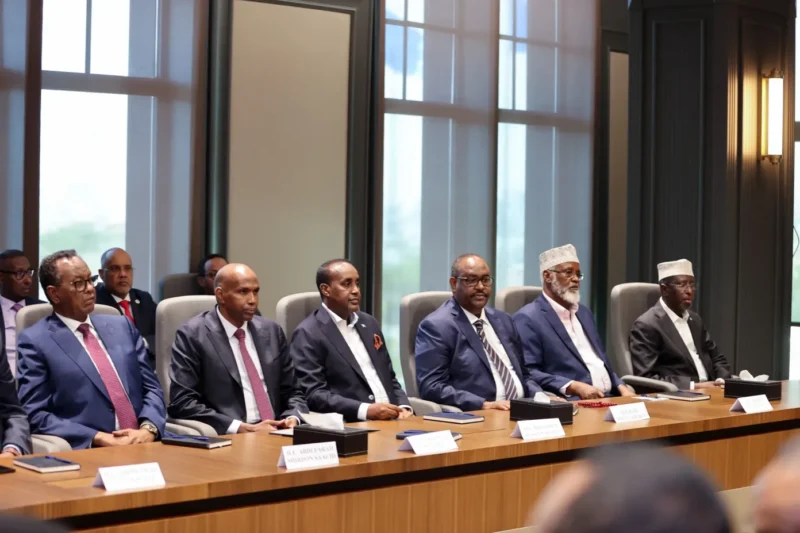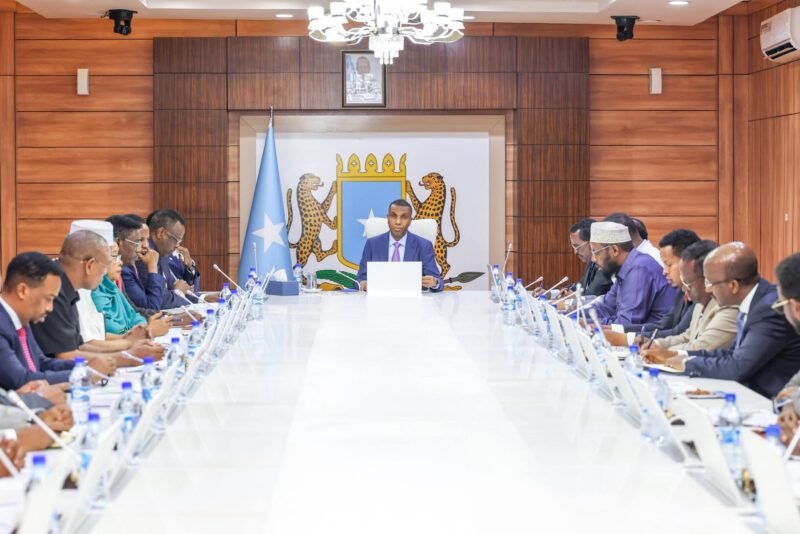
MOGADISHU — Somalia’s Council of Ministers approved a resolution on the implementation of the Constitution on Tuesday, in an extraordinary session convened ahead of the constitutional deadline rather than the cabinet’s usual Thursday meeting, and assigned a ministerial committee to prepare a draft law defining the number of government members and their responsibilities.
The extraordinary session, chaired by Prime Minister Hamza Abdi Barre, focused on constitutional implementation, state-building, strengthening government institutions and developing national administrative systems.
The Council tasked a committee led by the Minister of Justice and Constitutional Affairs with accelerating the implementation of the Constitution and preparing a draft law on the structure of government, to be completed within two months. According to the government statement, the law will define the number of government members and their responsibilities, and was described as the first such law the country will have had since 1968.
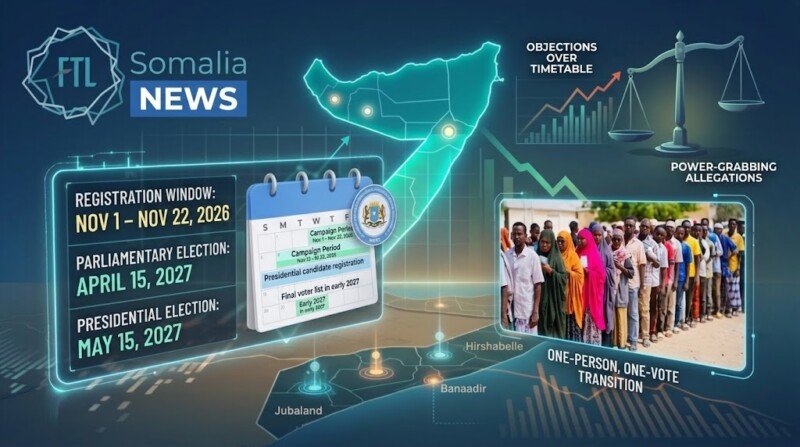
2027 Election Date Announced
Prime Minister Hamza Abdi Barre said the Constitution is in force and is being implemented in phases. He also said the government is working to hold a one-person, one-vote federal election in 2027, as stipulated by the Constitution.
This is the first time the cabinet has publicly mentioned a date for the next federal election. Opposition leaders have maintained that President Mohamud’s four-year term expired on 15 May 2026, while the federal parliamentary mandate ended in April. The government disputes that interpretation, arguing that constitutional amendments and parliamentary decisions extend its mandate until May 2027. The announcement of a 2027 election date appears to confirm the government’s position that its mandate extends beyond the original term.
Ministers Face Ultimatum to Choose Between Cabinet and Parliament
A central element of the cabinet’s resolution is the enforcement of constitutional provisions that bar officials from simultaneously holding ministerial and parliamentary positions. The Independent Constitutional Review and Implementation Commission (ICRIC) has set 14 October 2026 as the deadline for these provisions to take effect.
The directive affects a significant portion of Prime Minister Barre’s cabinet. Approximately 15 of the 25 ministers currently hold seats in parliament, placing them directly in the scope of the order. Among those impacted is Deputy Prime Minister Salah Ahmed Jama, who serves in the Upper House.
Some ministers are reportedly reluctant to resign from parliament, fearing they may struggle to regain their seats in future political contests. A delegation led by the deputy prime minister recently approached President Hassan Sheikh Mohamud seeking a postponement of the implementation of the disputed provisions, allegdly. The delegation reportedly encountered resistance to delaying the requirement for officials to choose between parliamentary and ministerial roles.
The practical implications of the deadline remain unclear. Some observers believe the new restrictions may only practically apply after the next general election and the formation of a new government, rather than immediately affecting the current Cabinet. If implemented right away, the changes could trigger a major reshuffle in both government and Parliament.
Impact on Cabinet’s Parliamentary Influence
The forced separation of executive and legislative roles could significantly weaken the Cabinet’s ability to push its legislative agenda through Parliament. Under the current arrangement, ministers who also serve as MPs provide the government with a direct voting bloc and a network of allies within the legislature. Removing them from Parliament would sever that link, reducing the executive’s influence over legislative proceedings.
The 2026 constitutional amendments introduced a stricter separation between the legislative and executive branches. Any Member of Parliament who is appointed to, or accepts, a position in the Cabinet or any executive institution automatically loses his or her parliamentary seat. This provision is intended to strengthen institutional separation, reduce conflicts of interest, and reinforce Parliament’s independence in exercising its oversight functions.
However, the practical consequence is that the Prime Minister would lose the ability to rely on ministers who are also MPs to shepherd legislation through the House, defend government positions during debates, and maintain discipline within the parliamentary majority. As reported in FTL Somalia’s coverage of institutional reforms, the House of the People has already struggled with quorum failures and absenteeism, with only 115 members attending a recent sitting against the required 138. The loss of 15 minister-MPs from the chamber would further reduce the pool of reliable attendees and could complicate the government’s ability to secure passage of key legislation.
The dispute over the implementation timeline reflects a broader tension between the presidency, the Cabinet and Parliament over the balance of power. The federal government views the dispute as a potential threat to its political future, amid concerns that the implementation process could destabilize the Cabinet and complicate its parliamentary support.
Somalia’s IATA Code Restored
The Ministry of Transport and Civil Aviation presented a report to the Council on the restoration of Somalia’s IATA code, which is used for the management and regulation of airline tickets. The Ministry said the restoration of this system will enable Somalia to strengthen its capacity to manage flight ticketing services and connect with international travel systems, as part of efforts to develop civil aviation services and restore important rights the country had lost.
Critical Note
The cabinet’s decision to hold an extraordinary session on a Tuesday, rather than the usual Thursday, signals the urgency the government attaches to the constitutional deadline. The meeting’s focus on implementing the Constitution and preparing a law on government structure reflects an effort to put in place the legal framework required by the amended constitution before the October 14 deadline expires.
The announcement of a 2027 election date is significant. For months, the government has avoided committing to a specific timeline, while opposition figures have insisted that President Mohamud’s mandate expired in May 2026. By publicly stating that elections will be held in 2027, the Prime Minister is effectively confirming the government’s interpretation that its mandate extends beyond the original term. This is unlikely to satisfy the opposition, which has demanded that elections be held on the basis of the 2012 Provisional Constitution, not the amended one.
The ultimatum to ministers to choose between their cabinet and parliamentary roles is a direct test of the government’s cohesion. Approximately 15 of 25 ministers hold parliamentary seats, and forcing them to choose could trigger a major reshuffle. More importantly, it could weaken the Prime Minister’s ability to control Parliament. The government has already faced quorum failures and absenteeism in the House. Losing 15 minister-MPs from the chamber would reduce its influence over legislative proceedings and make it harder to pass laws and secure approval for key appointments.
Whether the government intends to enforce the separation immediately or after the 2027 election remains unclear. If enforced now, it could destabilize the Cabinet and complicate the government’s political strategy. If deferred, it raises questions about the government’s commitment to its own constitutional framework. Either way, the decision reflects the broader tension between the executive and legislative branches and the unresolved question of how power will be shared under the amended constitution.
Share your story. FTL Somalia is continuing to investigate the constitutional implementation process and its impact on Somalia’s governance. If you have information or insights to share, contact us at info@ftlsomalia.com. Your identity will be protected.