
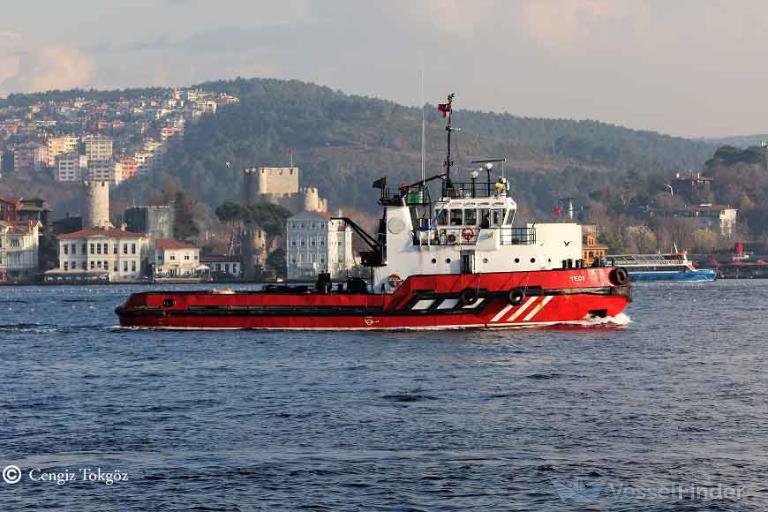
MOGADISHU — A tugboat sailing under the Somali flag was attacked by drones near the Ukrainian port of Odesa in the Black Sea, resulting in the deaths of two Azerbaijani sailors and injuries to two others, according to reports from Euronews and Azerbaijani officials.
The vessel, identified as the TEDY, is owned and operated by the Turkish company Mert Marine Corporation. It was first struck near Odesa and then subjected to two additional drone attacks overnight as it sailed toward the Romanian port of Constanța. The Azerbaijani Foreign Ministry confirmed the deaths of crew members Aslan Aliyev and Asim Gasimov, while Imran Novruzov and Rauf Aliyev were hospitalized in the Ukrainian city of Chornomorsk with burns. The vessel had a crew of ten, including citizens of Azerbaijan, Turkey, Germany, and Ukraine.
Ukraine’s Ministry of Reconstruction, Infrastructure, and Transport stated that the attack was carried out by Russia, describing it as part of a prolonged campaign against civilian ships and port infrastructure. Russia’s Defense Ministry claimed it had struck two cargo ships bound for Odesa and a tugboat, alleging the vessels were carrying military supplies.
Somalia’s Flag State Responsibilities Under UNCLOS
The attack carries particular significance for Somalia, as the TEDY was sailing under the Somali flag. Under the United Nations Convention on the Law of the Sea (UNCLOS), a ship flying the flag of a state has the nationality of that state. The flag state is required to exercise effective jurisdiction and control over ships flying its flag, including administrative, technical, and social matters, and to ensure the safety of navigation.
Somalia officially registered the commercial vessel Guney under the Somali flag in April 2026, the first such national registration since the country’s state collapse in 1991. The registration followed the Cabinet’s approval of a new Marine Transport Registration Regulation in January 2026, which established a comprehensive legal framework for vessels operating under the Somali flag, designed to enforce strict safety standards and ensure compliance with international maritime conventions.
Minister of Ports and Marine Transport Abdulkadir Mohamed Nur welcomed the Cabinet decision, noting that the framework addresses long-standing challenges in the sector and aims to eliminate irregularities that have historically affected Somali maritime administration.
The attack on the TEDY is the latest incident in a series of strikes against civilian vessels in the Black Sea, which have intensified since July. Several merchant ships flying the flags of third countries have been targeted, fueling concerns for the safety of seafarers.
Piracy Resurgence Adds to Maritime Security Challenges
The Black Sea attack occurs against the backdrop of a significant resurgence of piracy off Somalia’s coast, which has reached its highest level in more than a decade. The federal government has strongly condemned the resurgence of piracy, warning that it will raise the issue at the United Nations Security Council and calling for strengthened international cooperation.
At least 15 attacks on ships have been reported in the region so far in 2026, compared with just five in 2025. Six commercial ships were still being held with more than 90 seafarers on board by the end of August. The International Maritime Organization has called for the immediate release of the hostages, warning that their humanitarian situation is deteriorating rapidly due to severe shortages of food and water.
Somali pirates have converted captured vessels into floating bases from which they launch new attacks, marking a dangerous escalation in maritime crime. The MV Sward, a cement carrier hijacked in April 2026, is being used as a “mothership” to launch smaller attack skiffs against vessels in the Indian Ocean.
The resurgence of piracy is being attributed to the diversion of international naval assets to the Red Sea and the Gulf of Aden, where Iran-backed Houthi rebels have been attacking shipping. With naval patrols stretched thin, pirates have exploited the security vacuum to resume operations.
Puntland authorities have stated that they are investigating information suggesting that outside actors may be involved in the resurgence of piracy, warning that the renewed activity could be driven by political and economic interests.
Critical Note
The attack on the Somali-flagged TEDY in the Black Sea underscores the inherent risks that come with Somalia’s efforts to rebuild its national ship registry. As Somalia seeks to re-establish itself as a credible flag state and attract vessel registrations, it must grapple with the reality that ships flying its flag may become targets in conflicts far from its shores. The flag state’s obligations under UNCLOS are not merely administrative formalities; they carry real responsibilities for the protection of vessels and crews.
The incident also highlights the broader maritime security challenges facing Somalia. While the government has taken important steps to modernize its maritime administration, including the new registration regulation and the first ship registration since 1991, these efforts are undermined by the resurgence of piracy off its own coast and the proliferation of attacks on civilian shipping in the Red Sea and Black Sea. Somalia’s ability to exercise effective jurisdiction over its flag vessels will be tested by incidents like this one.
For the international community, the attack on a Somali-flagged vessel serves as a reminder that the consequences of regional conflicts extend far beyond their immediate theaters. The safety of seafarers, regardless of the flag they sail under, must remain a global priority. Somalia’s call for international cooperation to address piracy and maritime crime is not only a matter of national interest but a contribution to global maritime security.
Recommended Reading On ftlsomalia.com
- Somalia Launches First National Ship Registry Since 1991
- Ports Minister Agrees to Establish Somali National Ship Registry
- Cabinet Approves Maritime Registration Reform to Secure Somali Flag Reputation
- Somalia Calls for International Cooperation as Piracy Surges Off Puntland Coast
- Somali Pirates Turn Hijacked Ship into Mothership
- Piracy Fears Grow as Three Vessels Hijacked Off Somalia in Week