MOGADISHU, A member of the Somali Future Council has rejected the government’s invitation to the November consultative forum unless international mediators are present, a demand made in the same week that the United Nations held a formal farewell ceremony for its political mission in Mogadishu.
MP Abdulkadir Cosoble Ali, speaking in a brief statement, said a full resolution cannot be reached without international mediation. He called for representatives of the international community based in Mogadishu to observe any new talks.
“Many people have asked us about the forum called by the government and the leadership that is in office beyond its term. On this matter, I would say: since any internal forum is used by the Federal Government leadership to harden its electoral position, it is evident that no solution can be reached to the standing dispute without international mediation,” Cosoble said.
The UN Farewell and the Opposition’s Demand
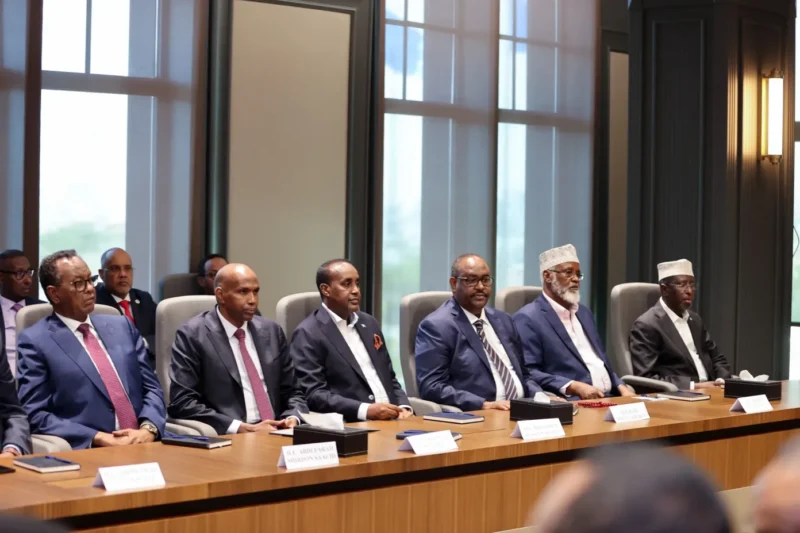
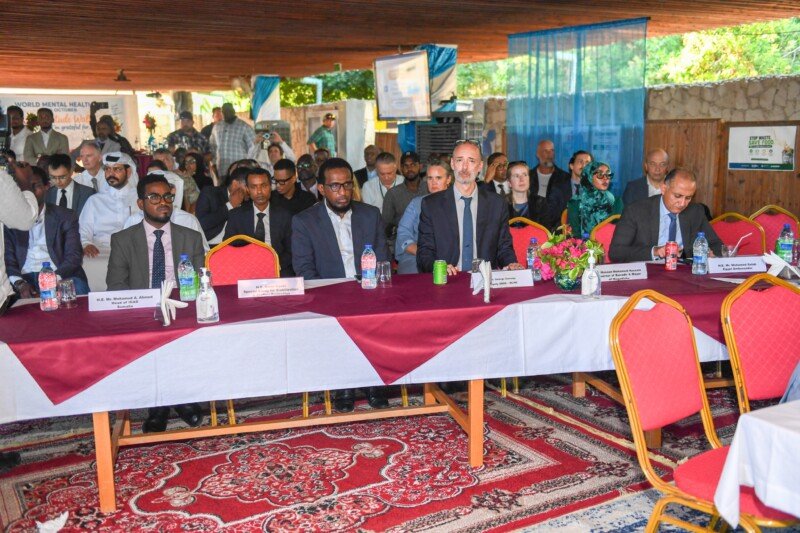
On Monday, Deputy Prime Minister Salah Ahmed Jama attended a formal ceremony in Mogadishu marking the closure of the United Nations Transitional Assistance Mission in Somalia. As reported in FTL Somalia’s coverage of the ceremony, the event was attended by senior government officials, former President Sheikh Sharif Sheikh Ahmed, former Prime Minister Mohamed Hussein Roble, MP Cosoble, civil society representatives, and diplomats from the United States, Italy, Türkiye, and Sudan.
UNTMIS will formally cease operations on October 31, completing a two-year transition carried out pursuant to Security Council resolutions 2753 (2024) and 2809 (2025), and in line with a request from the Federal Government of Somalia.
The Somali Future Council’s demand for international mediation is not new. As reported in FTL Somalia’s coverage of the Halane talks, the opposition coalition has consistently insisted that any dialogue be mediated by the international community, with representatives from the UN, EU, US, and UK present. The council has argued that the government cannot be trusted to referee a process it controls, and that only external guarantees can ensure a fair outcome.
The closure of UNTMIS removes the international mechanism that the opposition has relied on. In a September letter to the UN Security Council, the Somali Future Council requested an international mediation mechanism after the mission closes, warning that the country would otherwise be left without an independent body capable of monitoring political developments.
A Call for Troop Contributors to Intervene
Cosoble went further, suggesting that the countries contributing troops to Somalia should play a role in guaranteeing a political settlement. He named Uganda, Kenya, Djibouti, and Burundi as the African Union troop contributors whose governments should take responsibility for political guarantees, “since the security of the country is being sacrificed.”
That call places the troop-contributing countries in an awkward position. They are in Somalia under an African Union mandate to support security, not to arbitrate domestic political disputes. But Cosoble’s argument is that the political impasse is itself a security risk, and that the countries whose soldiers are exposed to that risk have an interest in resolving it.
The security transition is already under strain. At the second extraordinary summit of troop-contributing countries in Kampala on July 31, 2026, representatives from Uganda, Kenya, Burundi, Ethiopia, Egypt, and Djibouti appealed for 18 to 24 months of continued UN support to enable the orderly transfer of security responsibilities, as reported in FTL Somalia’s coverage of the Kampala summit. Washington rejected that timeline and proposed a 12-month drawdown instead, as reported in FTL Somalia’s coverage of the US position. AUSSOM relies on UNSOS for about 85 percent of its support requirements.
The Fiscal Context
The opposition’s demand for mediation is also shaped by the government’s deteriorating fiscal position. The 2027 draft budget approved by the Cabinet is 9.2 percent smaller than the 2026 budget, as reported in FTL Somalia’s coverage of the budget.
Customs revenue has fallen by approximately 40 percent due to the Strait of Hormuz disruption, as reported in FTL Somalia’s coverage of the revenue decline. A government with fewer resources and a contested mandate has less room to maneuver.
The Council’s Internal Debate
Cosoble’s statement follows comments from the Somali Future Council’s Secretary, Mohamed Adan Jimale (Koofi), who said on Wednesday that talks between Villa Somalia and various opposition groups had been underway and had reached a sensitive stage, with a scheduled continuation in November.
The Somali Future Council held a tense meeting at former President Sheikh Sharif Sheikh Ahmed’s residence earlier this week to debate its response to the invitation. As reported in FTL Somalia’s coverage of the meeting, members were divided, with some inclined to accept and others insisting on preconditions.
The government’s invitation, issued on October 26, was extended to four groups: Nabad iyo Nolol, the Somali Future Council, the National Unity Forum, and the Civil Society Coalition. The forum is scheduled for November 14-18 in Mogadishu, as reported in FTL Somalia’s coverage of the invitation.
Critical Note
Cosoble’s demand for international mediation is consistent with the opposition’s longstanding position, but it is also a demand that the government has repeatedly rejected. President Mohamud’s administration has framed international involvement in domestic political disputes as an infringement on Somali sovereignty. The Somali Future Council has framed it as a necessary guarantee against a government that controls the rules and the referees.
The timing of the statement is significant. The UN’s farewell ceremony is over and it doesn’t look like that the international community retains a formal presence and a residual political role. After October 31, that presence will be reduced to development and humanitarian agencies, which do not carry the same convening power. Cosoble’s statement is a last appeal ‘before’ the door closes.
The call for troop-contributing countries to intervene is equally problematic. Uganda, Kenya, Djibouti, and Burundi are in Somalia under an African Union mandate, and their governments have generally avoided public involvement in Somalia’s internal political disputes. Cosoble’s suggestion that they should take on a political role is a recognition that the security transition and the political crisis are inseparable.
The government’s invitation remains open, but the opposition’s conditions have not changed. Without international mediation, a freeze on unilateral electoral preparations, or a clear commitment to negotiate the terms of the process, the Somali Future Council is unlikely to attend. Whether the November forum proceeds with the opposition absent, or whether the government adjusts its terms to bring them in, will determine whether the dialogue is genuine or merely theatrical. The UN’s departure makes the stakes higher. There is no longer a backup mechanism if the talks fail..
Recommended Reading On ftlsomalia.com
- UN Closes Political Mission in Somalia After Three Decades
- African Leaders Endorse Phased AUSSOM Withdrawal as Somalia Rejects Internationalization of Domestic Politics
- Former President Shariif Hosts Tense Meeting as Future Council Weighs Dialogue Offer on Election
- Government Extends Formal Invitation to Nabad iyo Nolol and Other Rivals for November Dialogue
- Somalia’s 2027 Budget Shrinks by $127 Million (9.2%) as Cabinet Approves Draft