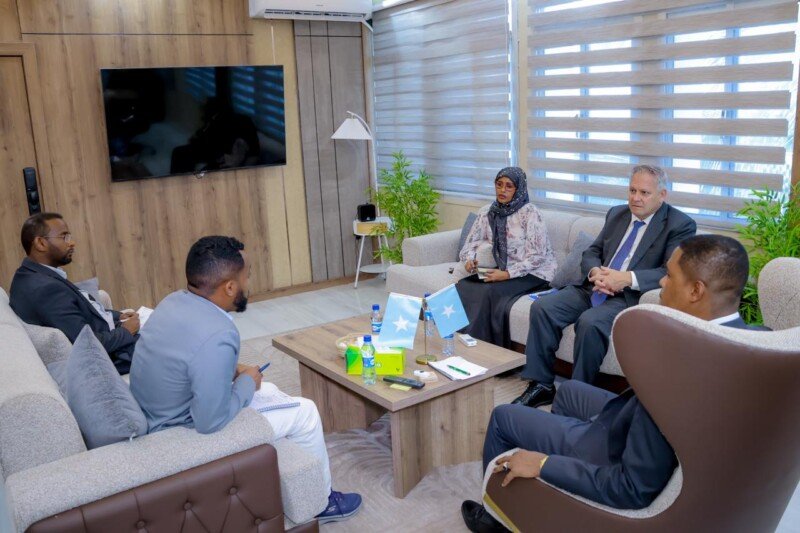
MOGADISHU — Somalia’s Minister of Information, Culture and Tourism, Abdifatah Qasim Mohamud, met with Mr. Robert Flannery, the United States Adviser for the East Africa Counterterrorism Programme, at his office in Mogadishu on Friday.
The meeting focused on strengthening Somalia-US cooperation in counterterrorism, public awareness, countering disinformation and extremist ideologies, and coordinating government messaging related to counterterrorism efforts.
Unified Messaging and Public Awareness
Minister Abdifatah emphasized the importance of preparing a unified media plan, implementing effective awareness campaigns, and strengthening cooperation between the two sides to convey accurate messages to the Somali public and enhance understanding and participation in counterterrorism efforts.
Mr. Flannery, for his part, highlighted the importance of continuing Somalia-US cooperation, particularly in the areas of media and strategic communications, to strengthen counterterrorism efforts and US government support on related matters.
The meeting was attended by the Director of the Strategic Communication Department at the Ministry, Abdishakur Ali Ahmed, and the Minister’s Adviser, Abdiasis Jeylani.
The discussion comes as Somalia’s information ministry has been working to centralise government communication and counter Al-Shabaab’s propaganda efforts. As reported in FTL Somalia’s coverage of the government’s media strategy, the ministry has emphasized the need for enhanced collaboration with independent media, with Minister Abdifatah highlighting private outlets as vital contributors to public awareness, peacebuilding, and national progress.
The ministry has also been active in countering Al-Shabaab’s digital presence. As detailed in FTL Somalia’s coverage of Al-Shabaab’s social media operations, the group creates thousands of social media accounts daily, including Facebook pages and Telegram channels, demonstrating sophisticated and persistent efforts to disseminate its messaging and recruit followers.
Broader US-Somalia Counterterrorism Cooperation
The meeting is part of a broader counterterrorism partnership between Somalia and the United States that spans military operations, intelligence sharing, and capacity building. The United States has conducted airstrikes against Al-Shabaab targets in support of Somali ground operations, and provides training and advisory support to Somali security forces.
In July 2026, the acting Commander of the Somali National Army, Brigadier General Sahal Abdullahi Omar, held talks with the Commander of U.S. Africa Command (AFRICOM), General Dagvin R.M. Anderson, in Mogadishu. As reported in FTL Somalia’s coverage of the meeting, the two sides discussed strengthening counterterrorism cooperation and accelerating coordination between Somali forces and their American counterparts.
The US relationship with Somalia has also faced challenges. Washington has contributed nearly $2 billion to the UN support mission in Somalia but has grown frustrated with what it views as insufficient progress by Somali leaders in assuming responsibility for their own security. As detailed in FTL Somalia’s coverage of the US-Somalia partnership, the United States has notified the African Union that it will no longer finance the UN Support Office in Somalia beyond December 2026, a decision that threatens to pull the logistical rug from under the 12,000-strong AUSSOM mission.
Ideological Countermeasures
The focus on countering extremist narratives reflects a growing recognition within the Somali government that military operations alone cannot defeat Al-Shabaab. In April 2026, Deputy Prime Minister Salah Ahmed Jama convened a high-level Coordination Forum on Preventing Extremist Ideology, organized by the National Center for Preventing and Countering Violent Extremism (TUBSAN). As reported in FTL Somalia’s coverage of the TUBSAN forum, the forum focused on strengthening national capabilities to counter extremist narratives before they take root within local communities, with a key priority being the expansion of grassroots awareness campaigns targeting youth.
The government has also intensified its targeting of Al-Shabaab’s propaganda infrastructure. In July 2026, NISA conducted operations that killed two senior Al-Shabaab propaganda operatives and destroyed broadcasting equipment used for Radio Andalus, the group’s media outlet. As detailed in FTL Somalia’s coverage of the NISA operations, the strike killed Cabdisamad Maxamed, the head of Al-Shabaab’s media wing, representing a significant tactical blow to the group’s propaganda machine.
The Ministry of Information has also coordinated with other government institutions on strategic communications. In May 2025, Defence Minister Ahmed Moalim Fiqi chaired the monthly meeting of the Communications for Stabilization Task Force, bringing together key government communications focal points to enhance coordination and messaging efforts in support of stabilization and early recovery initiatives in newly liberated areas.
Critical Note
The meeting between Minister Abdifatah and Mr. Flannery reflects a growing recognition that the fight against Al-Shabaab cannot be won through military means alone. The group’s ability to recruit, radicalise, and maintain cohesion relies heavily on its propaganda apparatus, including radio broadcasts, social media, and distribution of materials in areas under its control.
However, countering extremist narratives requires more than government messaging. It requires addressing the underlying grievances and governance failures that Al-Shabaab exploits, including land dispossession, lack of economic opportunity, and weak rule of law. A unified media plan cannot substitute for tangible improvements in the lives of ordinary Somalis. If the government’s messaging is not backed by visible action to address citizens’ concerns, it risks being dismissed as propaganda.
Coordination between multiple government institutions, federal member states, and international partners is also a persistent challenge. Different agencies often operate with different communications strategies and priorities, diluting the impact of counterterrorism messaging. The success of this cooperation will depend on whether it can produce a coherent, consistent message that resonates with Somali audiences, not simply a collection of separate campaigns.
Recommended Reading On ftlsomalia.com
- Somalia’s Information Minister Courts Independent Media Amid Allegations of State-Sponsored Digital Censorship
- Al-Shabaab Creates Thousands of Social Media Accounts for Propaganda, Says Somali Minister
- NISA Strikes Al-Shabaab Propaganda Hub and Militant Assembly Point in Coordinated Operations
- Somalia Intensifies Anti-Terror Ideology Campaign at TUBSAN Forum
- US Reaffirms Support for Somali Forces as Army Chief and AFRICOM General Hold Talks in Mogadishu
- Somalia and US Reaffirm Strategic Partnership as Diplomatic Leadership Transitions in Mogadishu