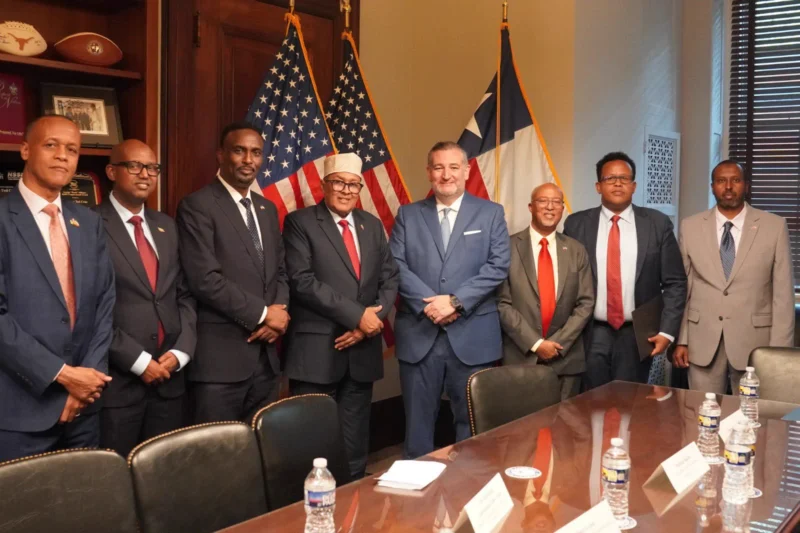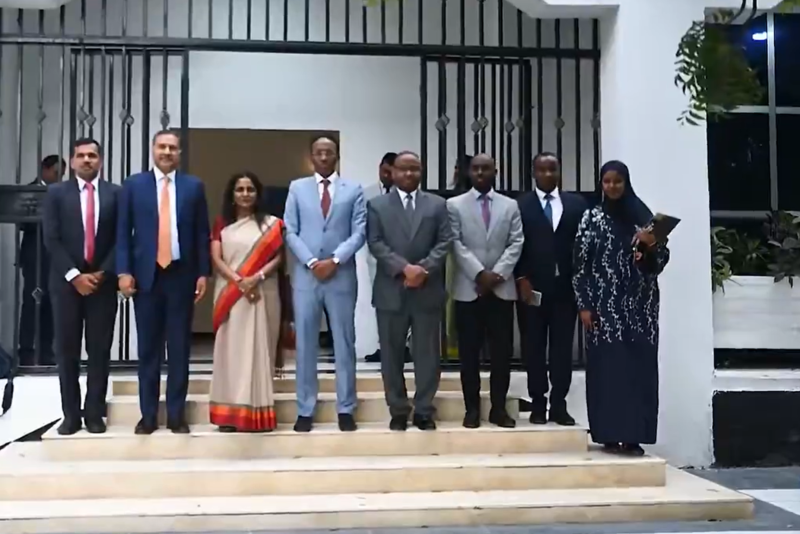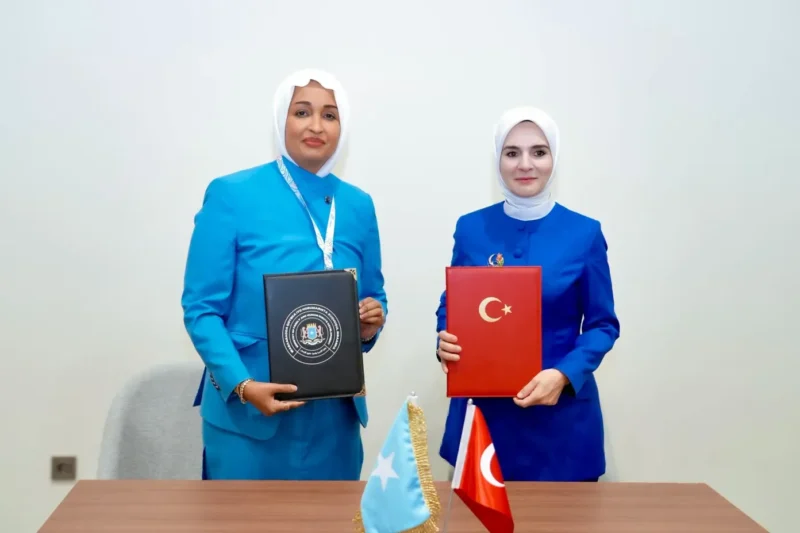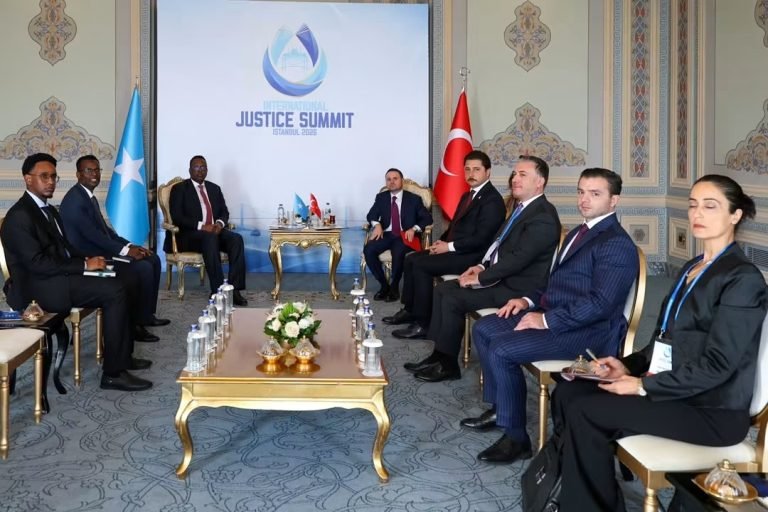
MOGADISHU — Somalia’s Minister of Justice and Constitutional Affairs, Hassan Moallim Mohamud, held a bilateral meeting with his Turkish counterpart, Justice Minister Akın Gürlek, on the sidelines of the International Justice Summit in Istanbul this week.
The meeting focused on strengthening cooperation between Somalia and Türkiye in the justice and judicial sectors, including criminal investigation, legal education, modernisation of justice systems through technology, and enhancing the knowledge and skills of justice sector personnel.
The Istanbul Summit
The International Justice Summit, held under the theme “The Future of Justice: Shared Responsibility for Humanity,” was inaugurated by Minister Gürlek and brought together justice ministers from Pakistan, Syria, Somalia, Georgia, the Democratic Republic of Congo, Libya, and North Macedonia. The Turkish Ministry of Justice confirmed that Gürlek held bilateral talks with each of his counterparts on the margins of the summit.
During the meetings, the ministers discussed efforts to develop cooperation in the field of justice and explored opportunities for joint work. The summit provided a platform for Somalia to engage with Türkiye and other nations on judicial reform priorities.
A Deepening Judicial Partnership
The Istanbul meeting builds on a judicial cooperation framework that has expanded significantly in recent years. In January 2024, the two countries signed an extradition agreement and a memorandum of understanding between their justice ministries. In December of the same year, they signed agreements on mutual legal assistance in criminal matters and the transfer of sentenced persons, as detailed in FTL Somalia’s coverage of the agreements.
The Somali Cabinet formally endorsed the judiciary agreement with Türkiye in May 2024, with ministers agreeing that the deal would enhance collaboration on legal matters and allow for the extradition of criminals and suspects between the two nations, as reported in FTL Somalia’s coverage of the Cabinet endorsement.
Minister Moallim previously met with then-Justice Minister Yılmaz Tunç in Ankara in February 2026, where the two discussed strengthening the institutional capacity of Somalia’s judicial system, as detailed in FTL Somalia’s coverage of the Ankara meeting. The Somali minister expressed appreciation for Türkiye’s willingness to share its expertise in judicial cooperation.
These agreements were ratified by the Turkish Parliament’s Foreign Affairs Committee in January 2026, with Turkish officials stating that they had transformed existing judicial cooperation into an institutional framework. In September 2026, Somalia’s House of the People distributed the second reading report of the Türkiye judicial cooperation agreements to MPs, as reported in FTL Somalia’s coverage of the parliamentary session.
Broader Justice Sector Support
Türkiye’s support for Somalia’s justice sector extends beyond ministerial agreements. In April 2025, the Turkish government funded and constructed a renovated vocational training centre for prisoners at Mogadishu’s Central Prison, equipped with modern tools for training in carpentry, tailoring, welding, and information technology.
Türkiye has also been a key partner in strengthening Somalia’s forensic investigation capacity. As reported in FTL Somalia’s coverage of the forensic partnership, Somalia and The Gambia have engaged Turkish institutions specializing in forensic science, crime scene analysis, and digital investigations to train law enforcement personnel and establish modern laboratories.
The Ministry of Justice, under Minister Moallim’s leadership, has also advanced a broader reform agenda. In April 2026, the ministry convened a senior leadership meeting to evaluate progress on priority projects, including ongoing constitutional review processes and judicial reforms, as reported in FTL Somalia’s coverage of the ministry’s review. The ministry has been working to modernise Somalia’s legal framework, including the introduction of a new Criminal Code to replace the outdated 1962 legislation.
Critical Note
The Istanbul meeting is the latest in a series of high-level engagements between Somali and Turkish justice officials, reflecting a relationship that has moved from symbolic gestures to concrete agreements and institutional cooperation. The extradition treaty, mutual legal assistance agreement, and prisoner transfer arrangements signed in 2024 provide a legal framework that did not exist a few years ago.
However, agreements on paper are not the same as functioning systems. Somalia’s judicial institutions remain weak, under-resourced, and in many areas unable to deliver basic services to citizens. The forensic capacity gap is particularly acute: sending DNA samples to South Africa for analysis, with three-month delays, means that many criminal cases cannot be built on scientific evidence. The vocational training centre at the Central Prison is a useful rehabilitative measure, but it does not address the broader dysfunction of the correctional system.
Türkiye’s willingness to share expertise and provide material support is valuable, and the Somali side has consistently expressed appreciation for it. But the sustainability of these efforts depends on whether Somalia can absorb and institutionalise the support. Training a cohort of justice officials or renovating a training centre is a beginning, not a transformation. The real test will be whether Somalia’s own institutions can eventually operate without external support, and whether the political will exists to prioritise judicial reform alongside security and economic development.
Recommended Reading On ftlsomalia.com
- Somalia Signs Justice Cooperation Agreement with Turkey
- Somali Cabinet Endorses Judiciary Agreement with Turkey
- Somalia, Turkey Boost Judicial Ties in Ministerial Meeting
- Parliament Passes International Judicial Cooperation Bill in 130-9 Vote
- Gambia, Somalia Partner with Türkiye to Boost Forensic Investigation Capacity
- Justice Ministry Assesses Key Projects, Advances Post-Constitutional Reform Agenda