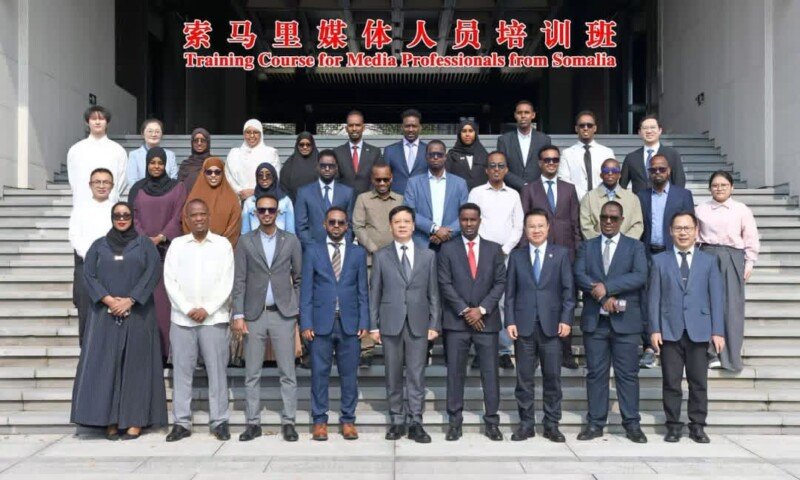
JINHUA, A 21-day training programme for 27 officials from Somalia’s Ministry of Information, Culture and Tourism has opened in Jinhua, in eastern China’s Zhejiang province, focusing on modern media strategies, artificial intelligence, and combating misinformation.
The programme, delivered by experts from Zhejiang Normal University, brings together directors, heads of government media departments, and other ministry personnel. Participants will study modern media strategies, the application of AI in communication, media management, and techniques for identifying and countering false information.
The initiative is part of broader efforts to strengthen the professional skills of Somali government media staff as the country seeks to modernise its public communication systems and adapt to changes in the digital media landscape.
A Relationship Built Over Months of Engagement
The training did not emerge in isolation. It follows a series of high-level engagements between Mogadishu and Beijing on media and technology cooperation throughout 2026. As reported in FTL Somalia’s coverage of Somalia’s AI integration, the Ministry of Information has already implemented advanced AI systems in national media operations, including automated translation, content generation, and digital distribution algorithms that have reduced editorial production time.
In August 2026, Information Minister Abdulfatah Kasim Mohamud met with Cao Shumin, Minister of China’s National Radio and Television Administration, in Beijing to discuss media modernisation, institutional capacity building, and professional training. The Minister also participated in the China-Africa Media Cooperation Forum, where he called for stronger support to modernise Somali broadcasting infrastructure, as reported in FTL Somalia’s coverage of Somalia’s engagement with Chinese and Arab media institutions.
At the opening ceremony in Jinhua, Zhu Yifeng, Vice-President of Zhejiang Normal University, said the workshop would promote the exchange of media expertise, strengthen bilateral ties, and advance cooperation between Somalia and China.
Abdishakur Ali Ahmed, Director of the Media Strategy Department at Somalia’s Ministry of Information, said the training offered government media representatives an opportunity to learn from China’s experience in modernising its media sector. He thanked the Chinese government, organisers, and institutions involved, particularly the Chinese Ministry of Commerce, which financed the training, and the Chinese Embassy in Somalia, led by Ambassador Wang Yu, which facilitated the initiative.
The Strategic Logic and Its Limits
China’s engagement with Somali media is part of a broader pattern of Beijing’s involvement in Africa’s information and communication sectors, alongside its expanding economic and security ties with Mogadishu. As reported in FTL Somalia’s coverage of China’s trade policy, Beijing has extended zero-tariff access to all 53 African nations, and the two countries have deepened defence and security cooperation. The media training represents another dimension of a relationship that now spans trade, security, and information.
For Somalia, the appeal is practical. The country’s state media infrastructure remains weak, despite recent investments. In 2025, the Ministry of Information established Somalia’s first Media Satellite Teleport in over three decades, a facility intended to modernise broadcasting capabilities, as reported in FTL Somalia’s coverage of the teleport launch. But infrastructure alone is insufficient. The government has struggled to counter Al-Shabaab’s sophisticated propaganda operations and to manage the rapid spread of misinformation during political crises.
The challenges facing Somali media are not limited to technical capacity. As reported in FTL Somalia’s coverage of media freedom concerns, independent outlets have accused the government of orchestrating digital censorship campaigns, including copyright strikes and bot-driven harassment against critical reporting. Journalists have been arrested and assaulted by security forces, with press freedom organizations documenting a pattern of intimidation.
Critical Note
The Jinhua training programme is a welcome investment in Somali media capacity, and the focus on artificial intelligence and counter-disinformation addresses genuine gaps in the government’s communication apparatus. The involvement of the Chinese Ministry of Commerce as a financier and the embassy in Mogadishu as a facilitator indicates a level of institutional commitment that suggests this is not a one-off gesture.
But the programme also raises questions that its organisers have not addressed. AI tools and modern media strategies are only as effective as the institutions that deploy them. Somalia’s Ministry of Information has struggled with limited budgets, political interference, and a state media apparatus that many Somalis view with skepticism. A 21-day training course can introduce new techniques, but it cannot resolve these structural weaknesses.
The deeper concern is one of orientation. China’s model of media management involves tight state control over information flows, a framework that is fundamentally different from the pluralistic, if chaotic, media environment that has emerged in Mogadishu over the past decade. The training is framed as technical, but the techniques being transferred are not politically neutral. How Somalia’s government media officials apply what they learn in Jinhua will depend on the political culture they return to. The programme can teach them how to use AI to detect misinformation. It cannot teach them how to resist the temptation to use the same tools for political advantage. The same ministry that is sending officials to learn about countering disinformation is the one accused of orchestrating digital censorship at home.
Recommended Reading On ftlsomalia.com
- Somalia Leads AI Integration in East African Community
- Somalia Joins Global South Media Forum in Cairo
- Somalia Launches First Media Satellite Teleport in 35 Years
- Somalia’s Information Minister Courts Independent Media Amid Allegations of State-Sponsored Digital Censorship
- Journalists Arrested, Beaten in Mogadishu Amid Press Freedom Crackdown