MOGADISHU, Somalia’s Armed Forces Court has sentenced a former police officer to death by firing squad for the murder of a senior police commander, concluding a case that exposed a web of betrayal, theft, and an alleged cover-up within the security services.
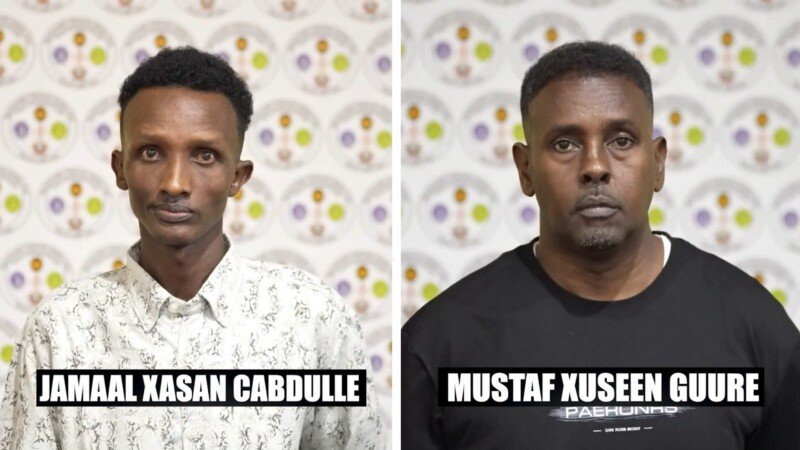
The court on Wednesday handed down a qisas (retribution) sentence to former Corporal Jamaal Hassan Abdulle for the killing of Brigadier General Salad Mohamed Guleid, the former head of Police Communications and Technology, who was shot dead inside his home in June 2026.
A second defendant, Mustaf Hussein Guure (known as “Kaamil”), an IT engineer who used falsified military credentials, was sentenced to one year of “light security” imprisonment for his role in concealing the crime and misleading investigators, according to the court’s ruling announced by Colonel Hassan Ali Nuur Shuute, head of the First Degree Armed Forces Court.
A Killing Born of Theft and Betrayal
The prosecution’s account painted a portrait of a trusted insider who turned on his benefactor. Jamaal had served as General Salad’s personal bodyguard and was described in court as a young man the general had raised and sponsored into the police force. After training, Jamaal was assigned to the police communications department, where the general served as commander. The defendant received a monthly salary of 200 units and a 500-unit bonus, benefits that continued until the general’s death.
The motive, according to the court, was a dispute over a lost AK-47 rifle registered to the deceased. Jamaal had been entrusted with the weapon. Instead of reporting its loss, he sold it and used the proceeds to fund an account on the betting platform 1Xbet. When he was informed that he could not return to the general’s home without the government-issued weapon, Jamaal is said to have avoided the residence until the night of the killing.
On the first of June 2026, Jamaal allegedly entered the general’s home without authorization. He shot General Salad three times in the back and arm with an AK-47. The court heard that he offered no assistance to the dying man. Instead, he attempted to erase evidence, cleaning bloodstains with the general’s own towel and garments, and discarding the shell casings outside the front of the house, where they were later recovered by investigators using CCTV footage.
Mustaf “Kaamil,” a friend of the general since 2019 who had lived in the same house, was accused of aiding Jamaal by failing to intervene during the 12 minutes he remained inside the home after the shooting. He was also found to have confirmed to arriving officers that no one else was present, misleading the initial investigation.
A Pattern of Military Justice
The verdict is the latest in a series of high-profile cases before Somalia’s military courts, which have increasingly been used to prosecute security force members accused of serious crimes against civilians and fellow officers. In September 2026, the same court sentenced a former soldier to death for killing a bajaj driver in Mogadishu over a trivial dispute, as reported in FTL Somalia’s coverage of the case. That verdict was also handed down by Colonel Hassan Ali Nuur Shuute.
The court has also prosecuted former NISA operatives and soldiers accused of collaborating with Al-Shabaab. In March 2026, a former NISA private was sentenced to death for a fatal shooting in Afgooye, as reported in FTL Somalia’s coverage of the verdict. The military justice system has become the primary venue for holding security personnel accountable, though its use of capital punishment and its limited transparency have drawn scrutiny from rights organizations.
Critical Note
The conviction of General Salad’s bodyguard is a significant moment for accountability within Somalia’s security forces. The general was a senior officer killed in his own home by a man he had raised and trusted. The court’s finding that Jamaal sold a government weapon to fund a betting account, then killed his benefactor to conceal the theft, is a stark illustration of how personal indiscipline and the easy availability of weapons can turn a trusted insider into a killer.
The sentence of one year for Mustaf “Kaamil,” however, raises questions about the court’s assessment of culpability. He was accused of actively misleading investigators and concealing the crime. A one-year “light security” sentence for what the prosecution described as complicity in a murder investigation is a lenient outcome, and it is not clear from the court’s public statement why his role was treated so differently from Jamaal’s.
The broader pattern is also worth noting. Somalia’s military courts have delivered a series of death sentences in 2026, often swiftly and with limited public documentation. These verdicts serve a deterrent purpose and address public demands for accountability. But they also operate within a system that lacks the transparency and procedural safeguards of civilian courts. The execution of General Salad’s bodyguard will be presented as justice for a fallen officer. Whether it is part of a consistent, fair system of military justice, or an isolated response to a particularly visible crime, is a question that the court’s brief public statements do not answer.