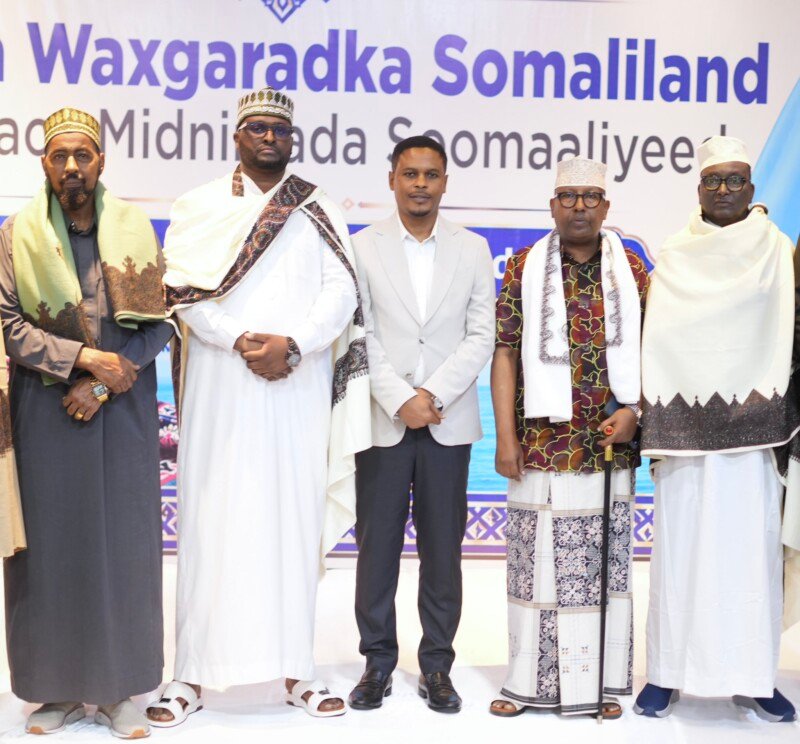
MOGADISHU, Senior federal ministers used a welcoming event for traditional elders from Somaliland who participated in the formation of Galmudug’s new administration to issue strong calls for national unity and dialogue, emphasizing that separation is not a viable path for the Somali people.
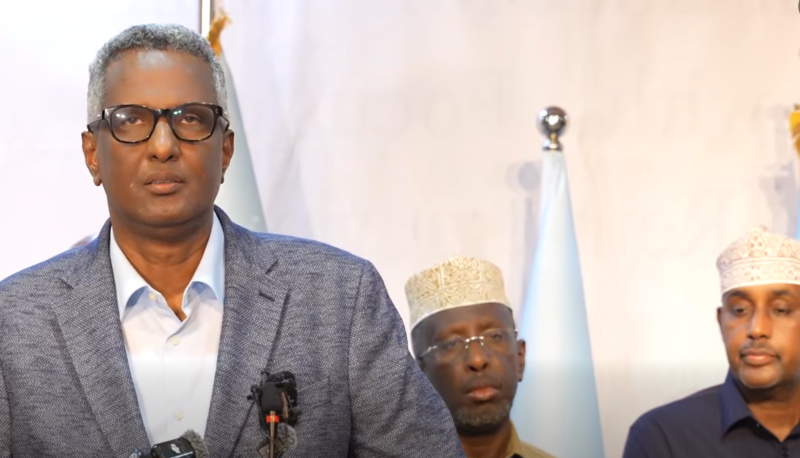
Defence Minister Ahmed Moalim Fiqi addressed the gathering, reflecting on the wounds left by the military government and arguing that the grievances of the past must be addressed through collective discussion. “What happened to the Somali people under the military government cannot be forgotten,” Fiqi said, adding that if there are errors in the 1960 union agreement, Somalis must come together to discuss them. He stressed that any issue that threatens the unity of the people and the country requires a shared table for dialogue.
Information Minister Abdulfatah Kasim Mohamud echoed these sentiments, delivering a stark message regarding the debate over Somaliland’s status. “What unity could not achieve cannot be achieved through separation,” Mohamud stated. He emphasized the necessity of strengthening dialogue, protecting the public interest, and avoiding rhetoric that breeds hatred and division within the community. He called for reinforcing the unity of the people and the country, urging all parties to pursue any avenue that could reunite the broader Somali society.
A Delicate Political Context
The ministers’ remarks come at a time of heightened political sensitivity regarding Somalia’s territorial integrity and the status of Somaliland. The federal government has recently been forced to defend the country’s unity on the international stage, particularly in response to Israeli Prime Minister Benjamin Netanyahu’s display of a map that categorized Somaliland and Puntland as separate geopolitical entities friendly to Israel and the UAE.
As reported in FTL Somalia’s coverage of the map controversy, the image placed Somaliland and Puntland in a separate category from the rest of Somalia, which was grouped with a Türkiye-Egypt-Saudi Arabia-Pakistan bloc. Mogadishu issued a strong condemnation, with the Information Ministry stating that “Somali territories, including Somaliland and Puntland, are integral and inseparable parts of the unified Somali nation.”
The government’s stance remains that Somaliland’s 1991 declaration of independence is null and void, a position complicated by Israel’s December 2025 recognition of Somaliland as a sovereign state. As detailed in FTL Somalia’s coverage of the diplomatic fallout, Israel became the first UN member state to formally recognize Somaliland, a move Mogadishu rejected as a violation of its sovereignty.
The relationship between Somaliland and Israel has deepened rapidly since then. Somaliland President Abdirahman Mohamed Abdullahi (Irro) visited Israel in June 2026, opening an embassy in Jerusalem and signing a strategic declaration with Netanyahu, as reported in FTL Somalia’s coverage of the visit. Direct flights between Hargeisa and Tel Aviv are also expected to begin in the near future.
The presence of Somaliland elders at the Galmudug event was likely framed by the ministers as evidence that cross-regional participation in federal state-building is possible and desirable. It signals that despite the political leadership in Hargeisa rejecting unity, there remain significant figures within the Somaliland community willing to engage with the federal system.
Minister Fiqi’s reference to discussing the “errors of the 1960 union” touches on a long-standing grievance often cited by Somaliland separatists. By acknowledging that the union agreement may have had flaws, Fiqi appears to be signaling a willingness to engage with historical grievances, while simultaneously rejecting the conclusion of separation.
Critical Note
The statements by Ministers Fiqi and Mohamud are rhetorically powerful, particularly the framing that “what unity cannot achieve, separation cannot either.” This appeals to a sense of shared destiny and pragmatism, suggesting that the challenges facing Somalis are better addressed together than apart. The Defence Minister’s acknowledgment of historical grievances is also notable, as it moves beyond the often rigid official narrative that treats the 1960 union as flawless.
However, these appeals are occurring in a political vacuum. The federal government has not articulated a concrete mechanism for the “dialogue” the ministers are calling for. The event was a welcoming ceremony for traditional elders participating in a different regional process, not a structured negotiation with Somaliland’s leadership. Mogadishu’s outreach remains directed at individuals rather than the political authority in Hargeisa, which continues to reject the premise of unity.
The ministers’ words will resonate with audiences already inclined toward Somali unity. They will not, on their own, persuade those who view the 1960 union as a historical mistake. For the dialogue to be meaningful, it must eventually move from ceremonial events in Mogadishu to a formal process that addresses the fundamental questions of power-sharing and recognition that have defined the Somalia-Somaliland impasse for over three decades.