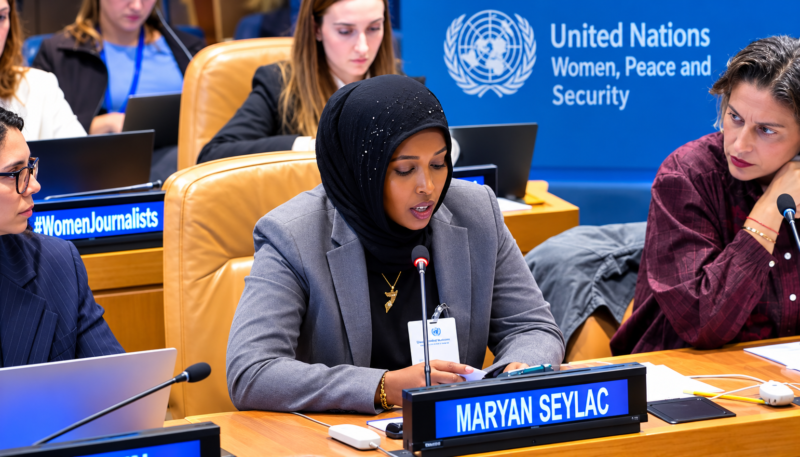
NEW YORK, Maryan Seylac, Executive Director of the Somali Women Media Association (SOMWA), participated in a panel discussion at the United Nations in New York this week focused on the Women, Peace and Security agenda and the role of women journalists in promoting peace, accountability, and gender equality.
The discussion highlighted the challenges women journalists face in conflict-affected settings, including violence, intimidation, and threats to their safety and professional independence. It also emphasized the contributions they make to shaping public debate, amplifying the voices of marginalized communities, and advancing peacebuilding efforts.
Women journalists, the panel noted, are not merely victims of conflict and violence but also powerful agents of change. Through their reporting, they bring attention to overlooked issues, document human rights violations, challenge misinformation, and hold those in power accountable. In conflict and crisis situations, independent journalism helps communities access reliable information and ensures that the experiences and perspectives of women and other marginalized groups are represented in public discourse.
A Global Stage for a Documented Crisis
Seylac’s participation in the UN panel underscores the importance of recognizing and supporting women journalists as key contributors to peace and security. Protecting their rights, ensuring their safety, and strengthening their participation in decision-making processes are essential to achieving the objectives of the Women, Peace and Security agenda.
For Somalia, the message is especially relevant. The threats Seylac described to the UN panel are not abstract. They are documented in SOMWA’s own annual reports. As reported in FTL Somalia’s coverage of SOMWA’s 2025 report, the association documented a surge in physical assaults, unlawful detentions, and digital intimidation of women journalists, marking the highest number of violations since the organization began monitoring. Seylac herself said at the time that the findings reflected a worsening climate for female journalists, many of whom face threats simply for doing their jobs.
The report highlighted that women covering sensitive stories, such as gender-based violence, corruption, or security issues, are often targeted by both state and non-state actors, leaving them vulnerable and isolated. Female journalists continue to endure online abuse, smear campaigns, and public shaming, forcing some to leave their jobs or go into hiding.
The Pattern Seylac Confronts
The UN panel’s focus on the safety of women journalists comes against a backdrop of documented abuses in Somalia. As reported in FTL Somalia’s coverage of the May 2026 crackdown, three journalists were detained and allegedly assaulted in Mogadishu, with the Somali Journalists Syndicate reporting that police chief Mahdi Omar Mumin told them he was “tired of arresting journalists” and that if they did not remain silent about planned protests, the only remaining option would be “death.”
The pattern extends beyond physical violence. As reported in FTL Somalia’s coverage of digital censorship allegations, independent media houses have reported mass reporting and false copyright complaints targeting their content on Facebook, with Shabelle TV and Universal TV losing video content shortly after posting protest footage. SOMWA described the development as a “highly organized wave of online subversion,” with Seylac warning that journalists now face pressure on multiple fronts, including harassment, arrests, and organized online campaigns targeting their work and credibility.
The detention of individual journalists has become a recurring feature of Somali media life. In August 2026, Mascuud Warsame, founder of Xogbile TV, was released after 40 days in NISA custody without charge, as reported in FTL Somalia’s coverage of his case. In May 2026, Goobjoog journalist Rowdo Hassan Taakilo was detained by security forces while returning home, prompting her employer to condemn the arrest as part of a broader pattern of intimidation, as reported in FTL Somalia’s coverage of the condemnation.
Across the wider region, the picture is similarly bleak. As reported in FTL Somalia’s coverage of Somaliland’s media crackdown, the British Office in Hargeisa disclosed that more than 50 journalist arrests had been recorded in Somaliland in less than two years, warning that the detentions risk undermining the region’s democratic reputation.
From Rhetoric to Protection
The panel discussion reinforced the need for greater international commitment to creating an enabling environment in which women journalists can carry out their work without fear of violence, harassment, or reprisal. That commitment, however, is easier to declare than to implement.
SOMWA has not limited itself to advocacy. As reported in FTL Somalia’s coverage of SOMWA’s safety training, the organization launched a two-day program in Mogadishu focused on physical security, digital safety, and psychosocial support, supported by UNTMIS. In July 2025, SOMWA and FESOJ held a workshop calling for comprehensive legal reforms and a national journalist protection mechanism, as reported in FTL Somalia’s coverage of the workshop.
These initiatives are necessary, but they cannot substitute for the protection that only the state can provide. The Somali government has the constitutional obligation to safeguard freedom of expression and the safety of journalists. Its record to date does not meet that obligation.
Critical Note
Seylac’s participation at the UN is a significant recognition of SOMWA’s work and of the courage of Somali women journalists who report from conflict zones at great personal risk. It is also a reminder of how much remains to be done. The Women, Peace and Security agenda is a framework, not a shield. It can provide legitimacy and visibility, but it cannot stop a bullet or a death threat.
The international community has repeatedly pledged to protect journalists and to support women’s participation in peace processes. In Somalia, those pledges have not translated into meaningful protection. The government has not prosecuted those who attack journalists. The security forces have not been held accountable for abuses against media workers. And the political culture continues to treat critical reporting as a threat rather than a public good.
SOMWA’s work is essential, and Seylac’s voice at the UN is important. But the real test of the WPS agenda is not what is said in New York. It is whether a woman journalist in Mogadishu can file a story without fear, whether the government investigates attacks against her, and whether the international partners who fund Somalia’s security sector also hold it accountable for protecting the freedom of the press. Until those conditions change, the gap between the rhetoric of the UN panel and the reality of Somali newsrooms will remain.
Recommended Reading On ftlsomalia.com
- Somali Women Journalists Face Surge in Abuse, SOMWA Warns
- Journalists Arrested, Beaten in Mogadishu Amid Press Freedom Crackdown
- Somalia’s Information Minister Courts Independent Media Amid Allegations of State-Sponsored Digital Censorship
- Journalist Mascuud Warsame Released After 40 Days of Unlawful Detention in Mogadishu
- Goobjoog Condemns Journalist Arrest, Demands Release
- UK Raises Alarm Over More Than 50 Journalist Arrests in Somaliland