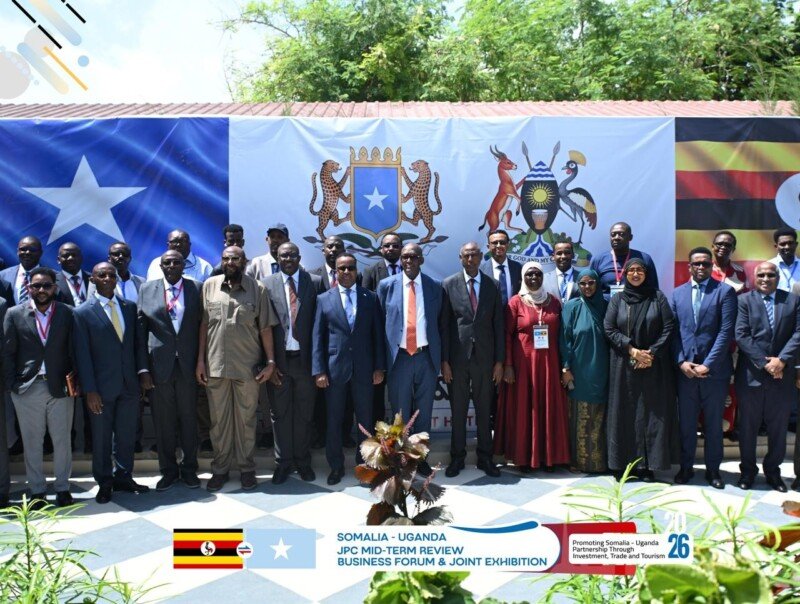
MOGADISHU, Somalia is hosting the first-ever Somali-Ugandan Business Forum alongside the Mid-Term Review of the Second Session of the Uganda-Somalia Joint Permanent Commission (JPC), with the second day of engagements underway in Mogadishu.
The two-day events were officially opened by Somalia’s Minister of Foreign Affairs and International Cooperation, Abdisalam Abdi Ali, and attended by Somalia’s Minister of Labour, Prof. Salim Aliyow Ibrow, and Uganda’s Minister of Labour, Lt. Gen. (Rtd.) Henry Tumukunde. Discussions are focused on security, trade, investment, tourism, fisheries, and labour cooperation, with the goal of translating shared priorities into concrete investment opportunities and practical benefits for both countries.
A 35-member Ugandan delegation, led by Ambassador Richard Kabonero, Uganda’s head of regional economic cooperation, arrived in Mogadishu earlier this week and was received at Aden Adde International Airport by Somalia’s Ambassador to Uganda, Fardowsa Mohamed Qanyare. The delegation includes policymakers, trade officials, and prominent business executives.
A Relationship Moving Beyond Security
The forum represents a deliberate effort by both governments to broaden a relationship that has historically been defined by security cooperation. Uganda has contributed troops to African Union peacekeeping missions in Somalia for nearly two decades, making it one of Mogadishu’s most consistent regional security partners. As reported in FTL Somalia’s coverage of regional military engagements, Uganda remains one of the largest troop contributors to AUSSOM, with thousands of soldiers deployed across multiple sectors.
The economic relationship, however, has lagged far behind the security one. Uganda’s exports to Somalia rose from $2.75 million in 2023 to $6.78 million in 2024, according to UN Comtrade data, led by tobacco products, aircraft parts, and wood products. Trade in the other direction is negligible: Somalia’s exports to Uganda were valued at just $35,400 in 2021, down from $671,000 in 2016.
Uganda’s Permanent Secretary in the Ministry of Foreign Affairs, Vincent Bagiire Waiswa, acknowledged the growth but said the private sector could do more. “Our imports and exports between Uganda and Somalia have exponentially grown. However, we believe that our private sector can do better than the current statistics,” he said.
Bagiire described Somalia as a potential trade bridge between Africa and the Gulf states, noting that Uganda is landlocked while Somalia has Africa’s longest coastline. He described Mogadishu as a prospective “New Dubai” within the East African Community.
The EAC Framework and Unfulfilled Commitments
Both countries are now members of the East African Community, a bloc that Somalia joined in 2024. As reported in FTL Somalia’s coverage of Somalia’s EAC membership, the government views regional integration as a mechanism to create opportunities for Somali businesses operating across Africa. The EAC represents a combined market of over 300 million people, and Somalia has taken steps to align its trade framework, including Cabinet approval of a draft Rules of Origin Law in August 2026.
Despite the optimistic framing, the JPC review has exposed gaps between commitments and implementation. The two countries agreed during their previous JPC session in Kampala in October 2025 to establish a Joint Permanent Investment and Business Council to address non-tariff barriers, but the council has yet to become operational. As reported in FTL Somalia’s coverage of the Kampala summit, the 2025 session was intended to produce landmark agreements on trade facilitation, investment protection, and tourism development.
Uganda has also submitted draft memoranda of understanding on customs, standards, statistics, and health that remain unsigned, and negotiations on a Bilateral Air Service Agreement are still pending. On the sidelines of the forum, the two countries signed a bilateral labour agreement aimed at protecting workers’ rights and regulating employment.
Critical Note
The Somali-Ugandan Business Forum is a welcome initiative, and the fact that Mogadishu is hosting it for the first time signals that the government is attempting to reposition Somalia as a commercial gateway rather than solely a security concern. The presence of a large private-sector delegation from Kampala suggests genuine interest on the Ugandan side.
But the numbers tell a story that the speeches do not. Bilateral trade of less than $7 million annually is negligible for two countries of Somalia’s and Uganda’s size. The Joint Permanent Investment and Business Council agreed in 2025 has not been operationalized. The air services agreement remains unsigned. The memoranda on customs, standards, and health are still drafts. A forum that produces a labour agreement and a communiqué is not the same as a forum that produces trade.
The deeper obstacle is not a lack of goodwill. It is the infrastructure and institutional gaps that make commercial exchange costly and unreliable. Uganda Airlines is the only carrier flying nonstop between Entebbe and Mogadishu, with four flights a week. That is a thin lifeline for a trade relationship that both governments say they want to expand. Somalia’s ports and customs systems remain weak, and Ugandan exporters face the same security and logistics constraints that have limited investment in Somalia for decades. The EAC framework provides a structure for integration, but as Somalia’s own experience has shown, membership alone does not generate trade. It requires the hard work of regulatory harmonization and infrastructure investment that the forum’s communiqué does not promise.
Recommended Reading On ftlsomalia.com
- Uganda, Somalia to Seal New Trade and Investment Pacts at Kampala Summit
- Somalia’s EAC Membership Is About Creating Opportunities for Somali Traders, Says Minister Beenebeene
- Hassan Sheikh Receives General Okiding as Regional Military Chiefs Convene in Mogadishu
- Somalia’s Trade Gap Hits US$2.13 Billion as Imports Surge 16%
- Somali President Holds Extensive Talks with Ugandan Counterpart in Kampala