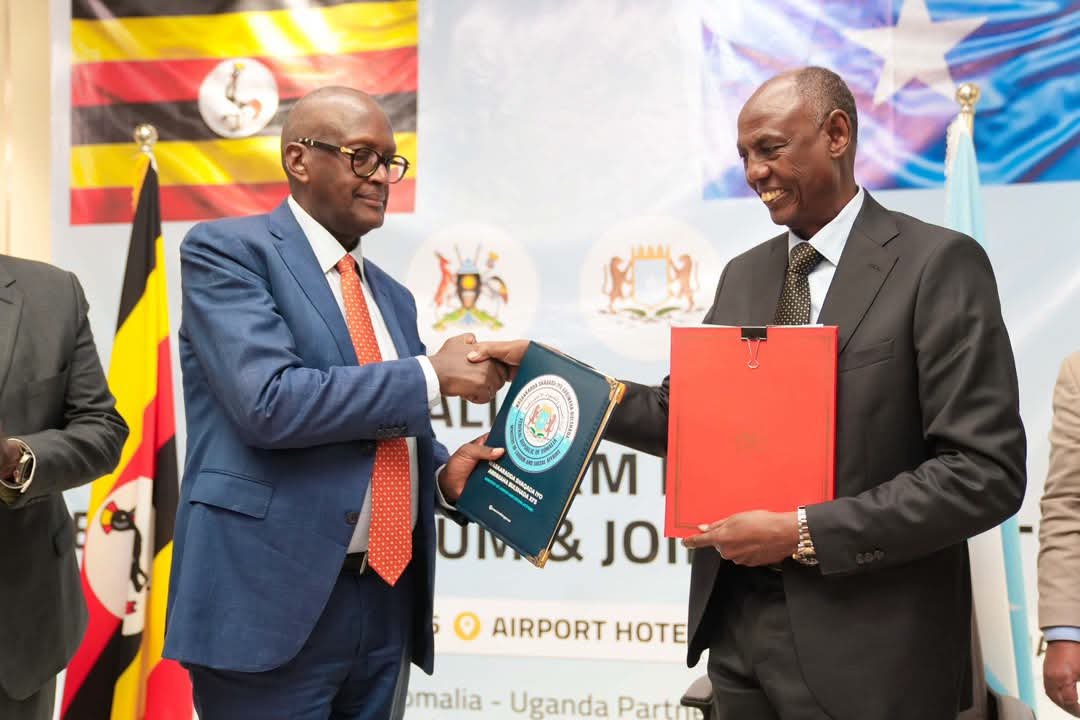
MOGADISHU, Somalia’s Minister of Labour and Social Affairs, Prof. Salim Alio Ibro, and Uganda’s Minister of Gender, Labour and Social Development, Lt. Gen. (Rtd.) Henry Tumukunde, signed a bilateral labour agreement on Wednesday aimed at regulating employment between the two countries and protecting the rights of workers.
The agreement, signed on the sidelines of the Somali-Ugandan Business Forum and the Joint Permanent Commission review in Mogadishu, establishes a framework for the orderly recruitment of citizens from both nations. It outlines the responsibilities of employers, standardizes employment contract procedures, and sets out protections against abuse and unlawful exploitation.
Under the terms of the accord, the two governments committed to ensuring transparent and fair recruitment processes, enhancing the safety and welfare of Somali and Ugandan workers, and strengthening cooperation between the relevant institutions in both countries. The agreement also includes a mechanism for joint follow-up and monitoring to ensure implementation and to resolve labour disputes in accordance with the laws and regulations of both nations.
A Response to a Growing Migration Corridor
The labour agreement formalizes a relationship that has developed informally over years. Somali nationals have long travelled to Uganda for education, business, and employment, while Ugandan professionals, particularly in education and technical fields, have worked in Somalia. The absence of a formal framework has left workers in both countries vulnerable to exploitative recruitment practices, contract disputes, and limited consular protection.
The signing coincides with a broader effort by both governments to deepen economic ties, as the two nations convene the first-ever Somali-Ugandan Business Forum alongside the Mid-Term Review of the Second Session of the Uganda-Somalia Joint Permanent Commission (JPC). As reported in FTL Somalia’s coverage of the business forum, discussions are focused on security, trade, investment, tourism, fisheries, and labour cooperation, with the goal of translating shared priorities into concrete investment opportunities. The labour agreement adds a social dimension to a relationship that has historically been defined by security cooperation and, more recently, by trade ambitions.
The two countries are also linked through the East African Community, which Somalia joined in 2024. The EAC’s protocol on the free movement of persons and labour provides a regional framework for cross-border employment, but bilateral agreements like the one signed on Wednesday are necessary to operationalize those principles at the national level. As reported in FTL Somalia’s coverage of Somalia’s EAC membership, the government views regional integration as a mechanism to create opportunities for Somali citizens operating across East Africa.
Critical Note
The signing of a bilateral labour agreement is a welcome step, and the provisions it outlines, covering contract standards, anti-exploitation measures, and dispute resolution, address genuine gaps in the current system. For Somali workers in Uganda and Ugandan workers in Somalia, a formal framework offers a measure of legal protection that informal arrangements could not provide.
But the agreement’s value will depend entirely on implementation. Somalia’s labour inspection capacity is weak, its consular services abroad are limited, and its domestic employment regulatory framework remains underdeveloped. Uganda faces its own challenges in enforcing labour standards, particularly for migrant workers. A signed document does not create inspectors, fund consulates, or build the institutional machinery needed to monitor compliance.
The agreement also raises questions about the scale of the problem it is meant to address. The number of Somali workers in Uganda and Ugandan workers in Somalia is not publicly documented. Without reliable data, it is difficult to assess whether the agreement responds to a significant need or is primarily a diplomatic gesture accompanying the broader business forum. The two governments have committed to joint monitoring and follow-up. Whether that mechanism will function, or will become another dormant bilateral committee, is the test that will determine whether this agreement protects workers or simply produces a photograph of two ministers shaking hands.