
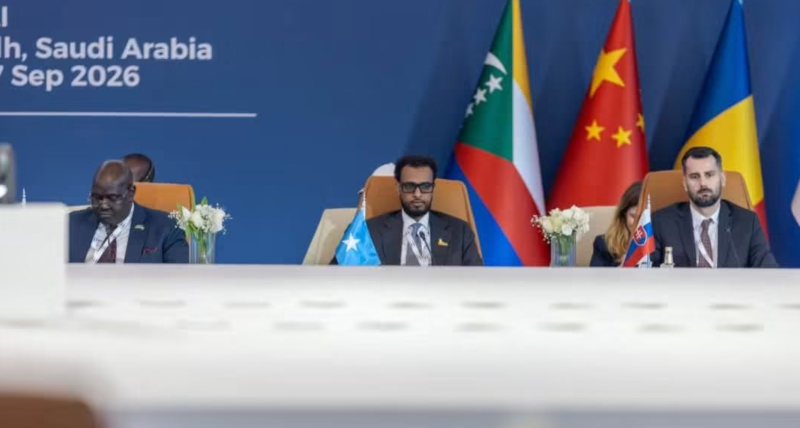
RIYADH — Somalia’s State Minister of Communications and Technology, Ahmed Osman Diriye, is participating in the 4th UNESCO Global Forum on the Ethics of Artificial Intelligence, which opened in Riyadh, Saudi Arabia, on Monday.
The forum, running from September 14 to 17, 2026, is co-organized by UNESCO and the Government of Saudi Arabia. It brings together governments, international organizations, experts, academics, private sector representatives, and civil society to discuss the challenges and opportunities of artificial intelligence.
The theme of this year’s forum is “Transforming Global Cooperation for Ethical AI Governance,” focusing on strengthening international cooperation to develop governance frameworks for AI that are based on responsibility, ethics, and the protection of human rights.
Somalia’s Growing Engagement in AI Governance
The forum holds particular significance for Somalia as the country works to develop policies and legislation related to digital transformation and artificial intelligence. Minister Diriye is also participating in a ministerial-level dialogue, where he is presenting Somalia’s perspective on the importance of international cooperation on AI and the role of governments in establishing policies and governance frameworks that ensure AI is used responsibly and ethically.
Somalia has been actively engaging in international AI governance discussions, with the Minister of Communications and Technology previously participating in the International Dialogue on AI Governance at the United Nations Office in Geneva. Minister Mohamed Adam Maalim addressed that forum, stating that while AI presents significant opportunities for improving public services, economic growth, and innovation, it requires a governance framework built on international cooperation and collective action.
Building National AI Capacity
In July 2026, Somali National University officially launched the Somali National Artificial Intelligence Centre (SNAIC), a Centre of Excellence established to advance AI research, education, innovation, and capacity building. The centre will focus on machine learning, natural language processing, data science, computer vision, robotics, and AI ethics, while promoting the application of these technologies in education, healthcare, agriculture, and economic growth.
Somalia has also positioned itself as a key innovator in AI adoption within the East African Community, with the Somali delegation presenting a comprehensive plan for artificial intelligence integration at regional summits. The Ministry of Information has implemented AI systems in national media operations, using automated translation and content generation to reduce editorial production time.
Hormuud Telecom and the German Agency for International Cooperation (GIZ) have signed a landmark agreement to develop an inclusive digital economy in Somalia, focusing on expanding cross-border payment systems, enhancing digital literacy, and fostering AI training programs tailored to boost youth employment.
The Deputy Prime Minister has also highlighted Somalia’s significant progress in the digital domain, including a new program designed to consolidate government services through a single, user-friendly platform. Beginning next year, Somali citizens will be able to obtain essential public documents via one integrated system, including birth certificates, marriage certificates, and business registrations.
Critical Note
Somalia’s participation in the Riyadh forum reflects the government’s recognition that artificial intelligence governance is not a distant concern but an immediate priority. As AI technologies proliferate globally, the frameworks that govern their development and use are being shaped now. For Somalia, engaging in these discussions is essential to ensuring that its voice is heard and that the resulting frameworks account for the unique circumstances of developing and post-conflict states.
The challenge for Somalia lies in translating participation in international forums into domestic capacity. The country has established a National AI Centre, adopted a National Digital Strategy, and begun developing legislation on data protection and cybersecurity. These are positive steps. Yet the infrastructure and skills gaps that constrain Somalia’s digital ambitions remain substantial. The most valuable item on the agenda when Somali officials engage with international partners is not a model or a memorandum but the foundational elements of power, connectivity, and technical expertise that make AI development possible.
Somalia’s engagement with the global AI governance agenda also raises questions about the balance between regulation and innovation. An overly restrictive framework could stifle the development of local AI solutions that address Somali-specific challenges, such as pastoralist economies, fisheries management, and drought monitoring. A framework that is too permissive risks creating vulnerabilities in data protection and cybersecurity, areas where Somalia has already experienced breaches. Getting this balance right will require sustained investment in institutional capacity and a clear-eyed assessment of where AI can deliver the greatest benefit for Somali citizens.
Recommended Reading On ftlsomalia.com
- Somalia’s Communications Minister Calls for Inclusive AI Governance at UN Summit in Geneva
- Somali National University Launches National Artificial Intelligence Centre
- Somalia Leads AI Integration in East African Community
- Hormuud Telecom and GIZ Sign Agreement to Boost East Africa’s Digital Economy
- Somalia Makes Major Digital Transformation Advances