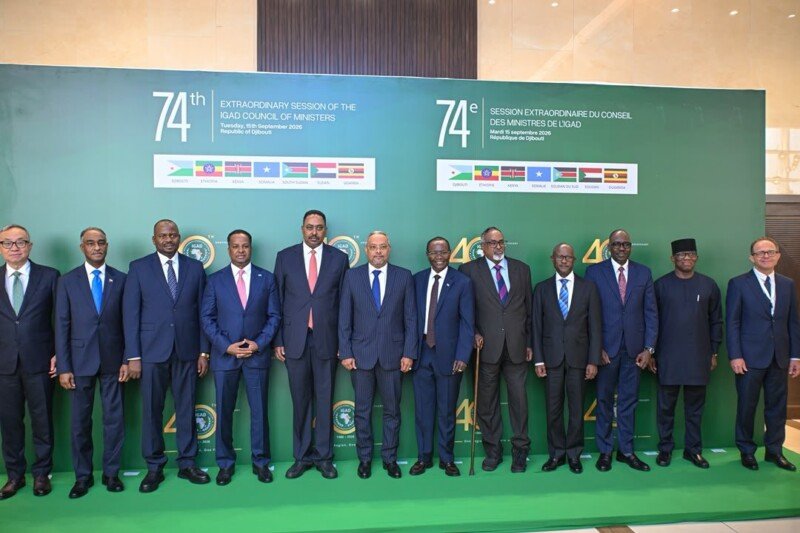
DJIBOUTI — Somalia’s Minister of Foreign Affairs and International Cooperation, Abdisalan Abdi Ali, has arrived in Djibouti to lead the Somali delegation at the 74th Extraordinary Session of the IGAD Council of Ministers, convening on September 15, 2026, to address pressing regional peace and security challenges.
The meeting brings together foreign ministers and designated representatives from IGAD member states to review current peace and security developments, assess ongoing regional efforts, and strengthen collective approaches towards stability and cooperation across the Horn of Africa.
According to the IGAD Secretariat, the Council will also discuss institutional matters, including issues related to the implementation and strengthening of the IGAD Treaty, in support of the Authority’s mandate and evolving regional priorities. The Council is expected to issue a communiqué outlining the outcomes and decisions of the meeting.
A Region Under Strain
The ministerial session comes as the Horn of Africa faces a convergence of crises. Sudan remains mired in a devastating civil war, South Sudan’s fragile peace process continues to face obstacles, and Somalia itself is navigating political tensions over federal member state elections and the ongoing fight against Al-Shabaab. The meeting also follows Eritrea’s withdrawal from the bloc and Somalia’s ratification of the revised IGAD Treaty in January 2026, a move that reached the two-thirds threshold required to operationalize the updated framework.
Somalia’s ratification of the revised treaty replaced the 1996 founding document with an updated legal structure for regional cooperation on peace, security, climate resilience, infrastructure, health, trade, and social development [citation:12]. IGAD Executive Secretary Workneh Gebeyehu described Somalia’s decision as demonstrating “decisive leadership” and reinforcing the bloc’s efforts to deepen regional integration.
The bloc has previously expressed readiness to collaborate with Somalis in the diaspora to develop their country, with Fathia Alwan, Director of IGAD’s Health and Social Development department, addressing the 10th International Conference of the Somali Diaspora on the potential of diaspora engagement.
IGAD has also historically advocated for civilian leadership in Khartoum, with Dr. Gebeyehu stating the organization’s interest in strengthening the capacity of security institutions and encouraging Somalis to build stronger institutions.
The bloc’s engagement with Somalia has been channeled through its representative office, with IGAD Representative Mohamud Kaarshe previously meeting with Sweden’s Ambassador to Somalia to discuss the organization’s crucial role in the region and enhance partnership on shared goals.
Critical Note
Somalia’s participation in this extraordinary session reflects the country’s continued commitment to regional multilateralism, even as it navigates complex bilateral relationships and internal political challenges. The ratification of the revised IGAD Treaty in January placed Somalia at the center of the bloc’s institutional renewal, giving Mogadishu a stake in shaping the organization’s future direction.
The regional context, however, is daunting. IGAD’s ability to mediate conflicts and promote stability has been tested by the war in Sudan, the fragile situation in South Sudan, and tensions between member states. The withdrawal of Eritrea has weakened the bloc’s representativeness. For Somalia, the value of IGAD lies in its potential to coordinate regional responses to shared threats, particularly Al-Shabaab and the resurgence of piracy. Yet the organization has historically struggled to translate communiqués into concrete action, and its capacity to influence events on the ground remains limited.
The Somali delegation has not publicly detailed its specific positions or proposals for the meeting. This absence of public diplomacy leaves room for uncertainty about Mogadishu’s priorities, whether they focus on security cooperation, institutional reform, or addressing political disputes with neighboring states. What is clear is that Somalia’s engagement with IGAD is part of a broader diplomatic strategy that includes the African Union, the United Nations, and the Arab League. Whether these engagements produce tangible benefits for Somali citizens remains the fundamental test.