I
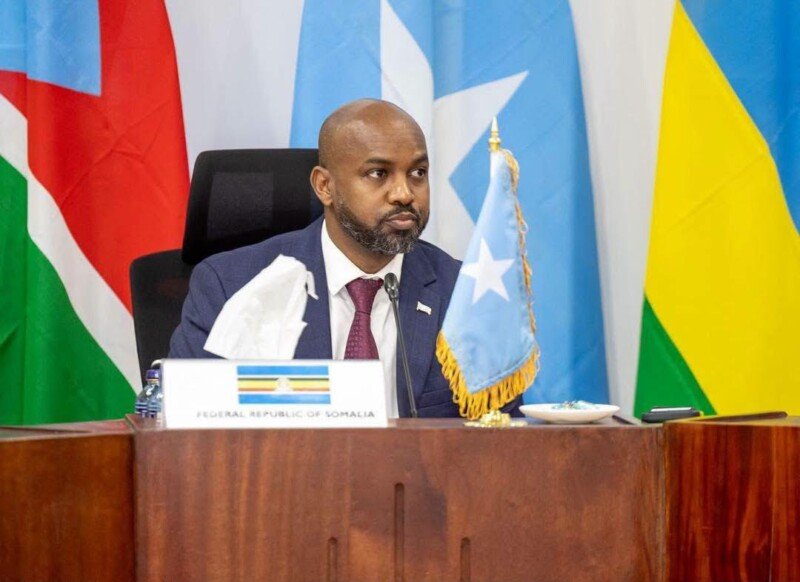
NAIROBI, Somalia assumed a visible leadership role in regional legislative cooperation this week, after the Secretary General of the House of the People, Abdirahman Mohamed Abdulle (Jaabiri), chaired a regional meeting of parliamentary secretaries in Nairobi, Kenya.
The meeting brought together the Secretaries General of the parliaments of member states of the East African Community, with discussions focused on developing cooperation between parliamentary administrations, accountability, and the efficiency of legislative institutions.
Participants reviewed the secretariat’s report and discussed measures to improve the functioning of parliaments and the administrative support provided to lawmakers. They also prepared recommendations to be submitted to the Assembly of Speakers of EAC member parliaments for consideration and assessment of how to strengthen legislative cooperation in the region.
A Regional Role Beyond Trade
The meeting reflects Somalia’s growing integration into East African institutions since joining the EAC in 2024. As reported in FTL Somalia’s coverage of Somalia’s EAC membership, the government has framed regional integration primarily as an economic opportunity for Somali traders and businesses, with a combined market of over 300 million people.
But the Nairobi meeting demonstrates that Somalia’s engagement with the EAC extends beyond trade and economics into governance, constitutional institutions, and legislative exchange. The Secretary General’s chairmanship of the regional forum signals that Mogadishu is seeking to play an active role in shaping the bloc’s parliamentary architecture, not merely to benefit from its market access provisions.
Somalia’s participation in EAC parliamentary affairs is particularly significant given the country’s own legislative challenges. The Federal Parliament has been at the center of the political crisis over constitutional amendments and the electoral timetable, as reported in FTL Somalia’s coverage of parliamentary proceedings. Engaging with regional counterparts on accountability, transparency, and administrative efficiency offers a channel for institutional learning that could inform domestic reform efforts.
The EAC’s Expanding Legislative Agenda
The EAC’s parliamentary dimension has grown in importance as the bloc has expanded. The East African Legislative Assembly, the EAC’s legislative arm, has been active in harmonizing laws across member states on trade, customs, and standards. The Assembly of Speakers and the Secretaries General forum provide the administrative and political backbone for that legislative work.
For Somalia, participation in these forums offers a platform to learn from peers with more established parliamentary systems. Kenya, Tanzania, Uganda, and Rwanda have decades of experience in parliamentary administration, committee systems, and oversight mechanisms. Somalia’s parliament, reconstituted after decades of conflict, can benefit from their expertise.
But the relationship is not one-sided. Somalia’s recent experience with direct elections at the federal member state level, in Galmudug and Hirshabelle, represents an experiment in democratization that other EAC members may find instructive, even as the process remains contested domestically.
Critical Note
The Nairobi meeting is a procedural engagement, not a political breakthrough. Parliamentary secretaries discuss administrative matters, not policy disputes. But the fact that a Somali official chaired a regional forum is a small signal that Somalia’s integration into the EAC is deepening beyond the rhetorical commitments of accession.
The more consequential question is whether Somalia’s parliament can translate the lessons of regional cooperation into domestic reform. The Federal Parliament has been criticized for its subordination to the executive, its failure to scrutinize major agreements with foreign partners, and its role in approving constitutional amendments that the opposition rejects. Engaging with regional counterparts on accountability and efficiency is worthwhile, but it will mean little if the parliament does not assert its independence at home.
Somalia’s EAC membership was sold primarily as an economic opportunity. The Nairobi meeting suggests that it is also a political and institutional one. Whether that potential is realized will depend on whether Somalia’s legislators and administrators are willing to apply what they learn from their regional peers to the challenges they face in Mogadishu.