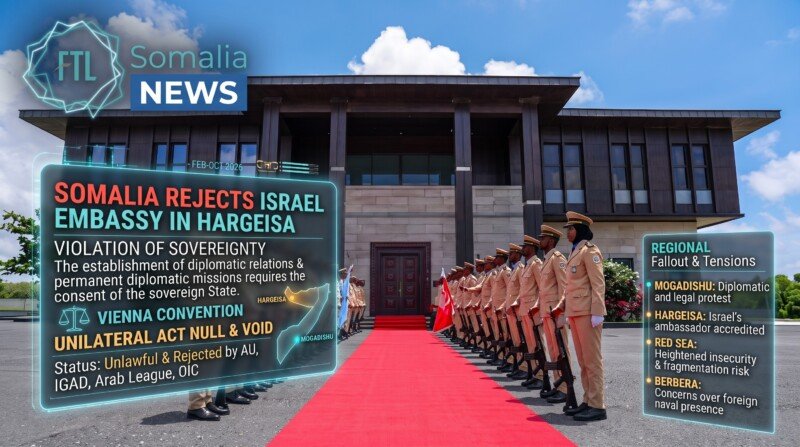
MOGADISHU, Somalia’s Ministry of Foreign Affairs and International Cooperation has condemned Israel’s accreditation of an ambassador in Hargeisa and the laying of a cornerstone for a “so-called embassy” on Somali territory, declaring the actions “null and void and without legal effect.”
In a press statement issued on November 3, the ministry said the move was undertaken without the consent of the Federal Government of Somalia and constituted a “flagrant violation of Somalia’s sovereignty, territorial integrity and unity.” It reiterated that Hargeisa and the Somaliland region remain “an integral and inseparable part of the Federal Republic of Somalia.”
The statement invokes the Vienna Convention on Diplomatic Relations, noting that the establishment of diplomatic relations and permanent diplomatic missions requires the consent of the sovereign State. “No unilateral act can circumvent that requirement or alter the status of Somali territory,” the ministry said.
The condemnation follows the credentials ceremony in Hargeisa last week, where Israel’s Ambassador to Somaliland, Michael Lotem, presented his papers to Somaliland President Abdirahman Mohamed Abdullahi, followed by the cornerstone-laying for a new Israeli embassy. The actions compound Israel’s unlawful recognition of December 2025, which Mogadishu noted has already been rejected by the African Union, IGAD, the League of Arab States, and the Organisation of Islamic Cooperation.
Red Sea Tensions and Diplomatic Fallout
The Somali statement situates the Israeli move within the broader security context of the Red Sea and the Gulf of Aden. At a time of heightened insecurity in the region, Mogadishu warned that “actions that encourage fragmentation and disregard internationally recognised borders risk deepening tensions across an already fragile region.”
Mogadishu demanded that Israel immediately reverse its measures and called on all states and international organizations to reject them and refrain from any engagement that would confer legitimacy upon them. The government also reserved the right to pursue all appropriate diplomatic, political, and legal measures under international law to defend the country’s sovereignty. As President Hassan Sheikh Mohamud has previously warned, Israel’s moves are seen in Mogadishu as part of a strategy to establish a naval base in Berbera, an “existential threat” to Somalia’s unity.
The statement is the latest in a series of condemnations from regional and international bodies. The Arab League, the African Union, and the OIC have all rejected the recognition. However, the diplomatic pushback has not altered the situation on the ground. Israel is the only UN member state to recognize Somaliland, and its embassy in Hargeisa is now a physical presence, as detailed in the formal recognition agreement of December 2025.
The Strategic Convergence
The fallout from the embassy opening extends beyond bilateral relations. Analysts have noted that Somaliland’s relationship with Israel is driven in part by a shared alignment with the UAE. Leaked Israeli security frameworks have designated Somaliland as “friendly,” and Hargeisa has sought Israeli air defense systems to counter Turkey’s military footprint in Somalia. Meanwhile, the UAE is building a military base at Berbera Airport, a project intended to serve U.S. and Israeli interests.
For Somalia, these developments present a dual challenge. The federal government is seeking to assert its sovereignty while managing a security transition as the African Union mission draws down. As the President drew a red line on foreign bases, the government’s ability to enforce its authority over Somaliland’s external relations is, in practice, highly limited.
Critical Note
The Somali government’s statement is clear, legally grounded, and diplomatically appropriate. It correctly cites the Vienna Convention, invokes the consensus of the African Union and the OIC, and demands that Israel reverse its actions. On the level of international law and diplomatic protocol, Mogadishu is on solid ground.
But the statement’s strength also reveals its limitation. It is a diplomatic protest, and it will not change the reality on the ground in Hargeisa. Israel has recognized Somaliland, opened an embassy, and appointed an ambassador. The African Union has condemned it. The Arab League has condemned it. The OIC has condemned it. And yet the embassy remains. The consensus that Mogadishu cites is a consensus of words, not of consequences.
The federal government is in an impossible position. It cannot compel Israel to withdraw its ambassador, and it cannot compel Somaliland to reject the recognition. It can only issue statements, file protests, and seek legal remedies that may take years to materialize. The statement says that “the unity of the Somali nation is not negotiable.” That is true as a matter of principle. But principles do not close embassies,.
Recommended Reading On ftlsomalia.com
- Israel Officially Recognizes Somaliland as Independent Sovereign State
- Somali President Accuses Israel of Seeking Berbera Base to Target Iran
- Somaliland and Puntland Designated as “Friendly” in Israeli Security Framework
- Hargeisa Wants Israel to Shield It From Turkish Drones and Warplanes
- “Not Under Any Circumstances”: Somalia’s President Draws a Red Line on Foreign Bases and Israeli Presence