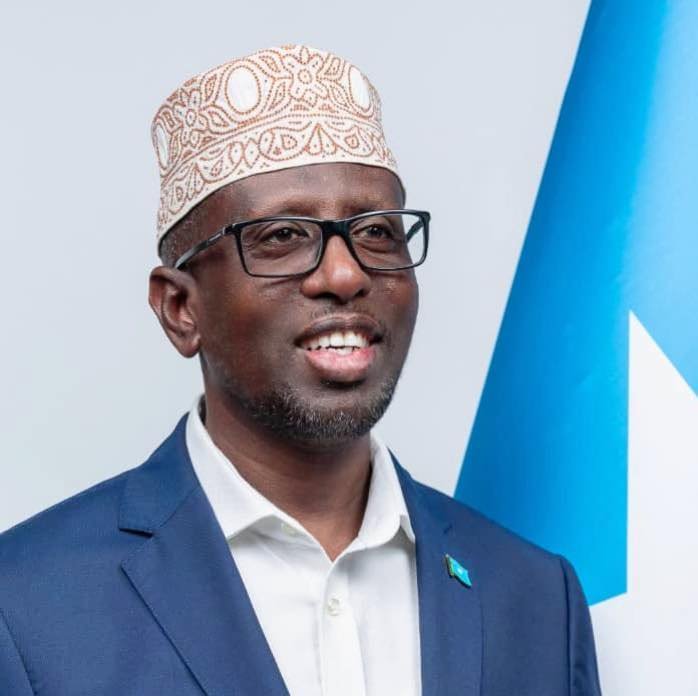


MOGADISHU — Somalia’s Minister of Defense, Ahmed Moallim Fiqi, has called on the Somali public to avoid actions and statements that could damage the strategic relationship between Somalia and Turkey, amid growing criticism and protests related to the role of Turkish forces in the country.
Minister Fiqi stated that the Turkish flag should not be burned, urging Somalis not to exploit political disputes or incidents to harm the relationship between Mogadishu and Ankara. His remarks came as anger and demonstrations erupted in parts of Somalia over allegations regarding the involvement of Turkish forces in military operations in the country.
The Minister did not directly addressed those allegations, but instead emphasized the importance of preserving the relationship between the two countries. Turkey has maintained close ties with Somalia for over a decade, playing a major role in training Somali forces and providing military support.
Growing Turkish Military Presence
Turkey’s military engagement with Somalia has expanded significantly in recent years, encompassing the training of thousands of Somali soldiers, the provision of advanced weaponry, and the establishment of institutional frameworks for long-term capacity building. President Hassan Sheikh Mohamud recently visited the Gorgor General Command, where the 21st Brigade was handed a new batch of armored vehicles and other heavy military equipment provided by Turkey.
The TURKSOM Military Academy in Mogadishu, established in 2017 with Turkish support, has trained thousands of Somali soldiers and officers. Turkish-made BMC Kirpi mine-resistant armored vehicles have been delivered to Mogadishu Port as part of Ankara’s ongoing support to Somalia’s security forces.
Turkish F-16 fighter jets and attack helicopters have conducted aerial demonstrations over Mogadishu, highlighting Turkey’s ongoing commitment to arming and training Somali security personnel.
Political Tensions and Opposition Concerns
The Turkish military presence has become a contentious political issue in Somalia. In May 2026, Turkey deployed F-16 fighter jets over Mogadishu, coinciding with the start of planned opposition demonstrations. The low-altitude flights and the overnight positioning of dozens of Turkish-supplied armored vehicles at major Mogadishu intersections marked one of Ankara’s most overt shows of support for President Hassan Sheikh Mohamud, claim members of the political opposition.
Eyewitnesses reported heavily armed security personnel deployed at critical thoroughfares, official buildings, and strategic crossroads throughout the city. Security forces also encircled the homes of opposition leaders with military vehicles and hundreds of personnel. The conspicuous military buildup was widely interpreted as a message to opposition figures who had called for protests against alleged state-orchestrated land confiscations and what they describe as growing authoritarian practices in the capital.
Critical Note
Minister Fiqi’s call to protect the Somalia-Turkey relationship reflects the delicate position of a government that relies heavily on Turkish military support while facing growing domestic criticism over that very dependence. The warning against burning the Turkish flag is a clear acknowledgment that members of the opposition found a soft spot.
The challenge for Mogadishu is that Turkey’s military support, while valuable, has become increasingly politicized. The F-16 flyovers and armored vehicle deployments during opposition protests suggest that Turkish assets are being used not only against Al-Shabaab but also as instruments of political intimidation. This blurring of lines between counterterrorism and internal political control risks undermining the legitimacy of both the Somali government and its Turkish partners.
For Somalia, the question is not whether Turkey is a valuable security partner, but whether that partnership can be conducted in a way that serves the nation’s long-term interests without deepening political divisions. The government must ensure that its military cooperation with Turkey is transparent, accountable, and focused on the shared threat of Al-Shabaab, rather than becoming a tool for domestic political advantage.