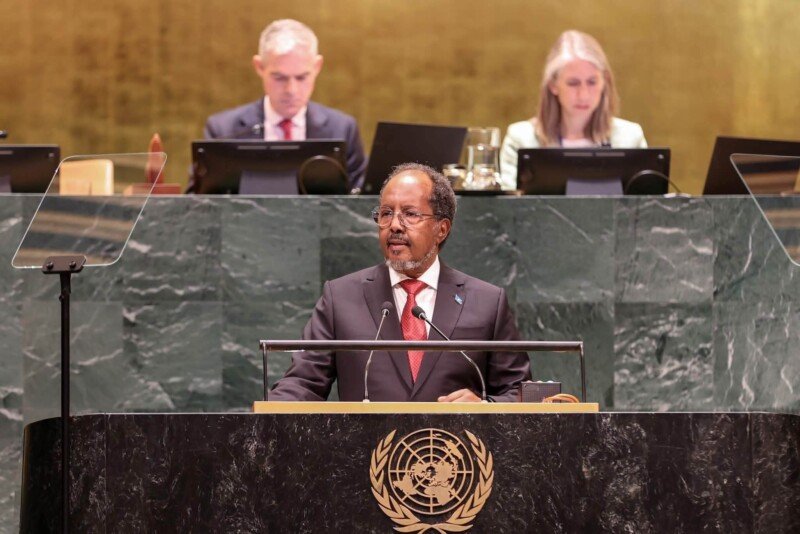
NEW YORK — President Hassan Sheikh Mohamud has called for sweeping reform of the United Nations Security Council, declaring that Africa can no longer remain unrepresented in the body that decides matters of war and peace.
Addressing the 81st session of the UN General Assembly, President Mohamud said the Council “must become more representative, transparent and effective,” and described Africa’s exclusion from permanent membership as a “historical injustice” affecting 54 sovereign states.
“Africa remains unrepresented in the permanent category,” he said. “This historical injustice against 54 sovereign states can’t be postponed indefinitely. Somalia supports the common African position and meaningful representation in both categories of the council.”
President Mohamud emphasized that African countries have the right to full representation on equal par with all other permanent Security Council members, given that many of the Council’s discussions directly concern African states.
The Ezulwini Consensus
Somalia’s position aligns with the African Union’s long-standing demand, known as the Ezulwini Consensus, which calls for at least two permanent seats for Africa with all the privileges of existing permanent members, including veto power if it is maintained, and five non-permanent seats in an enlarged Council.
The Security Council currently comprises 15 members. Five permanent members, the United States, United Kingdom, France, China and Russia, hold veto power. Ten non-permanent members are elected by the General Assembly for two-year terms. Africa holds three of those non-permanent seats but has never had a permanent representative.
Kenyan President William Ruto, who also addressed the Assembly, highlighted the contradiction at the heart of the current system. “Every nation is sovereign and equal under the UN charter. Yet, on the gravest question of war and peace, five nations possess a permanent power that the other 188 do not,” he said.
UN Chief Backs Reform
UN Secretary-General António Guterres reiterated his call for reform, stating that it is “unjust and indefensible” for Africa to lack permanent representation in the 21st century.
“Reform is not an attack on the United Nations,” President Mohamud added. “Reform is necessary to protect its legitimacy, renew confidence in its institutions and ensure that it remains capable of responding to the realities of our time.”
Somalia currently holds a non-permanent seat on the Security Council and is also a member of the African Union Peace and Security Council. As reported in FTL Somalia’s coverage of Somalia’s Security Council presidency, the country assumed the rotating presidency of the Council for January 2026, a historic milestone in its diplomatic recovery.
Support for Palestine
President Mohamud also reaffirmed Somalia’s support for Palestinian self-determination and an independent Palestinian state based on the 1967 borders, saying a two-state solution remained essential to lasting peace in the Middle East.
“Somalia stands firmly with the Palestinian people and their lawful rights to self-determination and statehood,” he added.
Sovereignty and Economic Concerns
The President reaffirmed Somalia’s commitment to protecting its sovereignty, unity, territorial integrity and internationally recognized borders, stating that disputes between nations should be resolved through dialogue and in accordance with international law, not through unilateral actions that create new tensions. As reported in FTL Somalia’s coverage of Somalia’s rejection of unilateral actions, Mogadishu has consistently opposed moves that undermine its territorial integrity.
He also raised concerns about the economic impact of instability around the Strait of Hormuz, saying Somalia’s dependence on imported food and fuel left the country particularly exposed. Disruption in the waterway had contributed to higher prices and an estimated 40 percent fall in customs revenue, he said. As reported in FTL Somalia’s coverage of the economic impact, fuel prices more than doubled in the first quarter of 2026, contributing to inflation projected at 5.9 percent for the year.
Critical Note
President Mohamud’s call for Security Council reform is both principled and strategically calculated. As a non-permanent member, Somalia has used its platform to amplify a demand that has been voiced by African states for more than two decades. The Ezulwini Consensus, adopted in 2005, set out Africa’s position clearly. Yet the reform remains blocked by a simple arithmetic: any amendment to the UN Charter requires the consent of all five permanent members.
The United States has expressed support for two permanent African seats, but only under the previous administration. The Trump administration has not reaffirmed that position. France has been supportive in principle. The other three permanent members have offered no clear endorsement. Principle, as one analysis noted, is not a draft article.
Africa’s own position contains a second difficulty: the Union says the seats belong to Africa, not to a named capital. Nigeria, South Africa, Egypt, Algeria and Kenya have all been discussed as possible occupants. Choosing among them would reopen regional rivalries, which is why the African Union insists on securing the seats first and assigning them later.
For Somalia, the call for reform carries an additional dimension. As a country that has been the subject of numerous Security Council resolutions, and which continues to depend on international security support, Somalia has a direct stake in how the Council operates. Its advocacy for reform aligns it with the broader African position and positions Mogadishu as a voice for the continent, not merely a recipient of international attention.
Whether the call produces tangible movement remains doubtful. The intergovernmental negotiations have been ongoing since 2009 with little to show. But the symbolic value of Somalia, a country rebuilding from decades of conflict, demanding a more representative global order is not insignificant. It reinforces Mogadishu’s claim to be a responsible international actor and a legitimate voice for African interests.