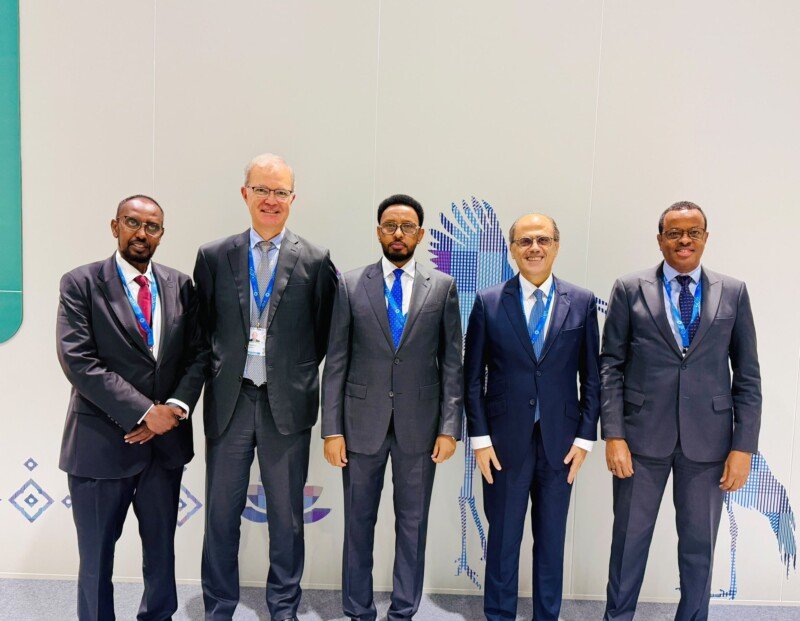
MOGADISHU — Somalia’s Minister of Finance, Bihi Iman Egeh, met with senior International Monetary Fund officials in Bangkok on the first day of the IMF-World Bank Group Annual Meetings, holding discussions with Dr. Mohamed Maait, Somalia’s Executive Director at the IMF, and Jihad Azour, Director of the Middle East and Central Asia Department.
The meeting, which Egeh described as “a pleasure,” focused on Somalia’s ongoing reform program, fiscal consolidation efforts, and strategies to respond to the severe external shocks facing the country. “We discussed the successful ongoing IMF program implementation, deepening fiscal reforms, enhancing public financial management and strategies to respond to the severe external shocks we are facing,” Egeh said in a post on X. “I am grateful for the strong support and partnership Somalia enjoys with the IMF.”
The Annual Meetings, held at the Queen Sirikit National Convention Center in Bangkok from 12 to 18 October, bring together central bankers, finance ministers, private sector executives, and representatives of civil society to discuss the global economic outlook, financial stability, and development financing[citation:3].
Economic Challenges Mounting
The discussions come at a critical juncture for Somalia’s economy. As reported in FTL Somalia’s coverage of the IMF Article IV consultation, the Fund has cut Somalia’s 2026 economic growth forecast to 2.3 percent, down from earlier projections of 2.6 percent, citing sharp foreign aid cuts, severe climate shocks, and spillovers from the Middle East conflict[citation:4].
The IMF noted that these challenges “have weighed on economic activity, raised inflation and food insecurity, pressured public finances, and dampened the near-term outlook.” Inflation is projected to reach 6.5 percent in 2026, driven by drought conditions and global trade disruptions that more than doubled domestic fuel prices earlier this year[citation:4].
The World Bank’s Somalia Economic Update, published in May 2026, similarly projected growth at 2.8 percent for 2026, noting that declining foreign aid, prolonged drought, and rising living costs had slowed the economy from approximately 4 percent growth in 2023-24[citation:5].
Reform Progress and Debt Relief
Despite these headwinds, Somalia has made significant progress on its reform agenda. In March 2026, the IMF completed discussions with Somali authorities in Nairobi and reached a staff-level agreement on the fifth review under the Extended Credit Facility arrangement, which unlocked a further $9.4 million in disbursements[citation:1].
More significantly, Somalia secured a $4.5 billion debt write-off from global lenders in July 2026, reducing its external debt from a high of $5.2 billion to approximately $600 million[citation:8]. The debt relief, under the Heavily Indebted Poor Countries initiative, has reduced Somalia’s external debt to below 6 percent of GDP, from 64 percent in 2018.
Somalia’s engagement with the IMF has been pivotal in anchoring its post-debt relief recovery efforts. The ECF program focuses on strengthening domestic revenue mobilization, improving public finance management, enhancing central bank operations, and developing a stable financial sector[citation:11].
Currency Reform and Financial Sector Development
The Central Bank of Somalia continues to advance its currency reform agenda. As reported in FTL Somalia’s coverage of the currency reform, Somalia is preparing to reintroduce the Somali shilling after 35 years without new domestic banknotes, with the new currency to be backed by a Currency Board Arrangement[citation:6].
Governor Abdirahman Mohamed Abdullahi has stated that “we cannot have a monetary policy without reintroducing the Somali Shilling,” and the Central Bank has made issuing a viable national currency one of its strategic priorities[citation:6]. The IMF has advised Somalia to exercise extreme due diligence in the rollout, emphasizing the need for strong institutional prerequisites before launch[citation:9].
The financial sector has also expanded. As reported in FTL Somalia’s coverage of banking sector development, the Central Bank has authorized 15 commercial banks to operate in the country, comprising 14 domestic institutions and one foreign bank[citation:13]. The banking sector’s total assets increased to $2.3 billion in 2025, equivalent to 20 percent of GDP[citation:12].
Critical Note
Somalia’s engagement with the IMF at the Bangkok Annual Meetings reflects a relationship that has matured significantly over the past decade. The completion of the HIPC debt relief process in 2026 was a landmark achievement, and the ongoing ECF program provides a framework for continued reform. The Finance Minister’s discussions with IMF leadership signal that Somalia remains engaged with its international partners despite mounting economic pressures.
However, the IMF’s downward revision of Somalia’s growth forecast to 2.3 percent should serve as a sobering reminder that reform progress does not automatically translate into economic resilience. The combination of aid cuts, climate shocks, and regional instability has created a challenging environment that requires sustained international support and domestic policy discipline.
The currency reform, while necessary for restoring monetary sovereignty, carries significant risks. The IMF’s caution about due diligence is well-founded. A currency board arrangement requires full foreign reserve backing, strict fiscal discipline, and public confidence. If launched prematurely or without adequate safeguards, it could undermine rather than strengthen Somalia’s financial stability.
For Somalia, the path ahead requires balancing immediate crisis response with long-term institution-building. The debt relief has opened space for concessional financing, but the country must use that space wisely to build the productive capacity and governance systems that will sustain growth beyond aid. The IMF meetings provide a platform for dialogue, but the real work happens at home.
Share your story. FTL Somalia is continuing to investigate Somalia’s economic reform program and its engagement with international financial institutions. If you have information or insights to share, contact us at info@ftlsomalia.com. Your identity will be protected.
Recommended Reading On ftlsomalia.com
- IMF: Somalia’s Growth to Slow to 2.3% Amid Aid Cuts and Drought
- Somalia’s Currency Reform: New Shilling to Be Backed by Currency Board Arrangement
- Central Bank Grants 15 Banking Licenses
- World Bank: Only 21% of Somali Households Receive More Than Eight Hours of Electricity Daily
- Somalia Secures IMF Staff-Level Agreement, Pledges Stronger Push for Economic Stability
- Finance Minister and World Bank Push Back on Former PM’s Economic Claims