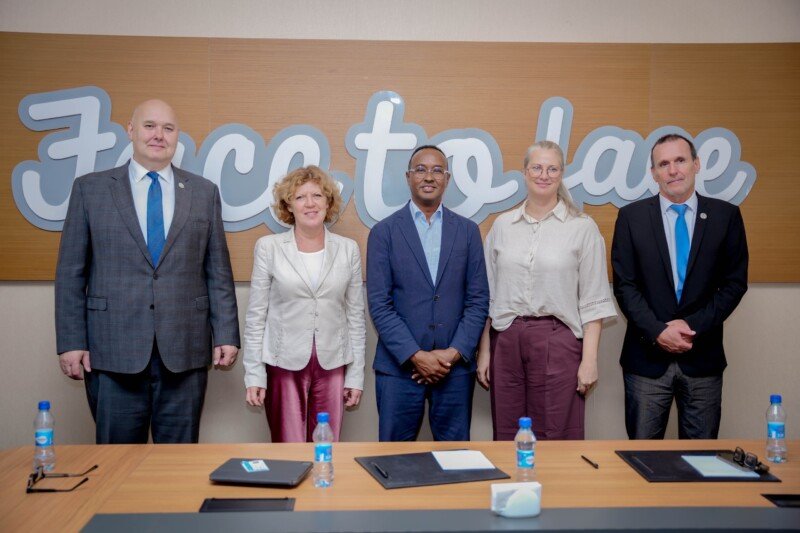
MOGADISHU, The Commissioner of the Somali Disaster Management Agency (SoDMA), Mohamud Moallim Abdulle, met with senior officials from the UN Food and Agriculture Organization (FAO) and representatives of the Norwegian government on Monday to strengthen coordination on El Niño preparedness, early warning systems, and emergency response.
According to a statement from the agency, the meeting brought together Rein Paulsen, FAO’s Director of Emergency and Resilience, Etienne Peterschmitt, FAO’s Representative in Somalia, and Norwegian government representatives. Discussions focused on linking early warning systems to coordinated early action to save lives, protect livelihoods, and reduce the impact of potential floods and other El Niño-related hazards.
The participants also stressed the need to mobilise financial resources and secure additional support for ongoing humanitarian needs, while calling for long-term investment in disaster preparedness, risk reduction, and community resilience.
A Race Against the Deyr Season
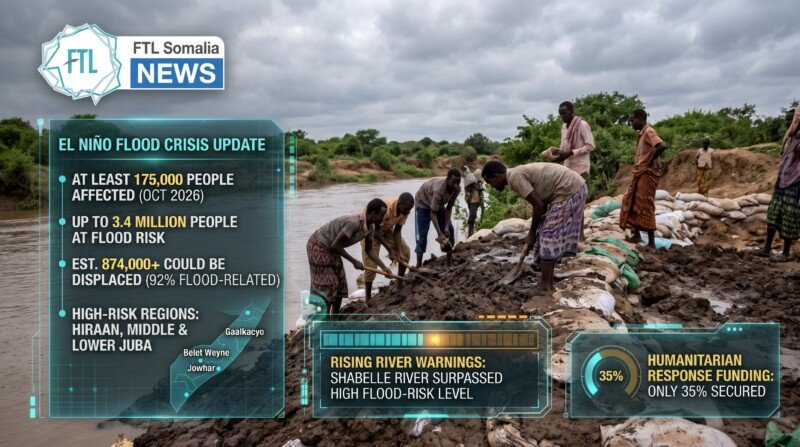
The meeting comes as Somalia enters the October-December Deyr rainy season under a high-risk climate scenario. Forecasts indicate a credible risk of severe flooding in the Jubba and Shabelle river corridors if El Niño strengthens alongside a positive Indian Ocean Dipole, a combination that has historically produced exceptional rainfall and widespread flooding, including in 1997 and 2023. SoDMA has already placed 29 districts across 14 regions on high alert for riverine and flash flooding, as reported in FTL Somalia’s coverage of the national preparedness warning.
The river levels are already responding. As reported in FTL Somalia’s coverage of the Shabelle River, water levels at Jowhar rose by 2.22 metres in a single week, approaching the moderate flood-risk threshold. The UN Office for the Coordination of Humanitarian Affairs has warned that projected El Niño rains and severe flooding could affect up to 3.4 million people across 16 regions.
The Funding Gap
Despite the urgency, the international response remains underfunded. In June, FAO and the World Food Programme requested $202 million to support anticipatory action in 22 high-risk countries, including Somalia. By late September, they had received only about $40 million, roughly one-fifth of the target.
Rein Paulsen, the FAO official who attended Monday’s meeting, told AFP that “funding is a very real challenge that’s limiting our ability to do what we know can mitigate and minimise the impact of either flooding or droughts.” He noted that early action avoids the need for a far more expensive humanitarian response if the full disaster unfolds.
Norway has been one of the few donors to step forward, allocating NOK 30 million (approximately $2.8 million) from its humanitarian reserve to support the FAO-WFP joint appeal for anticipatory action in high-risk countries, including Somalia. SoDMA has maintained a consistent partnership with Norway on disaster preparedness, including a high-level meeting in March 2026 with Norway’s Ministry of Foreign Affairs to address drought response and humanitarian support, as reported in FTL Somalia’s coverage of the earlier Norwegian delegation.
The funding gap is compounded by broader humanitarian constraints. The World Food Programme has warned that it will assist fewer than 5 percent of Somalis facing emergency hunger starting in October, down from more than four million people per month during the 2022-2023 drought response. As reported in FTL Somalia’s coverage of the WFP warning, communities devastated by the 2023 floods are once again bracing for El Niño with depleted coping mechanisms.
From Warnings to Action
Commissioner Abdulle reaffirmed SoDMA’s commitment to leading the government’s disaster risk management efforts and strengthening coordination with international organisations and partners to ensure timely humanitarian assistance.
The agency has taken institutional steps in recent months. In September 2026, SoDMA signed a two-year cooperation agreement with the WFP covering risk forecasting, preparedness, early warning systems, and anticipatory action, as reported in FTL Somalia’s coverage of the agreement. The government also approved a National El Niño Preparedness Plan in September, consolidating efforts across federal institutions, Federal Member States, and local authorities, as detailed in FTL Somalia’s coverage of the plan’s approval.
But the challenge extends beyond coordination meetings. A report published by WardheerNews on the same day as the SoDMA-FAO talks noted that recent floods in Galkacyo exposed the failure of disaster preparedness, despite months of warnings and national simulation exercises. The gap between early warning and early action, the report argued, remains the central weakness in Somalia’s disaster response architecture.
Critical Note
The meeting between SoDMA, the FAO, and Norwegian representatives is a necessary coordination exercise, and the participants articulated the right priorities: linking warnings to action, mobilising resources, and investing in resilience. But the gap between the rhetoric of preparedness and the reality of implementation is the central problem, and it is not clear that this meeting closed it.
The numbers tell a sobering story. FAO and WFP asked for $202 million to prepare 22 high-risk countries for El Niño. They received $40 million. Norway’s contribution is welcome but marginal against the scale of the need. Somalia alone has 5.4 million people acutely food insecure and 1.6 million displaced, according to the latest IPC analysis. The Deyr rains are already falling. The window for anticipatory action, which must be taken before floods peak to be effective, is narrowing by the day.
The Galkacyo floods are a warning that coordination meetings do not necessarily translate into timely action on the ground. SoDMA has conducted simulation exercises and convened national preparedness forums. It has engaged with the FAO, WFP, and donors. It has signed agreements and approved plans. But when the water arrived, the response was found wanting. The question for Commissioner Abdulle and his partners is whether this Deyr season will be different, or whether Somalia will once again document its warnings and then suffer the consequences.
Share your story. FTL Somalia is continuing to follow El Niño preparedness and the humanitarian response across the country. If you have information or insights to share, contact us at info@ftlsomalia.com. Your identity will be protected.
Recommended Reading On ftlsomalia.com
- SoDMA Urges 29 Districts Across 14 Regions to Prepare for Super El Niño Flooding
- Shabelle River Nears Flood Alert Level at Jowhar as El Niño Rains Intensify
- SoDMA and WFP Sign Two-Year Deal to Strengthen Somalia’s Disaster Preparedness
- Deputy PM Chairs Ministerial Meeting as Government Approves National El Niño Preparedness Plan
- Somalis Displaced by 2023 Floods Face New Threat as El Niño Looms, WFP Says
- Somali Disaster Official Welcomes Norwegian Delegation