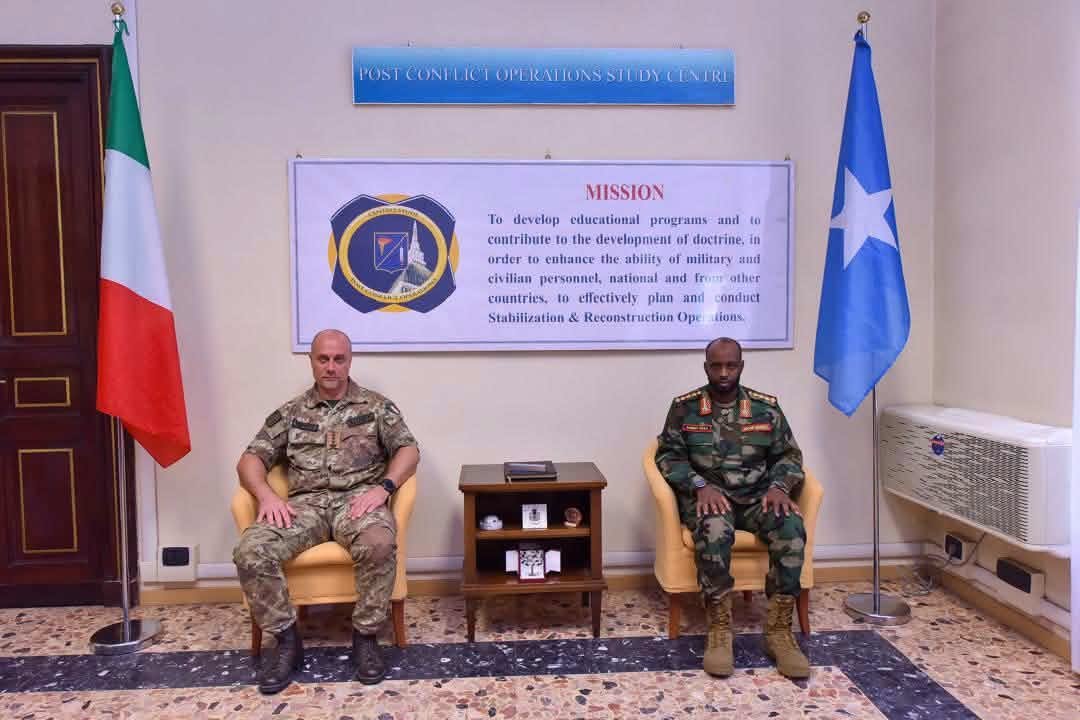
ROME, The Commander of the Somali National Army’s Training and Doctrine Command, Major General Ahmed Isse Ahmed, led a delegation to Italy this week for talks aimed at expanding military training cooperation and deepening the defense partnership between Rome and Mogadishu.
General Ahmed visited Italy’s Training and Doctrine Command headquarters in Turin, the Italian Special Forces School, and other training and educational facilities under the Italian command. He held meetings with his Italian counterparts to discuss strengthening cooperation in training, improving the knowledge and skills of Somali forces, and expanding Italy’s support for the Somali National Army.
The visit is the latest in a series of high-level engagements between Somali and Italian defense officials in 2026. In July, the Commander of Somalia’s Special Forces, Adam Mohamed Omar, met with the Commander of the Italian Special Operations Command, Admiral Paolo Pezzutti, in Rome to discuss advanced training and capacity building for Somali special operations units. In May, Somali Infantry Commander General Sahal Abdullahi Omar hosted an Italian military delegation in Mogadishu to discuss tactical support and training for ground troops, as reported in FTL Somalia’s coverage of the earlier defense talks.
Italy’s Deepening Role in Somalia’s Security Sector
Italy has been one of Somalia’s most consistent security partners, both bilaterally and through the European Union. In September 2026, Defence Minister Ahmed Moallim Fiqi met with a senior Italian delegation led by General Giovanni Maria Iannucci, Commander of Italy’s Joint Operations Command, to discuss expanding security and defense cooperation, as reported in FTL Somalia’s coverage of the meeting. General Iannucci’s visit to Mogadishu was part of a broader regional mission that also included Djibouti and Saudi Arabia, with Italian officials emphasizing that Red Sea security directly affects Italy’s national interests.
Italy is the largest contributor to the EU Training Mission in Somalia (EUTM Somalia), with approximately 150 military personnel deployed. The mission, which has operated since 2010, provides training, mentoring, and advisory support to Somali defense institutions. In October 2026, Italian Brigadier General Ivan Falasca took command of EUTM Somalia, succeeding Brigadier General Elio Manes.
Beyond EUTM, Italy leads the Bilateral Training Mission for Somali and Djiboutian Police Forces (MIADIT Somalia), implemented by the Carabinieri. The mission, which resumed activities in September 2026, focuses on building the capacity of Somali police forces in security and territorial control.
Italy’s engagement has also extended to formal agreements. In July 2026, Somali Internal Security Minister Abdullahi Sheikh Ismail (Fartaag) and Italian Interior Minister Matteo Piantedosi signed a Memorandum of Understanding on police development, counter-terrorism, and border management, as reported in FTL Somalia’s coverage of the agreement.
The Strategic Context
Italy’s defense engagement in Somalia is driven by both historical ties and contemporary strategic interests. The stability of the Horn of Africa and the safety of navigation in the Red Sea directly impact Italy’s security and economic interests. General Iannucci stated during his September visit that “defending free navigation here is equivalent to defending Italy.”
The training relationship has also extended to specialized units. Italy’s Col Moschin special forces regiment has previously trained Somali bodyguard units in Livorno, and Italian officials have discussed establishing a national military training and advisory mission in Mogadishu. The Somali Army Chief, Brigadier General Ibrahim Mohamed Mahmoud, met with Italy’s Defense Attaché, Captain Antonino Mazzocca, in February 2026, with Italy reaffirming its commitment to training and equipment support, as reported in FTL Somalia’s coverage of the meeting.
Critical Note
Italy’s commitment to Somali military training is substantial and sustained, and the frequency of high-level consultations reflects a genuine partnership. The Italian model, combining bilateral training, EU mission leadership, and police capacity-building through the Carabinieri, is more comprehensive than that of most other partners.
But the visit also highlights a persistent question: how much of this training translates into lasting operational capability. Italy has trained Somali forces for over a decade through EUTM, yet the Somali National Army remains dependent on external support for logistics, pay, and specialized capabilities. The Training and Doctrine Command, which General Ahmed heads, is the institution responsible for converting foreign training into a self-sustaining system. Its ability to do so depends on resources and institutional stability that the Somali government has struggled to provide.
Italy’s engagement also carries a geopolitical dimension. As Rome deepens its role alongside Türkiye, Egypt, and other partners, the coordination among these external actors becomes critical. Fragmented training programmes with different doctrines and standards can create parallel systems rather than a unified force. The challenge for Somalia is to manage these partnerships in a way that builds a coherent national army, not a patchwork of externally trained units. General Ahmed’s visit to Turin is a step in that direction. Whether it produces results will depend on what happens after the delegation returns to Mogadishu.
Recommended Reading On ftlsomalia.com
- Defence Minister Fiqi Meets Italian Military Delegation Led by Gen. Iannucci
- Somali Army Chief Welcomes Italian Military Team for Defense Talks
- Somali Army Commander Holds Talks with Italian Defense Attaché to Boost Military Ties
- Somalia and Italy Deepen Security Ties with New MoU on Police Development and Border Management