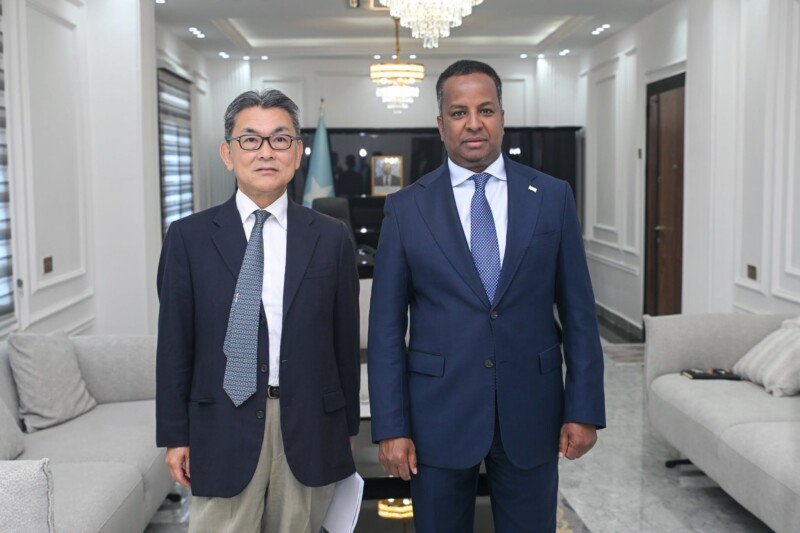
MOGADISHU, Somalia’s Minister of Foreign Affairs and International Cooperation, Abdisalam Abdi Ali, received Japan’s Ambassador to Kenya and non-resident Ambassador to Somalia, Matsuura Hiroshi, at the ministry headquarters on Tuesday to discuss expanding bilateral cooperation between the two countries.
According to a statement from the Somali National News Agency (SONNA), the meeting focused on strengthening the long-standing friendship between Somalia and Japan and exploring avenues for broader collaboration in areas of mutual interest, including peace, stability, and development.
A Partnership Spanning Security, Livelihoods, and Governance
Japan’s engagement in Somalia extends well beyond diplomatic courtesy. In May 2026, Japan funded a police instructor training program at the General Kaahiye Police Training School in Mogadishu, implemented in partnership with the African Union Support and Stabilization Mission in Somalia (AUSSOM). Tokyo has also donated equipment to the Somali Police Force’s Mine Action Unit and supported training for female officers in explosive ordnance disposal, as reported in FTL Somalia’s coverage of Japan’s security sector support.
On the economic front, Japan has been a significant contributor to Somalia’s blue economy ambitions. In late 2025, Japan, Somalia, and the UN’s Food and Agriculture Organization launched a two-year, $2 million project to revitalize the fisheries sector, focusing on sustainable management, job creation, and food security. The agreement was signed by Ambassador Hiroshi Matsuura and FAO Somalia Representative Etienne Peterschmitt, as reported in FTL Somalia’s coverage of the fisheries partnership.
The initiative aimed to modernize fish processing and storage facilities, train local fishermen in sustainable practices, and enhance value chains for coastal communities. A subsequent launch ceremony in December 2025, attended by Deputy Minister of Fisheries Ali Ifiye Ali, underscored the project’s focus on combating illegal fishing and strengthening marine resource management, as detailed in FTL Somalia’s coverage of the fisheries modernization launch.
Japan has also supported Somali women and girls through the LEAP project, implemented by UN Women, which reached more than 440 women with leadership training, protection services, and livelihood opportunities. The program, funded by Tokyo, has helped women transition from reliance on aid to running small businesses and leading local protection committees, as reported in FTL Somalia’s coverage of the LEAP initiative.
Debt Relief and Diplomatic Expansion
Japan’s relationship with Somalia has also been shaped by debt relief and diplomatic engagement. In November 2024, Somalia’s Finance Minister Bihi Egeh and Japan’s Deputy Head of Mission Ogihara Hiroshi signed an agreement finalizing Somalia’s debt relief process, building on the Paris Club accord that canceled much of the country’s debt, as reported in FTL Somalia’s coverage of the debt relief agreement.
Diplomatically, Somalia has sought to expand its footprint in East Asia. In August 2025, Somalia’s Ambassador to China, Dr. Hodan Osman, presented her credentials to Japan as a non-resident ambassador, a move officials described as a milestone in broadening partnerships with one of the world’s largest economies, as reported in FTL Somalia’s coverage of the accreditation.
Critical Note
Tuesday’s meeting between Minister Abdisalam and Ambassador Hiroshi is a routine diplomatic engagement, but it reflects a relationship that has quietly become one of Somalia’s more substantive partnerships in Asia. Japan’s contributions span security training, fisheries development, women’s empowerment, and debt relief, a breadth that few other bilateral partners can match.
What is notable about Japan’s approach is its emphasis on implementation through multilateral channels. The fisheries project is implemented with the FAO. The police training is conducted with AUSSOM. The women’s empowerment program runs through UN Women. This model allows Japan to contribute to Somalia’s development while minimizing its direct footprint and security exposure, a pragmatic approach for a country whose constitution limits overseas military engagement.
The challenge, as with all donor partnerships in Somalia, is sustainability. The fisheries project is a two-year initiative. The police training is a discrete program. The LEAP project reaches hundreds of women, not thousands. These are meaningful interventions, but they are not transformative at scale. Japan’s value to Somalia lies less in the volume of its assistance than in the reliability of its engagement and the technical quality of its support. Whether that support expands or remains at its current level will depend on factors beyond Mogadishu’s control, including Japan’s own budgetary priorities and the trajectory of Somalia’s political stability.
Recommended Reading On ftlsomalia.com
- Japan and UN Join Forces to Revitalize Somalia’s Fisheries Sector
- Japan-Funded Police Instructor Training Program Launched in Mogadishu
- Japan-Backed Initiative Transforms Lives of Somali Women and Girls
- Somalia and Japan Sign a Debt Relief Agreement
- Somalia Expands Diplomatic Footprint as Envoy to China Accredited in Japan