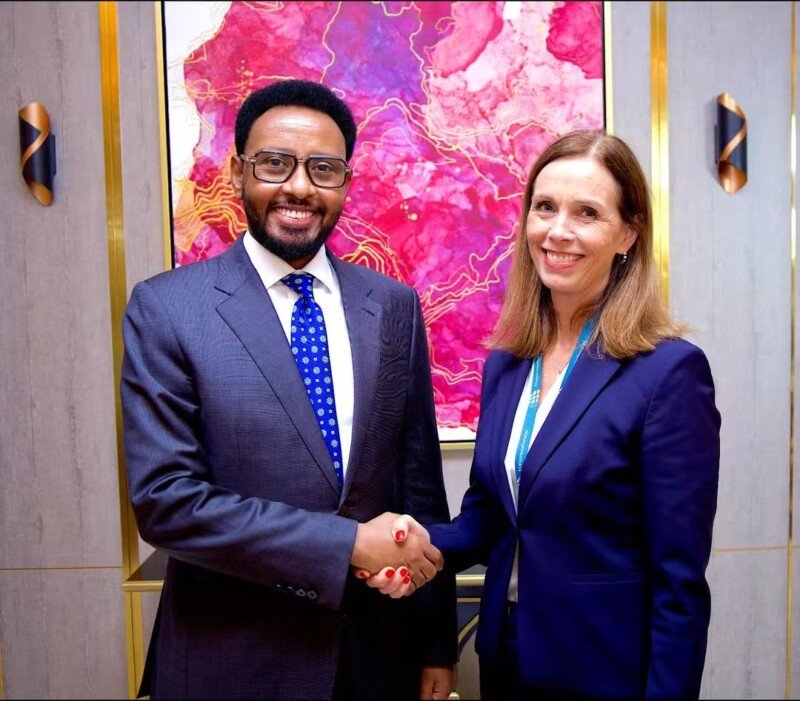
MOGADISHU — Somalia’s Finance Minister, Bihi Iman Egeh, met with Norway’s Ambassador to Somalia, Kenya and Seychelles, Siv Cathrine Moe, and senior embassy officials in Mogadishu on Friday to discuss strengthening economic cooperation and accelerating key financial reforms.
The talks focused on efforts to support Somalia’s economic development and reforms aimed at strengthening the country’s financial system, according to a statement from the Somali Ministry of Finance. The two sides also discussed ways to expand development cooperation, with particular attention to sustainable economic growth and development initiatives.
The meeting forms part of ongoing cooperation between Mogadishu and Oslo on economic development and efforts to strengthen Somalia’s public financial management systems. No new agreement or specific financial commitment was announced following the meeting.
A Longstanding Partnership
Norway has been a consistent partner in Somalia’s state-building and development efforts, providing support across multiple sectors including governance, humanitarian assistance, and peacebuilding. The meeting between Minister Egeh and Ambassador Moe reflects the continued engagement between the two countries.
As reported in FTL Somalia’s coverage of Somalia-Norway relations, Foreign Minister Abdisalam Abdi Ali held a bilateral meeting with Einar Rystad, the Special Envoy of the Norwegian Government to Somalia, in August 2026, focusing on advancing political and diplomatic cooperation.
Norway’s support has extended to Somalia’s debt relief process, with Somali officials expressing gratitude for Norway’s role in assisting the country’s exit from the list of heavily indebted poor countries in late 2023. Deputy Prime Minister Salah Ahmed Jama also held a high-level meeting with Norwegian Ambassador Gunnar Holm in July 2025 to strengthen the bilateral partnership, as detailed in FTL Somalia’s coverage of the development talks.
Norway has also provided significant humanitarian support. In October 2025, the Norwegian government announced a contribution of NOK 45 million (approximately US$4.5 million) to the Somalia Joint Fund’s Human Rights and Gender Window, as detailed in the United Nations in Somalia. The funding is intended to strengthen national and local capacities for accountability, access to justice, and gender-responsive governance.
Critical Note
The meeting between Finance Minister Egeh and Ambassador Moe is a routine diplomatic engagement, but it reflects a relationship that has produced tangible results over more than a decade. Norway has been a consistent partner in Somalia’s debt relief process, humanitarian response, and institutional reform. Its support for the Somalia Joint Fund has helped sustain critical investments in human rights and gender equality during a period of transition.
However, the absence of a new agreement or specific financial commitment following the meeting raises a question about what, concretely, the talks achieved. The statement from the Ministry of Finance notes that the discussion focused on reforms and sustainable growth, but provides no detail on specific programmes, timelines, or funding levels. For a partnership that has been ongoing for years, the public record of what is being agreed and delivered remains thin.
Norway’s role in Somalia’s debt relief process was instrumental, and its continued support for financial reforms is valuable. But Somalia’s reform agenda faces persistent challenges: weak revenue mobilisation, limited institutional capacity, and political disputes that complicate economic governance. Development partners can provide technical assistance and financial support, but they cannot substitute for the political will needed to implement reforms. The question for Norway, and for Somalia’s other partners, is whether their engagement is producing the systemic changes that will make Somalia’s economy self-sustaining, or whether it is sustaining a cycle of dependency that outlasts each individual project.