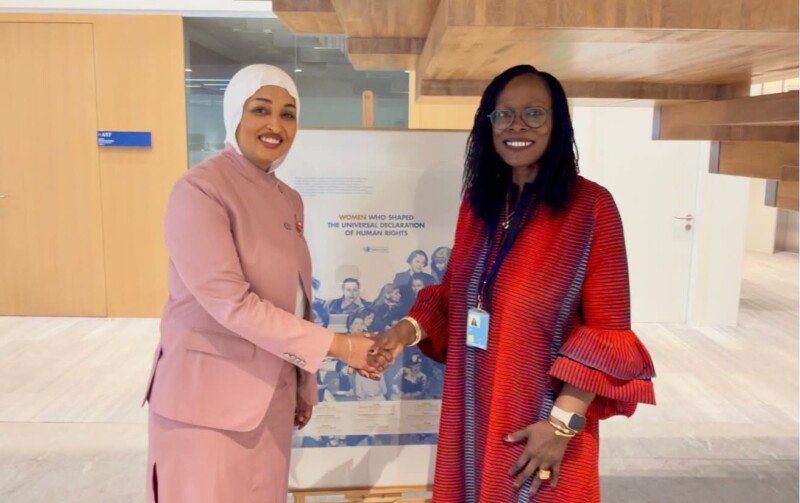
GENEVA — Somalia’s Minister of Family and Human Rights Development, Ambassador Khadija Mohamed Al-Makhzoumi, held a private meeting with the Deputy High Commissioner for Human Rights at the Office of the UN High Commissioner for Human Rights (OHCHR), Awa Dabo, in Geneva on Friday.
The meeting focused on strengthening cooperation between the Federal Government of Somalia and OHCHR, particularly in the promotion and protection of human rights in Somalia. The two sides also discussed efforts to establish an OHCHR office in Somalia and the importance of such a presence in strengthening national institutions, supporting human rights initiatives, and expanding technical cooperation between Somalia and the United Nations.
Minister Al-Makhzoumi thanked OHCHR for its continued support and cooperation with the Somali government and reaffirmed her ministry’s commitment to expanding international cooperation and advancing efforts to promote and protect human rights in Somalia. She was accompanied by the ministry’s Director General, Mohamed Bashir Omar, and experts and advisers from the Ministry.
Follow-Up to Address at Human Rights Council
The meeting followed Minister Al-Makhzoumi’s address to the 63rd session of the UN Human Rights Council on Thursday, as reported in FTL Somalia’s coverage of the address. In her remarks to the Council, the Minister outlined Somalia’s human rights commitments, noting that the government has supported 259 recommendations from the fourth cycle of the Universal Periodic Review and calling for the OHCHR office in Mogadishu to be fully operationalised.
She highlighted progress in submitting initial reports under the Convention on the Rights of the Child, the Convention against Torture, the International Covenant on Economic, Social and Cultural Rights, and the International Covenant on Civil and Political Rights. She also cited the approval of the national anti-FGM bill in 2025, the launch of Somalia’s first national justice sector strategy, and human rights training for police, custodial officers, and prosecutors.
Background: Handover of UN Human Rights Office
The discussions in Geneva follow the Federal Government’s completion of the handover of the UN Human Rights Office in Somalia, which operated under the UN Transition Mission in Somalia (UNTMIS) Human Rights and Protection Group. As detailed in FTL Somalia’s coverage of the handover, the transition transferred full responsibility for human rights matters to national institutions, following consultations in Mogadishu, Geneva, and New York.
The handover was the culmination of the Somalia Human Rights Transition Plan for 2025–2026, a framework aligned with UN Human Rights Council Resolution HRC60/L.14. UNTMIS provided technical assistance to legislative and policy development, capacity development, and outreach activities to the Ministry of Family and Human Rights Development, the NIHRC, and Somali security forces. Mentoring and training on human rights and protection for the Somali National Army and Somali Police Force were transferred by June 2026.
The transfer coincided with the conclusion of the mandate of the UN Independent Expert on Human Rights in Somalia in October 2025, ending three decades of direct international monitoring of Somalia’s human rights record. The government framed the handover as a transition, not an end to human rights support, with Somali institutions now taking direct responsibility for protecting and promoting citizens’ rights.
At the centre of Somalia’s new human rights architecture is the National Independent Human Rights Commission (NIHRC), established under Article 111B of the Provisional Constitution. As detailed in FTL Somalia’s coverage of the Commission’s leadership, Dr. Maryan Qasim was elected as its first chairperson in February 2026, marking a significant step toward national ownership of human rights oversight. The Commission has been building its operational capacity through workshops and partnerships with the United Nations and the European Union.
Host Country Agreement Provides Framework
The discussions build on the Host Country Agreement signed on 6 May 2026 by Minister Al-Makhzoumi and UN High Commissioner for Human Rights Volker Türk. The agreement established a comprehensive human rights mandate for the OHCHR in Somalia, including monitoring, reporting, technical assistance, and capacity-building activities, and envisaged establishing an office in Mogadishu contingent on funding.
That agreement was the first Host Country Agreement Somalia has signed with the UN human rights office, marking the culmination of 18 months of work by the Ministry of Family and Human Rights Development to strengthen governance in the human rights sector.
Critical Note
The meeting between Minister Al-Makhzoumi and Deputy High Commissioner Awa Dabo is a continuation of Somalia’s sustained engagement with the international human rights system. The Host Country Agreement signed in May 2026 was a genuine milestone, and the handover of the UN human rights office in September 2026 marked the end of three decades of direct international monitoring.
However, the operative phrase in all official statements on the OHCHR office is the same: “contingent on funding.” No timeline has been announced, and no specific financial commitment has been made public. An agreement that exists on paper but lacks the resources to establish an office is a framework without substance. The Somali government has demonstrated it can sign agreements and complete transitions. The next test is whether it can secure the funding and political conditions necessary to make the office operational.
Somalia’s human rights challenges remain significant, as documented by the OHCHR itself: ongoing conflict, displacement, gender-based violence, restrictions on civic space, and gaps in access to justice. An OHCHR presence in Mogadishu would provide technical support and monitoring capacity, but it would not substitute for Somali institutions capable of investigating and prosecuting abuses. The NIHRC, led by Dr. Maryan Qasim, has a strong constitutional mandate and has begun building its capacity. Whether it can operate independently and effectively is the question that will determine whether Somalia’s human rights progress is real or rhetorical.
Recommended Reading On ftlsomalia.com
- Federal Government Completes Handover of UN Human Rights Office, Pledges Stronger National Oversight
- Minister Al-Makhzoumi Outlines Somalia’s Human Rights Commitments at UN Council
- Somalia, UK Discuss Human Rights Cooperation in Geneva
- Dr. Maryam Qasim Ahmed Elected Head of Somalia’s Human Rights Commission
- Parliament Reviews Family and Child Rights Bills as Helpline Records 187 Abuse Cases
- Somalia Launches New Women’s Peace Initiative