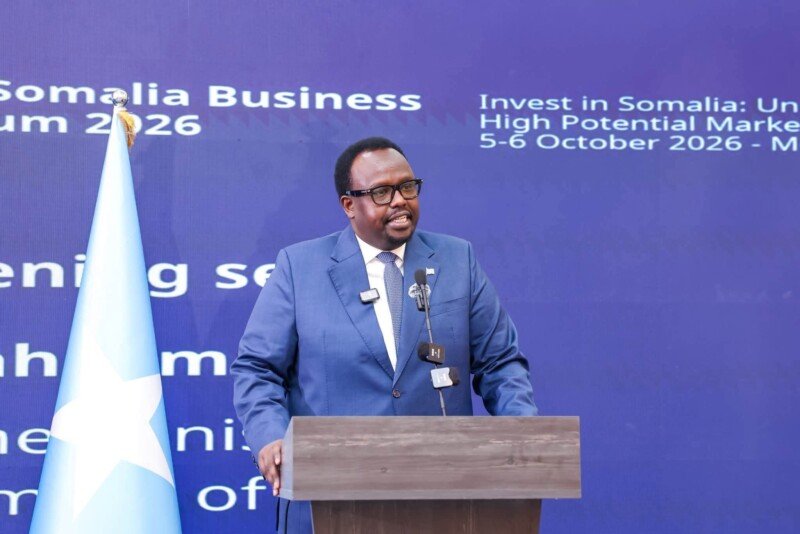

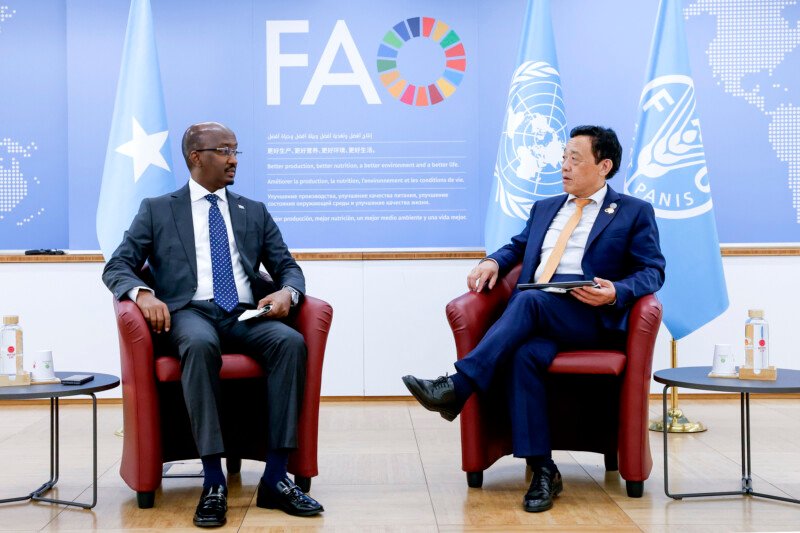
ROME — Somalia’s Minister of Fisheries and Blue Economy, Ahmed Hassan Adan, held a high-level meeting with the Director-General of the Food and Agriculture Organization (FAO), Dr. Qu Dongyu, in Rome on September 9, 2026, to discuss strengthening cooperation on fisheries development, marine resource protection, and accelerating blue economy initiatives.
The Minister stated that fisheries development and the blue economy are among the Somali government’s priorities and play an important role in the National Transformation Plan 2025–2029.
Both sides discussed the Somalia Blue Economy Transformation Programme, which aims to integrate research, fisheries data, sustainable management of marine resources, investment, job creation, food security, and improving the livelihoods of coastal communities.
Data, Monitoring and Enforcement
One of the key topics of the meeting was the need for Somalia to obtain reliable scientific data to assess fish stocks and priority species in Somali waters. The stock assessment programme is expected to enhance the country’s capacity for issuing fishing licenses, setting catch quotas, and implementing conservation and sustainable management measures, building on previous efforts to advance Somalia’s blue economy agenda through data-driven methods.
The discussions also examined accelerating the implementation of the Fisheries Information Management System (FIMS), which aims to improve data collection on caught fish, electronic reporting, vessel data, and traceability of fisheries products. The Fisheries Management and Development Council has been working to harmonize legislative frameworks and ensure Somalia’s ocean resources are managed equitably and sustainably.
Emphasis was placed on strengthening cooperation between the Federal Government of Somalia and federal member states to achieve a unified system for managing fisheries data and resources.
The meeting also addressed the fight against illegal, unreported, and unregulated (IUU) fishing. The Minister requested that FAO expand its technical support to Somalia, particularly in vessel tracking and monitoring, law enforcement, registration of boats and vessels, port inspections, and regional information sharing, building on previous initiatives launched with Japan and FAO to modernize the country’s fisheries infrastructure and combat illegal fishing.
Both sides also proposed establishing a joint task force between the Ministry of Fisheries and Blue Economy and FAO to work on preparing plans and programmes for developing marine resources and financing the fisheries sector.
Somalia has been actively engaging with international partners to unlock its vast marine resources, with the blue economy recognized as a cornerstone of the country’s long-term development vision and critical for creating jobs, enhancing food security, and driving sustainable economic growth.
The country is also set to begin exporting fish and other seafood products to China in September 2026, following the implementation of a tariff-free agreement that opens one of the world’s largest seafood markets for Somali products.
Critical Note
The meeting reflects Somalia’s continued efforts to build a modern, science-based, and sustainable fisheries sector. The focus on reliable data and improved monitoring is a necessary step toward managing Somalia’s marine resources effectively and combating IUU fishing, which is estimated to cost the country hundreds of millions of dollars annually.
Yet, the effectiveness of these efforts depends on implementation. Somalia has long faced challenges in enforcing fisheries regulations, including weak institutional capacity, limited naval patrol capability, and gaps in coordination between federal and state authorities. The proposed joint task force with FAO and the emphasis on FIMS are positive developments, but they require sustained investment and political commitment to deliver results.
The broader challenge remains balancing the development of the blue economy with the protection of marine resources. Somalia’s coastline, the longest in mainland Africa, offers significant economic potential, but realizing this potential will require not only technical support from partners like FAO but also improvements in governance, infrastructure, and security along the coast.
Recommended Reading On ftlsomalia.com
- Fisheries Minister, UNECA Director Discuss Blue Economy Cooperation
- Somalia Holds Seventh Fisheries Council Meeting to Boost Blue Economy
- Somalia, UNDP Deepen Blue Economy Cooperation Talks
- Somalia to Begin Fish Exports to China in September Under Landmark Tariff-Free Deal
- Somalia Introduces Fisheries Plan to Spur Economy and Combat Illegal Fishing
- Mogadishu Port Chief Welcomes Somali Fishing Company Exporting to International Markets