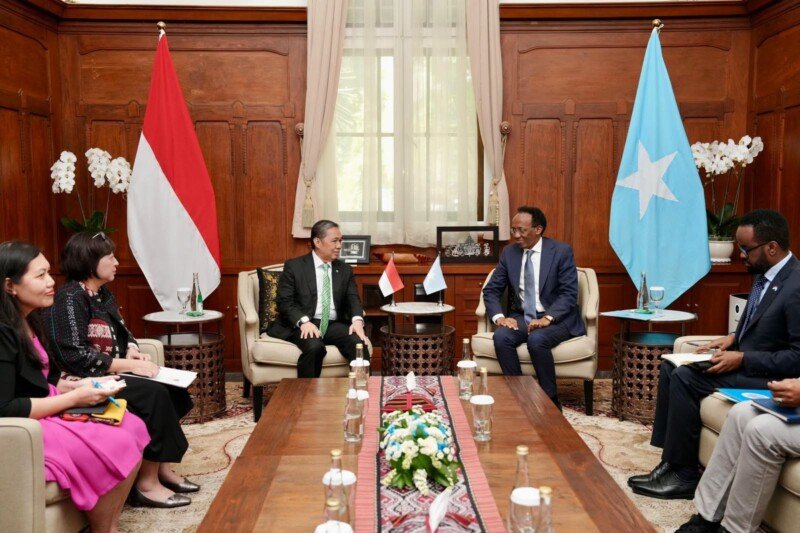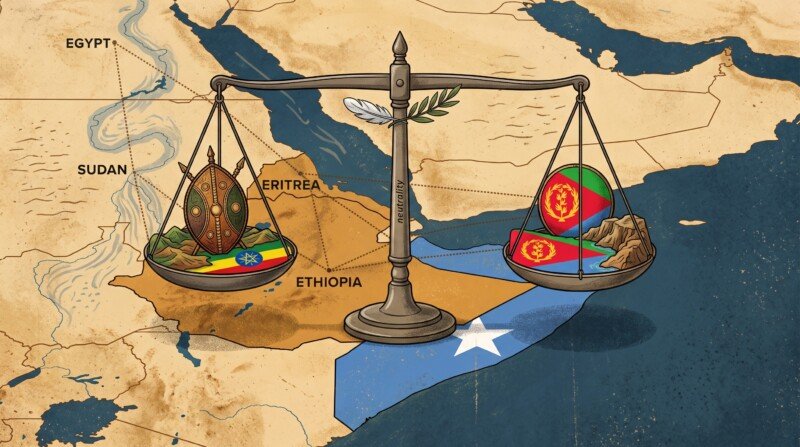
MOGADISHU — Somalia’s government has told the BBC that it remains neutral in the escalating confrontation between Ethiopia and Eritrea, insisting it has good relations with all parties even as the crisis in the Horn of Africa deepens.
Deputy Foreign Minister Hassan Mohamed Ali Nadara told BBC Somali that Somalia’s position is “one of peace and neutrality,” citing the country’s shared interests with the region’s states, its historical ties with some, its religious and geographical bonds with others, and the various agreements it has signed with several of them.
“The region is facing many problems right now, so that we do not add another problem and compound the existing obstacles across multiple fronts — security, economic, and movement — the Somali government is working to participate in reducing or resolving them, while of course protecting its own objectives and unity,” Nadara said.
The Regional Crisis
The tensions between Ethiopia and Eritrea have escalated sharply in recent weeks. Ethiopia accused Eritrea of supporting rebel groups fighting the government, particularly in Tigray, allegations Eritrea has repeatedly denied.
Days ago, Eritrean forces entered northern Ethiopia, moving toward areas where clashes are ongoing between Ethiopian federal forces and regional forces, according to residents of the Tigrayan town of Adigrat who spoke to the BBC. As reported in FTL Somalia’s coverage of the Eritrea-Ethiopia standoff, Eritrea has formally asked the UN Security Council to take “deterrent measures” against Ethiopia, accusing Addis Ababa of declaring war.
Fighting in the region began two weeks ago after months of tension between the Ethiopian government and the Tigray People’s Liberation Front (TPLF), the party that governs Tigray. Both sides accuse each other of violating the 2022 agreement that ended a two-year civil war. As detailed in FTL Somalia’s coverage of Ethiopia’s response, Addis Ababa has rejected what it describes as “political rhetoric, coercive measures, or acts of destabilization” from regional actors.
Somalia’s Balancing Act
Somalia shares a long land border with Ethiopia, while its relations with Eritrea and Egypt are strong. President Hassan Sheikh Mohamud participated in the four-way Alamein summit with Egypt, Eritrea, and Sudan before the current escalation.
When asked about perceptions that Somalia is not neutral given its participation in that summit, Nadara rejected the suggestion. “Somalia is neutral on this matter, and we have good relations with all these countries. There is no change that has come between those good relations that we are aware of,” he said.
On Ethiopia specifically, Nadara said relations remain as they were, noting that Ethiopian forces are in Somalia as part of AUSSOM. “Today there is no problem between the two governments,” he said.
Somalia joined the Alamein Declaration on 4 October 2026, formalizing coordination with Egypt, Eritrea, and Sudan on regional security, Red Sea governance, and the Nile dispute. As reported in FTL Somalia’s coverage of the summit, the declaration affirmed support for Somalia’s sovereignty and rejected recognition of Somaliland.
Analysts Disagree
Analysts who spoke to the BBC disputed the deputy minister’s characterization of Somalia’s position. Ahmed Kaboole, a security analyst, pointed to what he described as a gap between Somalia’s actions and its words following the Alamein summit.
Prof. Liban Igal, who focuses on Horn of Africa affairs, argued that Somalia should have confined itself to regional security matters and avoided entanglement in the overlapping disputes between Egypt, Eritrea, and Sudan.
“Somalia should have stayed within its borders and not leaned toward one side,” Igal said.
Egypt’s Expanding Military Presence
The regional crisis unfolds as Egypt accelerates its military deployment to Somalia. As reported in FTL Somalia’s coverage of Egypt’s troop deployment, Egyptian military technical teams are preparing for the deployment of army troops, with forces reportedly to be stationed in the Ceelcade area near the former Cisiley airfield in Middle Shabelle.
Reports indicate that Egyptian forces would be positioned approximately 400 kilometres from the nearest point of the Somalia-Ethiopia border, significantly farther than earlier reported locations in Gedo or Hiiraan, as detailed in FTL Somalia’s coverage of the Ceelcade site. This positioning appears designed to manage Ethiopian sensitivities while deepening the Egypt-Somalia defence relationship.
Egypt has pledged approximately 1,091 troops to AUSSOM. As reported in FTL Somalia’s coverage of Somalia-Egypt talks at the UN General Assembly, Egypt has consistently advocated for sustainable funding for AUSSOM and reaffirmed its full support for Somalia’s unity, sovereignty, and territorial integrity.
Concerns Over Ethiopian Troop Withdrawal
Reports in Somali media have suggested that Ethiopian forces in Somalia could withdraw following the renewed fighting in Ethiopia, though the BBC could not independently verify these reports.
Nadara said he had no confirmed information about a withdrawal. “As far as I know, no confirmed information has reached us that forces are leaving. Of course, they remain in the locations and bases they were in, and they continue the work they were doing with the Somali government,” he said.
Somalia’s security transition is already strained by uncertainty over AUSSOM’s future. As reported in FTL Somalia’s coverage of Ethiopia’s troop withdrawal, more than 3,000 Ethiopian troops are expected to withdraw from South West State in the coming weeks, redeploying to Tigray, Amhara, and Afar.
Impact on Somalia
Nadara acknowledged that the conflict in Ethiopia could have significant consequences for Somalia, including economic, security, and movement impacts.
“The whole of East Africa could be affected. The world is now one place. A disease that breaks out in one place can reach many places. A conflict that breaks out in one place can affect many countries. Ethiopia is a large country in the region with many neighbors. Of course, if the fighting inside it increases or crosses into another government, Somalia could be affected economically, in terms of security, and in movement,” he said.
The African Union, the United States, and the United Nations have called on all sides to exercise restraint.
Critical Note
Somalia’s claim of neutrality rests on a narrow definition: that it has no direct dispute with Ethiopia or Eritrea and maintains diplomatic relations with all parties. By that measure, the deputy minister’s statement is accurate. Somalia has not severed ties with Ethiopia, Ethiopian forces remain in the country under AUSSOM, and no formal rupture has occurred.
But neutrality is not only about the absence of direct conflict. It is also about perception and alignment. Somalia signed the Alamein Declaration with Egypt, Eritrea, and Sudan, all of which have been accused by Ethiopia of supporting rebel groups. The declaration itself includes provisions on Red Sea governance and the Nile that are directed at Ethiopian policy. Somalia’s participation in that framework inevitably creates the impression of alignment, regardless of its stated neutrality.
The deputy minister’s insistence that Somalia has “good relations with all” is technically true but diplomatically evasive. The question is not whether Somalia has good relations, but whether it can maintain them if the region polarizes further. Somalia’s leaders face a difficult balancing act: preserving ties with Ethiopia, its largest neighbor and a fellow contributor to the AU mission, while maintaining the strategic relationships with Egypt and Eritrea that have provided diplomatic support on Somaliland and the Red Sea.
What Somalia needs most is clarity about its own interests, not a posture of neutrality that may prove unsustainable. As the region’s crisis deepens, the space for ambiguity is shrinking.
Share your story. FTL Somalia is continuing to investigate Somalia’s diplomatic positioning amid the regional crisis in the Horn of Africa. If you have information or insights to share, contact us at info@ftlsomalia.com. Your identity will be protected.
Recommended Reading On ftlsomalia.com
- Eritrea-Ethiopia Standoff Escalates as Somalia Watches Its Regional Partners Confront Each Other
- Egypt Prepares to Deploy Troops to Somalia as Horn of Africa Tensions Escalate
- Ethiopia Rejects ‘Coercive Measures’ as Egypt, Eritrea, Somalia and Sudan Formalize Bloc
- Ethiopia’s Troop Withdrawal and the Egypt-Eritrea Alignment: What It Means for Somalia
- Somalia and Egypt Discuss Red Sea Security, Sovereignty and AUSSOM Funding at UN General Assembly
- Egypt Emerges as Key Partner in Rebuilding Somalia’s Air Force