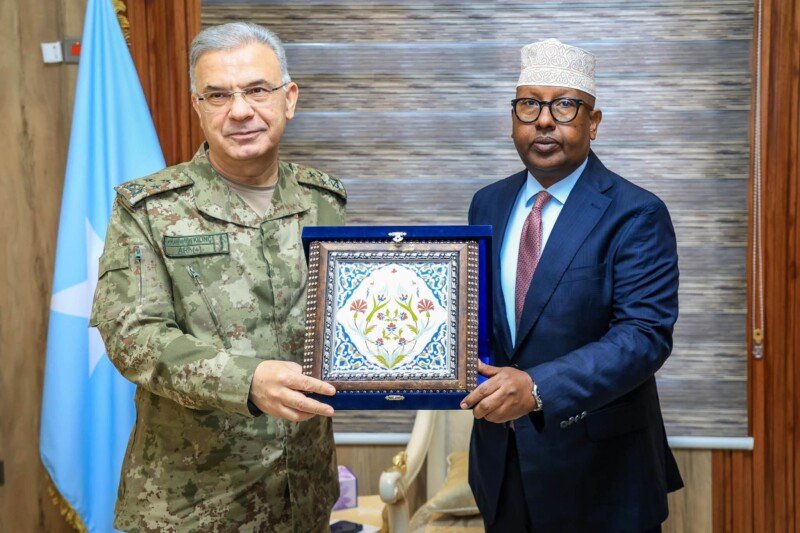
MOGADISHU, Somalia’s Defence Minister Ahmed Moallim Fiqi met with Turkish General Sabahattin Kılınç, Commander of the Joint International Strategic Command of the Turkish Armed Forces General Staff, on Wednesday to discuss deepening defence cooperation, counterterrorism efforts, and the security situation in the Horn of Africa.
The meeting focused on military collaboration, regional security, and what the Somali government described as “foreign interference supporting militant groups.” Fiqi praised Türkiye’s continued support for Somalia’s fight against terrorism, reaffirming the importance of the two countries’ longstanding defence partnership.
The talks were attended by the Permanent Secretary of the Ministry of Defence, Yusuf Ali Mohamed; Somali National Army Assistant Chief of Defence, Major General Mohamed Ali Barise; and TURKSOM Military Training School Commander, Major General Sabahattin Kalkan.
The TURKSOM Anchor
The meeting is the latest in a series of high-level engagements between Somali and Turkish military officials. In September 2026, Fiqi received a Turkish military delegation led by Major General Sabahattin Kalkan, the commander of the TURKSOM Military Training Academy, to discuss training and capacity-building for the Somali National Armed Forces. The minister commended TURKSOM’s role in developing the professional skills of Somali military personnel and thanked the Turkish government for its continued support.
TURKSOM, which opened in Mogadishu in 2017, is Türkiye’s largest military training facility outside its borders. It provides training for Somali officers, non-commissioned officers, and soldiers, along with support in organization, military structure, and logistics. The base has trained thousands of Somali soldiers and remains a cornerstone of Ankara’s security engagement in the Horn of Africa.
Türkiye’s Regional Calculations
The defence talks come as Türkiye expands its military footprint in the Horn of Africa, driven in part by the deteriorating security environment in the Red Sea. The Turkish parliament recently approved a two-year extension of its military mission in Somalia, a decision that analysts say is linked to Ankara’s concerns over Houthi attacks on shipping and the broader militarization of the Bab el-Mandeb corridor.
In late January 2026, Türkiye deployed F-16 fighter aircraft and additional military personnel to reinforce its base in Mogadishu, the first deployment of advanced manned combat aircraft to Somalia. The move signaled that Ankara is playing a long game in the region, positioning itself as a key security actor in one of the world’s most critical maritime corridors.
Türkiye’s approach to Somalia is also shaped by its broader regional strategy. Analysts at ISPI note that Ankara’s support for Somalia’s territorial integrity is not merely a principled commitment to international law, but a calculated effort to preserve recognised state structures and limit the influence of competing actors, particularly the UAE and Israel, whose engagements in Somaliland and the Red Sea threaten to bypass the sovereign frameworks in which Türkiye is embedded. The UAE’s role in the region, including its alleged involvement in networks that challenge Mogadishu’s authority, has been a recurring concern for the federal government.
The broader security transition in Somalia, including the unravelling of the African Union mission and the Ugandan withdrawal, adds urgency to the Turkish partnership. As Somali forces are expected to assume greater responsibility for security, Türkiye’s training and equipment become more critical than ever.
Critical Note
The meeting between Minister Fiqi and General Kılınç is a routine defence engagement, and it should be reported as such. But the language of the readout is worth noting. Fiqi praised Türkiye’s support and discussed “foreign interference supporting militant groups,” a phrase that aligns with Mogadishu’s concerns about external actors, particularly the UAE and Israel, whose activities in Somaliland and the Red Sea have unsettled the federal government.
Türkiye is Somalia’s most important military partner. TURKSOM has trained thousands of soldiers, Turkish drones have supported counterterrorism operations, and Ankara’s diplomatic backing has been consistent. But the relationship is not without its tensions. Türkiye’s regional strategy is driven by its own calculations, including its concerns over the Red Sea and its competition with the UAE and Israel. Somalia benefits from Turkish support, but it does not control the terms of that support. Ankara decides when to deploy F-16s, when to extend its mission, and how to position itself in the broader regional rivalry.
The defence partnership is real and valuable. But it is also a reminder that Somalia’s security is shaped by actors whose interests extend far beyond Mogadishu. The meeting on Wednesday was about cooperation. It was also about the geopolitical currents that brought a Turkish general to Mogadishu in the first place, and that will determine how long he and his successors remain.