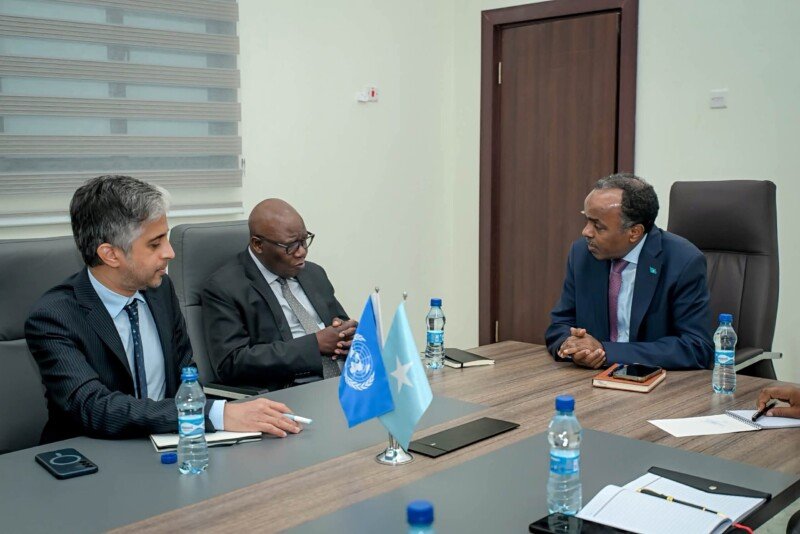
MOGADISHU — Somalia’s State Minister for Foreign Affairs and International Cooperation, Ali Mohamed Omar, met with a United Nations delegation led by the Officer-in-Charge of the UN Transitional Assistance Mission in Somalia (UNTMIS), Raisedon Zenenga, on 14 October 2026 to discuss the final phase of the mission’s transition, recent political and security developments, and the need for a handover that strengthens Somali institutions and protects gains in peacebuilding and state-building.
The State Minister reaffirmed the Federal Government’s commitment to a Somali-led transition and thanked the United Nations for its longstanding partnership, according to a statement from the Ministry of Foreign Affairs and International Cooperation.
The Final Phase of UNTMIS Transition
UNTMIS succeeded the UN Assistance Mission in Somalia (UNSOM) on 1 November 2024, following the adoption of UN Security Council Resolution 2753. The mission’s mandate is set to conclude by 31 October 2026, when all functions are expected to be fully taken over by national institutions and existing UN development programmes.
The transition is structured in two main phases. Phase One, which ran from November 2024 to October 2025, prioritized support and capacity building in state-building, human rights, rule of law, security sector support, and countering violent extremism. Phase Two, from November 2025 to October 2026, involves the progressive transfer of all remaining functions to the Federal Government, the UN Country Team, and other partners.
The transition is condition-based, with the Security Council regularly reviewing progress to ensure a stable handover of responsibilities.
Handover of Field Offices and Coordination
The handover of field offices is already underway. As reported in the UN’s coverage of the Dhusamareb handover, UNTMIS officially transferred the United Nations office in Dhusamareb to Galmudug state authorities on 30 November 2025. For remaining sites, internal discussions are being held on post-UNTMIS mechanisms to ensure cost-effective and efficient use of premises and assets.
The Joint Technical Committee (JTC) continues to guide the development of modalities for the second phase, ensuring all remaining UNTMIS tasks are fully transitioned to the Federal Government, UN Country Team, or other stakeholders by 31 October 2026.
Security and Justice Sector Focus
UNTMIS has been actively supporting Somalia’s rule of law and security institutions. Until 31 October 2026, the mission will continue to provide strategic, policy, and technical advice on advancing the revised national security architecture, establishing a national security council, and implementing the security sector development plan.
The mission has also supported the professionalization and accountability of the Somali Police Force and facilitated consultations on a national policy to counter social media misuse, misinformation, and hate speech.
As reported in FTL Somalia’s coverage of the Justice Minister’s meeting with UNTMIS, the mission has played a central role in strengthening Somalia’s justice and corrections sector. In August 2026, the mission held a Joint Justice and Corrections Service Closure Workshop to mark the transition of responsibilities to national institutions.
The handover of human rights responsibilities is also underway. As reported in FTL Somalia’s coverage of the human rights handover, UNTMIS has been transferring its human rights monitoring and reporting functions to the National Independent Human Rights Commission, with the UN pledging continued support after the mission’s closure.
Critical Note
The meeting between State Minister Omar and Officer-in-Charge Zenenga marks a critical juncture in Somalia’s relationship with the United Nations. As UNTMIS prepares to close its doors on 31 October 2026, the transition represents both an opportunity and a risk. The opportunity lies in Somalia’s stated commitment to national ownership and self-reliance, a goal that the international community has endorsed through the phased handover. The risk lies in whether Somali institutions are prepared to assume the functions that UNTMIS has performed, from political good offices to technical support on constitutional review and security sector reform.
The transition is taking place against a backdrop of increasing political divisions among Somali stakeholders and severely constrained global resources, as noted in a report by the UN Secretary-General. These factors could complicate the handover and undermine the sustainability of the gains achieved during UNTMIS’s mandate. The mission’s departure is not an ending; it is a test of whether the foundations it helped build can withstand the pressure of Somalia’s ongoing political and security challenges.
Share your story. FTL Somalia is continuing to investigate the UNTMIS transition and its impact on Somalia’s institutions. If you have information or insights to share, contact us at info@ftlsomalia.com. Your identity will be protected.
Recommended Reading On ftlsomalia.com
- Justice Minister Receives UNTMIS Delegation as Mission Prepares to Close
- NIHRC and UNTMIS Discuss Handover of Human Rights Monitoring Responsibilities
- Federal Government Completes Handover of UN Human Rights Office
- Minister of Justice Commends UNTMIS Support as Mission Concludes Justice Sector Assistance
- Foreign Affairs Minister Meets UNTMIS Delegation