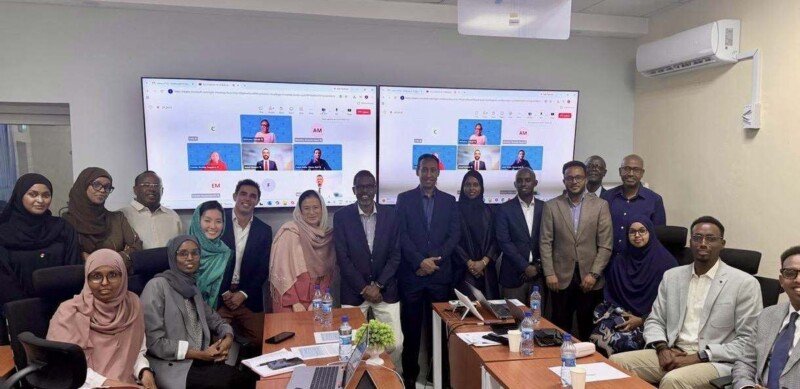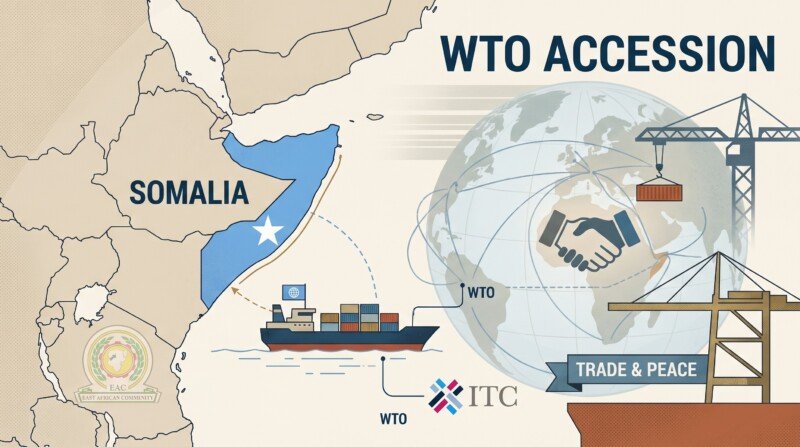
MOGADISHU, Somalia’s federal government has welcomed the outcome of a joint working visit by delegations from the World Trade Organization (WTO) and the International Trade Center (ITC), describing it as a significant step forward in the country’s decade-long effort to join the global trading body.
The visit, the first of its kind by WTO experts to Somalia, was led by the Office of Somalia’s Chief Trade Negotiator. According to a government statement, discussions focused on assessing progress in the accession process, responding to questions from WTO member states, reviewing technical documentation, and preparing Somalia’s proposals for opening markets in goods and services.
Somalia’s Chief Trade Negotiator, Sadiq Haji Ibrahim, reaffirmed the government’s commitment to accelerating the accession process, emphasizing the need to strengthen coordination between national institutions and international partners to complete remaining requirements and ensure readiness for the next phase of negotiations.
UK Support and the Trade for Peace Initiative
British Ambassador to Somalia Charles King confirmed his country’s support for Somalia’s WTO accession, noting that the United Kingdom is working with the ITC to help turn the accession goal into practical progress. “The ultimate objective is to create business opportunities, attract investment and generate jobs for Somali citizens,” King said.
The delegation also discussed the relationship between WTO accession, Somalia’s membership in the East African Community (EAC), and its participation in the African Continental Free Trade Area (AfCFTA). These overlapping frameworks represent Somalia’s broader strategy of regional and continental economic integration, as reported in FTL Somalia’s coverage of Somalia’s EAC integration. Separate consultations were held on the Trade for Peace Somalia Initiative, which aims to strengthen the role of trade in peacebuilding, stability, and inclusive economic development.
The government expressed gratitude to the UK for its support of the ITC-implemented “Making Trade Happen” project and commended the technical assistance provided by both the WTO and ITC.
A Decade-Long Process Nearing Completion
Somalia’s WTO accession process has been underway for approximately ten years. In October 2026, the Cabinet reviewed a report from the Ministry of Commerce and Industry stating that Somalia had fulfilled all required conditions, including tariff scheduling and the establishment of administrative institutions, as reported in FTL Somalia’s coverage of the Cabinet review.
The next milestone is the second meeting of the Working Party on Somalia’s accession, expected in early 2027. That meeting will formally advance the negotiating process and bring Somalia closer to full membership.
Somalia has also deepened its engagement with global trade institutions. In March 2026, Commerce Minister Gamal Mohamed Hassan represented Somalia at the 14th WTO Ministerial Conference in Yaoundé, Cameroon, where he held bilateral talks with his Turkish counterpart on expanding trade cooperation, as reported in FTL Somalia’s coverage of the ministerial conference.
Critical Note
The first WTO visit to Mogadishu is a genuine milestone in a process that has spanned more than a decade. It signals that the international trade body is taking Somalia’s candidacy seriously enough to send technical experts to the country, rather than conducting the entire process remotely from Geneva.
But the Cabinet’s statement that Somalia has “fulfilled all required conditions” is optimistic. Accession processes involve complex negotiations on market access, domestic support, and regulatory alignment. The process is nearing completion, but it is not finished. The Working Party meeting in 2027 will be the real test of whether Somalia’s technical preparations are sufficient and whether member states are satisfied with the commitments Mogadishu has offered.
The deeper challenge is not accession itself, but what comes after. Somalia’s trade deficit exceeds $2.6 billion, and its productive capacity remains limited. As reported in FTL Somalia’s coverage of Somalia’s AfCFTA ratification, analysts have cautioned that the country’s biggest obstacle is not access to markets but the ability to produce goods that can compete in them. WTO membership will give Somalia a rules-based framework for trade and a seat at the table in global negotiations. It will not, by itself, generate exports, attract investment, or create jobs. Those outcomes depend on infrastructure, security, and the kind of institutional capacity that the accession process is meant to build.
Recommended Reading On ftlsomalia.com
- Somali Cabinet Approves Ebola Preparedness Committee, Reviews EAC Benefits and WTO Progress
- Somalia’s EAC Membership Is About Creating Opportunities for Somali Traders, Says Minister Beenebeene
- Somalia Engages in WTO Conference to Boost Global Trade
- Somalia Formally Joins AfCFTA as 50th Member, Opening Access to 1.4 Billion Consumer Market