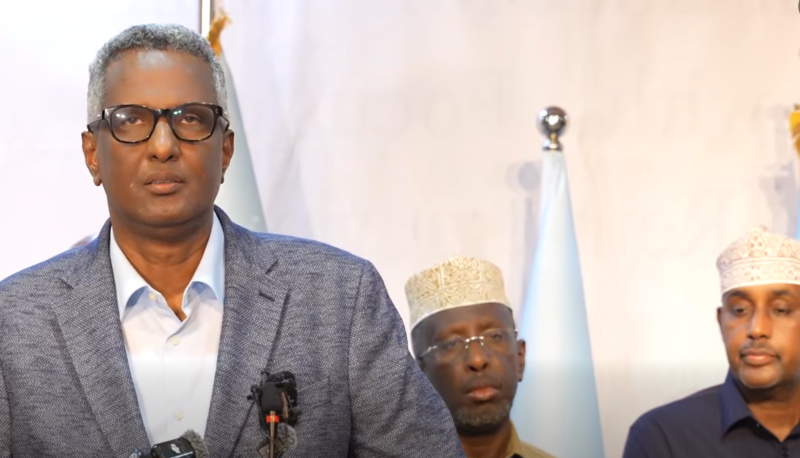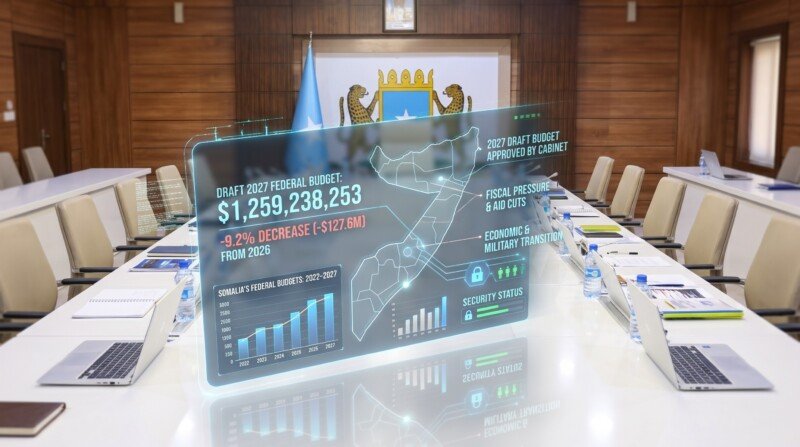
MOGADISHU, Somalia’s Council of Ministers approved a draft 2027 federal budget of $1,259,238,253 during a special session on today, October 27, 2026, chaired by Acting Prime Minister Salah Ahmed Jama, setting up a parliamentary debate over a fiscal plan that is nearly 9 percent smaller than the budget approved for 2026.
The session, held at the Office of the Prime Minister, also heard a security briefing from the Ministry of Internal Security on recent military operations against Al-Shabaab, which the government refers to as the Khawaarij. The Cabinet approved the appointment of Shukri Hassan Osman as Director of the Civil Service and Retirement Authority and welcomed the conclusion of the United Nations political office in Somalia.
Somalia’s Federal Budgets: 2022–2027
| Fiscal Year | Total (USD) | Status | Change from Previous Year |
|---|---|---|---|
| 2022 | $918,700,000 | Approved by Parliament | — |
| 2023 | $973,985,805 | Approved by Parliament | +$55.3M (+6.0%) |
| 2024 | $1,079,315,784 | Approved by Parliament | +$105.3M (+10.8%) |
| 2025 | $1,318,415,492 | Approved by Parliament | +$239.1M (+22.2%) |
| 2026 | $1,386,807,242 | Approved by Parliament | +$68.4M (+5.2%) |
| 2027 (Draft) | $1,259,238,253 | Approved by Cabinet | −$127.6M (−9.2%) |
The Numbers: A Budget in Retreat
The draft 2027 budget represents a decrease of approximately $127.6 million, or 9.2 percent, from the 2026 budget of $1,386,807,242, which Parliament approved on December 22, 2025, with 174 votes in favor, four against, and one abstention, as reported in FTL Somalia’s coverage of the 2026 budget approval.
The decline is consistent with the pressures identified in the IMF’s 2026 Article IV consultation, which cut Somalia’s growth forecast to 2.3 percent and warned that “sharp foreign aid cuts since 2025, severe and recurrent climate shocks, spillovers from the Middle East war and evolving electoral dynamics” had “weighed on economic activity, raised inflation and food insecurity, pressured public finances, and dampened the near-term outlook,” as reported in FTL Somalia’s coverage of the IMF forecast.
The revenue base itself is under strain from two directions. Customs revenue, the backbone of federal income, has fallen by approximately 40 percent due to the Strait of Hormuz disruption, as reported in FTL Somalia’s coverage of the revenue decline. And the fragmentation of customs across competing ports continues to erode the federal government’s share, as detailed in FTL Somalia’s analysis of the $19 per-barrel tariff gap between Mogadishu, Puntland, and Jubaland.
At the same time, the government’s ability to verify what it is owed from its own concessions remains weak. As reported in FTL Somalia’s coverage of the Auditor General’s findings, the Office of the Auditor General was unable to verify $34.26 million in concession fees from airport and port operations because the operators did not submit audited financial statements. A budget drafted on revenue that cannot be independently verified is a budget built on uncertain ground.
Monetary Reform and Digital Infrastructure
The 2027 budget process coincides with significant changes in Somalia’s monetary system. The Central Bank is preparing to reintroduce the Somali shilling, with the design withheld to prevent counterfeiting, and plans to process small transactions in shillings through the digital payment system, as reported in FTL Somalia’s coverage of the currency reform.
That digital backbone is already substantial. The national payment system processed 337,788 transactions worth approximately $593 million in the first quarter of 2026, with the Real Time Gross Settlement system accounting for 79 percent of total value, as reported in FTL Somalia’s coverage of the payment system data. A modern payment rail is a prerequisite for collecting revenue efficiently, and its expansion is one of the few bright spots in an otherwise constrained fiscal picture.
Aviation reform offers a similar lesson in incremental progress. The nationwide rollout of the IATA Billing and Settlement Plan, following a successful pilot, is expected to bring Somalia’s ticketing and settlement systems into line with global standards, as reported in FTL Somalia’s coverage of the IATA BSP rollout. These technical reforms do not close the budget gap on their own, but they build the institutional capacity that makes revenue collection possible.
What Comes Next: Parliament’s Role
The Cabinet’s approval is the first step in the budget process. The draft now proceeds to the House of the People and the Upper House for review, committee hearings, and a final vote. For the 2026 budget, that process took until late December, with the joint session preceded by a third reading report from the Joint Budget Committee.
Parliament has historically exercised its prerogative to scrutinize and amend budget proposals. The 2026 budget session was marked by procedural disruptions before the final vote, indicating that the legislature is not a rubber stamp. The 2027 draft will face questions about whether a smaller nominal budget can sustain the security operations the Cabinet discussed, fund the transition from AUSSOM, and maintain spending on education, health, and social services.
Critical Note
The Cabinet’s approval of a smaller 2027 budget is a tacit admission that the fiscal assumptions underpinning previous budgets are no longer sustainable. The 2026 budget was built on expectations of continued external support and customs revenue that have not materialized. The 2027 draft reflects a more austere reality.
Whether that austerity is managed intelligently is the question Parliament must answer. A smaller budget does not automatically mean better fiscal discipline. It can also mean underfunded security operations, neglected services, and deferred investment. The IMF’s downgrade to 2.3 percent growth, below population growth, means real GDP per capita is contracting. A shrinking budget in a shrinking economy is a recipe for deepening hardship.
The Cabinet’s simultaneous appointment of a new Civil Service Director and its recognition of the UN mission’s closure suggest a government preparing for a period of reduced international scaffolding. The 2027 budget is the first test of whether Somalia’s institutions can manage that transition without the external buffers that have long sustained them. The Auditor General’s inability to verify $34 million in concession fees, the $19 per-barrel tariff gap between competing ports, and the 40 percent collapse in customs revenue are not separate problems. They are the same problem: a state that does not yet control, measure, or collect what is rightfully its own. Parliament’s review will determine whether the draft is adjusted to meet that reality, or simply passed as presented.
Share your story. FTL Somalia is continuing to follow the 2027 budget process and fiscal policy. If you have information or insights to share, contact us at info@ftlsomalia.com. Your identity will be protected.
Recommended Reading On ftlsomalia.com
- Parliament Approves $1.38B Budget Amid Chaos
- Somalia’s Customs Revenue Falls 40% as Hormuz Disruption Hits Trade
- The $19 Gap: How Bosasso and Kismayo Are Undercutting Mogadishu Port and Draining Federal Revenue
- IMF: Somalia’s Growth to Slow to 2.3% Amid Aid Cuts and Drought
- Turkish Business Delegation Visits Villa Somalia as Auditor General Unable to Verify $34 Million in Concession Fees
- Somalia Central Bank Says New Somali Shilling Is in Final Preparations for Printing