
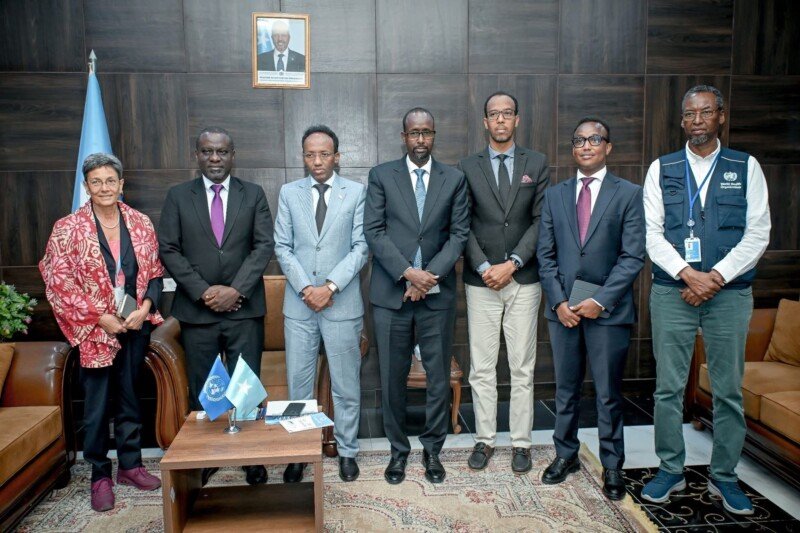
MOGADISHU — The Deputy Minister of Foreign Affairs and International Cooperation, Hassan Mohamed Ali (Nadaara), has received Dr. Humphrey Karamagi, the new World Health Organization (WHO) Country Representative for Somalia, at the ministry’s headquarters in Mogadishu.
The Deputy Minister welcomed Dr. Karamagi and wished him success during his tenure. The two officials discussed the continued support provided by WHO to Somalia, particularly in the health sector, focusing on strengthening the national health system and expanding access to essential health services.
Both sides also reaffirmed their commitment to further strengthening close cooperation between the Somali government and WHO, to advance and implement national health priorities.
WHO’s Role in Somalia’s Health Sector
WHO has been a key partner in Somalia’s health sector, supporting the government’s efforts to combat disease outbreaks, improve maternal and child health, and strengthen health systems. Somalia has actively participated in global health governance, leveraging its seat on the WHO Executive Board to advocate for vulnerable health systems and secure financial support for fragile states.
Health officials have previously held high-level discussions with WHO leadership, focusing on enhancing cooperation between the Ministry of Health and the global body, with particular attention to developing essential healthcare services and supporting maternal and child health initiatives.
WHO has supported Somalia’s health response with critical supplies, including the delivery of lifesaving Severe Acute Malnutrition kits to Banadir Hospital, designed specifically for children suffering from the most critical form of malnutrition.
The organization has also supported the development of national health strategies, including the 2025–2030 Hepatitis Prevention and Control Strategy, which aims to align Somalia’s efforts with the global goal of eliminating viral hepatitis as a public health threat.
With technical support from WHO, Somalia has piloted the Electronic Immunization Register in healthcare facilities, enhancing the monitoring and recording of vaccination data to improve immunization tracking and vaccine stock management.
Somalia has played an active role in regional health governance, with the Health Minister opening the 71st session of the WHO Regional Committee for the Eastern Mediterranean in Doha, emphasizing the country’s commitment to strengthening health systems and fostering collaboration with regional partners.
Critical Note
The meeting between the Deputy Foreign Minister and the new WHO Country Representative signals the Somali government’s continued commitment to its partnership with the UN health agency. Dr. Karamagi’s appointment comes at a critical time when Somalia is working to rebuild its health infrastructure and improve health outcomes after decades of conflict and instability.
However, the effectiveness of this partnership will ultimately be measured by tangible improvements in health outcomes, particularly for the most vulnerable populations. Somalia continues to face significant health challenges, including high maternal and child mortality rates, malnutrition, and recurrent disease outbreaks. The country hosts approximately 3.3 million internally displaced persons, and nearly 5 million people require humanitarian assistance according to the Somalia Humanitarian Needs and Response Plan. Acute malnutrition remains dire, with UN data projecting 1.84 million children under five will suffer from acute malnutrition during 2026, including approximately 500,000 facing life-threatening severe malnutrition [citation:9]. While WHO has provided crucial support, the broader issue of Somalia’s health financing—where the country remains heavily dependent on donors—underscores the need for a long-term strategy for sustainable health system development.
The government’s commitment to strengthening the health system is welcome, but it must be accompanied by sustained domestic investment and effective coordination among partners to ensure that health services reach all Somalis, particularly those in remote and conflict-affected areas.
Recommended Reading On ftlsomalia.com
- Somalia Advocates for Health Priorities Through WHO Board Position in Geneva
- Somali Health Minister Meets WHO Chief in Geneva
- EU and WHO Deliver Lifesaving Malnutrition Kits to Somali Hospitals
- Somalia Launches National Hepatitis Strategy Workshop
- Somalia Pilots Electronic Immunization Register in Benadir
- Somali Health Minister Opens WHO Regional Committee Meeting