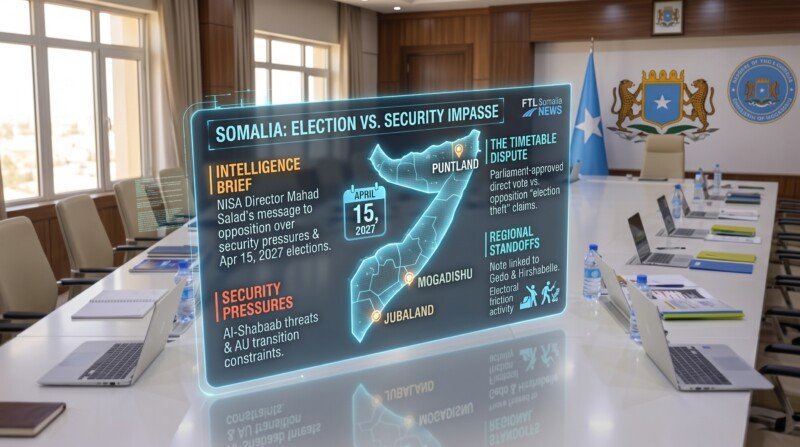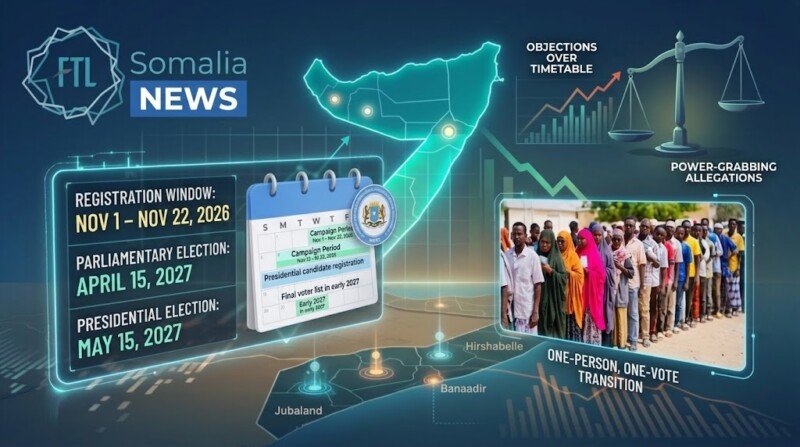

MOGADISHU — The National Independent Electoral and Boundaries Commission (NIEBC), led by Chairperson Abdikarim Ahmed Hassan, has released the official timetable for Somalia’s 2027 federal elections, setting parliamentary elections for 15 April 2027 and the presidential vote for 15 May 2027. The announcement marks the first time the electoral body has formally scheduled federal elections under the amended constitution.
According to the timetable, registration of political parties and voters will reopen from 1 to 22 November 2026, a 21-day period. Candidate lists for both chambers of parliament must be submitted by 22 November 2026, in line with Article 42 of the National Elections Law, which requires submission 120 days before polling day. The provisional voter list will be published on 21 January 2027, followed by the final voter list on 15 March 2027. Campaigning for parliamentary elections will begin on 27 February 2027.
Full Timetable
| # | Activity | Date |
|---|---|---|
| 1 | Reopening of registration of political parties and voters | 1–22 November 2026 (21 days) |
| 2 | Deadline for submission of candidate lists for both chambers | 22 November 2026 |
| 3 | Publication of provisional voter list | 21 January 2027 |
| 4 | Start of parliamentary election campaign | 27 February 2027 |
| 5 | Publication of final voter list | 15 March 2027 |
| 6 | Parliamentary elections (both chambers) | 15 April 2027 |
| 7 | Presidential election | 15 May 2027 |
The Government’s Election Commitment
The NIEBC announcement formalizes the timeline Prime Minister Hamza Abdi Barre first mentioned on 13 October 2026, when he said the government was working to hold a one-person, one-vote federal election in 2027. As reported in FTL Somalia’s coverage of the cabinet announcement, that was the first time the government publicly committed to a date for the next federal election.
The timing is significant. Opposition leaders have maintained that President Hassan Sheikh Mohamud’s four-year term expired on 15 May 2026, while the federal parliamentary mandate ended in April. The government disputes that interpretation, arguing that constitutional amendments and parliamentary decisions extend its mandate until May 2027. The NIEBC’s timetable, placing the presidential election on 15 May 2027, confirms the government’s position that its mandate extends beyond the original term.
The Galmudug Precedent and the Credibility Question
The NIEBC’s decision to schedule federal elections comes amid lingering questions about the commission’s credibility, following the Supreme Court’s annulment of the Galmudug elections in August 2026. The court found that the July 30 vote had not been administered in accordance with constitutional and electoral requirements for free, fair and impartial elections, and said the irregularities were substantial enough to affect the integrity and outcome of the process.
The case had been brought by the Towfiiq political organization, which challenged the July election results. The Supreme Court ordered a rerun, which was held on 30 September 2026. However, the NIEBC subsequently excluded Towfiiq from the list of 12 organizations cleared to contest the rerun, despite the party having successfully challenged the previous election in court. The commission did not provide a detailed public explanation for the exclusion.
The rerun results were ratified by the Supreme Court on 13 October 2026, confirming the allocation of all 89 seats in the Galmudug House of Representatives. As reported in FTL Somalia’s coverage of the Supreme Court ruling, the ruling party Cadaaladda iyo Wadajirka secured an overwhelming majority with 67 of the 89 seats.
The sequence of events, a court annulment of an election administered by the NIEBC, followed by the exclusion of the party that brought the successful challenge, has raised questions about whether the same commission can be trusted to administer federal elections. Former Chairperson Halima Ismail Ibrahim has warned that Somalia should not proceed with any national election unless three critical conditions are met: a political agreement on the election model, a mutually agreed electoral commission, and legally recognized competing political parties. She described it as “dangerous and politically irresponsible” to discuss or organize elections without first reaching consensus on these foundations.
The Political Opposition and the Risk of Parallel Elections
The electoral framework remains deeply contested. The Somali Future Council, an opposition alliance including Puntland and Jubaland, has rejected this version of one-person, one-vote model as proposed, and the constitutional amendments that underpin it. The Council insists that any electoral framework must be negotiated among all stakeholders and cannot be imposed unilaterally by the federal government.
The opposition has repeatedly threatened to organize parallel elections and form a rival administration if the government proceeds without a negotiated agreement. As reported in FTL Somalia’s coverage of the opposition’s threat, opposition leaders warned of a potential constitutional vacuum if the political deadlock persisted, and the Council accused President Mohamud’s administration of unilateral decision-making and failing to build consensus.
Puntland has also signaled that it may proceed with independent regional elections if no national agreement is reached, announcing in February 2026 that it could conduct elections under its own constitutional framework to prevent a governance vacuum.
Federal Government’s Limited Reach in Puntland and Jubaland
The federal government’s ability to organize elections in Puntland and Jubaland is severely constrained. Both states have rejected the constitutional amendments and the electoral framework, and they have declined to participate in negotiations mediated by Turkey, questioning Ankara’s neutrality. The opposition alliance has effectively accused Mogadishu of interfering in regional political processes and said relations between the federal government and Puntland and Jubaland had effectively broken down.
This means that the NIEBC’s timetable applies, in practice, only to areas under federal government control. Puntland and Jubaland are unlikely to participate in federal elections scheduled for April and May 2027. If those states proceed with their own electoral processes, Somalia could face a scenario in which two parallel electoral tracks emerge, one administered by the NIEBC in federally controlled areas and another organized by opposition-controlled states.
Critical Note
The NIEBC’s release of a federal election timetable is a procedural step that moves Somalia from a general commitment to hold elections in 2027 to a concrete schedule. But the credibility of that schedule depends on factors that go well beyond the calendar.
The Galmudug precedent is troubling. The Supreme Court annulled an election administered by the NIEBC, citing substantial irregularities. The commission then excluded the party that had successfully challenged the vote from the rerun. Whether the exclusion was justified or not, the commission has not provided a detailed public explanation, leaving the impression that the decision was political rather than procedural. If the NIEBC cannot explain its decisions in Galmudug, how can it be trusted to administer federal elections impartially?
The opposition’s threat of parallel elections is not merely rhetorical. Puntland and Jubaland have both rejected the constitutional framework and signaled their willingness to proceed independently. The federal government has no capacity to organize elections in those states without their cooperation. If the government proceeds with the NIEBC timetable anyway, it risks producing a partial election that lacks national legitimacy.
For Somalia, the 2027 elections represent both an opportunity and a risk. If held credibly and with broad participation, they could mark a historic transition to direct democratic governance. If held amid political division, contested legitimacy, and a compromised electoral commission, they could deepen the divisions they are meant to resolve. The NIEBC has done its part by setting the timetable. Whether the political class can deliver on the promise of free and fair elections remains the central question.
Share your story. FTL Somalia is continuing to investigate Somalia’s electoral process. If you have information or insights to share, contact us at info@ftlsomalia.com. Your identity will be protected.