MOGADISHU — The National Independent Human Rights Commission (NIHRC) issued a press statement on 26 September 2026 condemning the killing of five-year-old Ikhlas, whose body was found on the outskirts of Baidoa after she had been missing for three days.
The Commission called for a prompt, thorough, impartial and effective investigation, and confirmed that it had been in contact with security authorities, who informed the NIHRC that several individuals had been detained in connection with the case.
“Every child has the right to life, dignity and protection from all forms of violence and harm,” the Commission said. It also urged the media and the public to refrain from circulating graphic images of the child’s body and to respect the dignity and privacy of Ikhlas and her family.
The statement is a welcome intervention in a case that has rightly shocked the country. But it also raises a troubling question: why does the Commission speak with such clarity on the killing of a child, while remaining largely silent on the systematic violations that have become a defining feature of life in Mogadishu?
Land Grabs and Forced Evictions
Mogadishu is in the grip of a forced eviction crisis that has displaced hundreds of thousands of people. According to the Norwegian Refugee Council, over 2 million people across Somalia have experienced forced evictions since 2017, with Banadir region accounting for more than 1 million of them. In 2025 alone, 143,548 evictions were registered in the city, of which 63,132 individuals were evicted from government properties.
These evictions are frequently carried out without adequate notice, genuine consultation, compensation, or provision of alternative housing. The Coalition of Somalia Human Rights Defenders has documented that forcible evictions of IDPs have been carried out while violating human rights, resorting to power abuse, and in violation of national law and humanitarian standards.
More disturbingly, the cleared public properties are allegedly being sold without proper legal process, public consultation, planning, or transparency. Land that was once reserved for military installations, public institutions, educational and healthcare facilities, housing for civil servants, and recreational areas is being converted into private assets. Former Somali presidents have united in condemning the illicit land deals. Opposition leaders and human rights groups have raised alarm over the unlawful sale of public property, as reported in FTL Somalia’s coverage of religious leaders’ calls to halt land grabs.
The Union of Somali Ulema Councils, the country’s highest religious authority, issued a statement in August 2026 calling on the federal government to halt actions that deny citizens their property rights, following complaints from residents who possessed legal ownership documents but had their property seized or subjected to fees with no clear legal basis.
The NIHRC has not issued a comparable public statement on the eviction crisis or the land grab allegations. It has not called for investigations into the demolitions in the Tookiyo neighbourhood or the forced evictions in Wabari district. It has not condemned the use of live ammunition against civilians protesting the destruction of their homes. It has not addressed the widespread allegations that public land is being converted into private wealth under the cover of urban redevelopment.
Arrest and Harassment of Journalists
The Commission’s silence is also conspicuous on the treatment of journalists. In May 2026, Kalsan TV journalist Ja’far Mohamed Jim’ale and cameraman Noradin Hasan Ali were arrested by Somali security forces while covering forced evictions and clashes in Dayniile district. They were mistreated at a military camp, forced to perform humiliating exercises, stripped to their underwear, and transferred without notice to a different police station to conceal their whereabouts from relatives and their employer. They were released after 36 hours without charge, as reported in FTL Somalia’s coverage of the press freedom crackdown.
In the same week, journalists from Goobjoog Media Group, Shabelle Media Network, Somali Stream, and Kaab TV were detained in separate incidents. None were formally charged. The National Union of Somali Journalists condemned the pattern as “a serious abuse of power and a dangerous attack on media freedom.”
In August 2025, a woman journalist based in Mogadishu was arrested and physically assaulted after she exposed an armed robbery committed by uniformed personnel. She was grabbed by the neck and threatened by two armed officers. The Somali Journalists Syndicate called it an unlawful act that violates press freedom and underscores the precarious safety of journalists in Somalia.
Somalia ranked third on the Committee to Protect Journalists’ 2024 Global Impunity Index, highlighting the high rate of unsolved journalist killings. The EUAA’s country guidance notes that journalists in Somalia face arbitrary arrests, detentions, beatings, torture and physical abuse by state actors, and that self-censorship is widespread.
The NIHRC has not issued a single public statement on the arrest, assault, or intimidation of journalists in Mogadishu. It has not condemned the raids on media houses. It has not called for accountability for the officers who detained and mistreated reporters doing their jobs.
A Pattern of Selective Silence
The Commission’s mandate is clear. Under Article 41 of Somalia’s Provisional Constitution, the NIHRC is tasked with promoting and protecting human rights, investigating and registering human rights violations, monitoring prisons and detention facilities, and raising public awareness. It is meant to be independent, adequately resourced, and compliant with the Paris Principles.
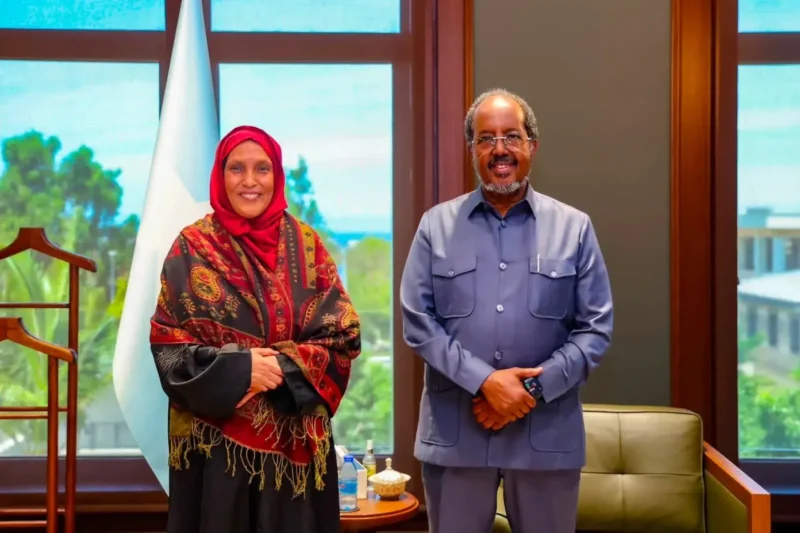
The NIHRC was formally established in 2025 after years of delays, with nine commissioners approved by Parliament and elected in February 2026. Dr. Maryam Qasim Ahmed was elected Chairperson, bringing over forty years of expertise in public administration and social services. Expectations were high that the Commission would become a credible, independent voice for accountability in a country where impunity has long been the norm.
Since her appointment, Dr. Qasim has engaged extensively with international partners on institutional development. In September 2026, she met with the Head of UNTMIS, Raisedon Zenenga, to discuss the handover of UN human rights monitoring responsibilities as the UN mission prepares to close in October 2026. She also met with the newly appointed UNDP Resident Representative, Christophoros Politis, to discuss accountability, complaints management and reporting systems. These engagements have focused on building the Commission’s institutional capacity, strengthening its monitoring and reporting systems, and improving how it handles citizen complaints.
Those efforts are necessary and welcome. But they also highlight a gap between the Commission’s institutional development and its public posture on politically sensitive violations. The Commission is building systems to receive and process complaints. It has not yet demonstrated a willingness to act on the most visible and consequential abuses facing Somali citizens.
Those expectations are now being tested. The Commission has shown it can speak clearly when the victim is a child whose killing generates public outrage. But it has not shown the same willingness to address violations that implicate the government, security forces, or powerful commercial interests.
The eviction of tens of thousands of IDPs, the unlawful sale of public land, and the arrest and assault of journalists are not peripheral issues. They are central to the human rights crisis in Somalia. They are also politically sensitive, because they involve actors with power and influence.
The Commission’s selective silence suggests either a lack of capacity, a lack of independence, or a conscious decision to avoid confrontation with the government that appointed its members and controls its budget. None of these explanations is consistent with the Paris Principles or the Commission’s constitutional mandate.
Critical Note
The NIHRC’s statement on the killing of Ikhlas is appropriate and necessary. But it also exposes the Commission’s failure to address the broader pattern of abuses that have become systemic in Mogadishu. The forced eviction crisis, the land grabs, and the crackdown on journalists are not isolated incidents. They are the product of a governance system in which state power is used to dispossess the vulnerable and silence critics. A human rights commission that cannot or will not confront these violations is not fulfilling its mandate.
The Commission’s credibility depends on its willingness to speak truth to power, not only to condemn crimes that are already the subject of public outrage. The institutional support it is receiving from UNTMIS and UNDP is important, but capacity building alone does not produce accountability. If the Commission remains silent on the evictions and the attacks on journalists, it will be seen as a body that serves the government rather than the people. That would be a profound failure, not only for the Commission but for the thousands of Somalis who hoped that its creation would mark a new era of accountability.
Recommended Reading On ftlsomalia.com
- NIHRC and UNTMIS Discuss Handover of Human Rights Monitoring Responsibilities
- Somalia’s Human Rights Commission and UNDP Discuss Accountability, Complaints Management and Reporting Systems
- Somalia Reclaims Human Rights Oversight as Parliament Backs New Commission
- Dr. Maryam Qasim Ahmed Elected Head of Somalia’s Human Rights Commission
- Human Rights Commission Launches Capacity Workshop in Mogadishu
- NIHRC Discusses Institutional Vision with Swiss Envoy