MOGADISHU, Somalia’s National Identification and Registration Authority (NIRA) has operationalized its Hubiye verification platform, a digital system designed to allow service providers to confirm the authenticity of National ID cards in real time, alongside new legal procedures aimed at safeguarding citizen data.
According to a statement released by NIRA, the Hubiye platform enables financial institutions, telecommunications companies, and government agencies to verify an individual’s identity against the national database before processing transactions or granting access to services. The system is intended to reduce identity fraud while facilitating smoother interactions between citizens and the institutions that serve them.
How the Verification Works
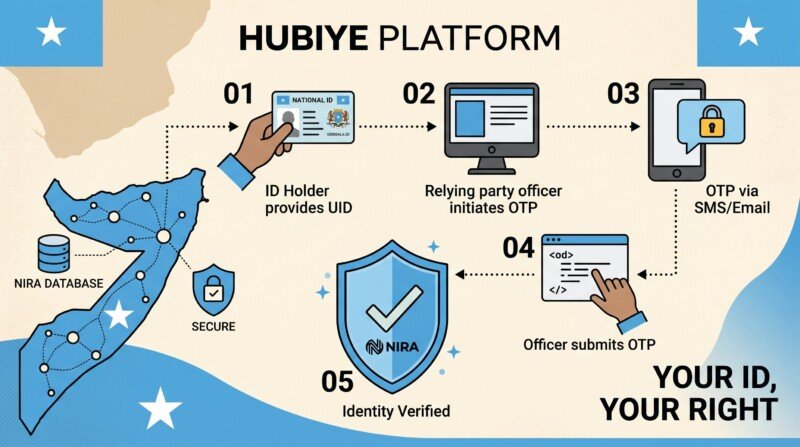
The Hubiye platform operates by linking a citizen’s Unique Identification Number with authorized relying parties. When a bank, telecom operator, or government office needs to confirm an identity, the system performs a dual-layer check: it validates the ID against NIRA’s central database and then confirms the individual’s presence through a real-time One-Time Password sent to the citizen’s registered device.
This structure is designed to prevent a common vulnerability in identity systems, where a stolen or forged card can be presented without the holder’s knowledge. The OTP requirement ensures that verification requires the active participation of the ID holder, adding a layer of security that a physical card alone cannot provide.
NIRA has described the platform as the foundation of Somalia’s identification ecosystem, with the capacity to support verification for citizens residing abroad as well, through integration with international agencies.
The Broader Push for Digital Identity
Hubiye is one component of a larger digital infrastructure that NIRA has been building since the passage of the Identification and Registration Act in March 2023. The authority has registered more than 1.5 million Somalis with biometric digital identities, processing between 12,000 and 15,000 registrations daily, as reported in FTL Somalia’s coverage of the national ID rollout.
The government’s target is to reach 15 million citizens by 2029. The National ID has already become mandatory for domestic air travel, passport applications, and opening a bank account. The Auditor General’s Office is integrating the government payroll system with NIRA’s database to eliminate ghost workers, with completion targeted for December 2027.
NIRA has also launched the eAqoonsi mobile application, allowing citizens to carry their National ID digitally on smartphones with the same legal validity as the physical card, as reported in FTL Somalia’s coverage of the digital ID app.
Critical Note
The launch of Hubiye represents a meaningful technical advance. A national ID system is only as valuable as its verification mechanisms, and the OTP layer addresses a real weakness in card-based identity systems. For banks and telecom companies operating in Somalia, a reliable, real-time verification tool reduces the risk of fraud and simplifies customer onboarding, both of which are prerequisites for financial inclusion and investment.
But the platform’s effectiveness will be tested by the same constraints that have challenged NIRA’s broader rollout. The agency does not officially operate in Puntland, Somaliland, or Jubbaland, where political and administrative obstacles have prevented registration. Puntland has established its own identification authority and rejected the federal system. A verification platform that covers only part of the country’s population and territory cannot function as a national identity infrastructure. It can only serve the regions where NIRA is operational.
The data security procedures that NIRA has implemented are a welcome signal that the authority recognizes the sensitivity of the information it holds. The National Data Protection Act and the establishment of a Data Protection Authority provide a legal framework. Whether those safeguards are sufficient, and whether they are enforced consistently, will determine whether Somalis trust the system enough to use it. The Hubiye platform is a tool for verification. It is not, by itself, a guarantee of trust.
Recommended Reading On ftlsomalia.com
- Auditor General Links Government Payroll to NIRA National ID System to Combat Ghost Workers
- NIRA Launches eAqoonsi Digital ID App for Somali Citizens
- NIRA Registers Somali Returnees from Yemen, Linking National ID to Reintegration
- Somalia Enforces National ID for Domestic Travel, Puntland Residents Stranded
- Somalia Requires National ID for Passport Applications Starting 2026