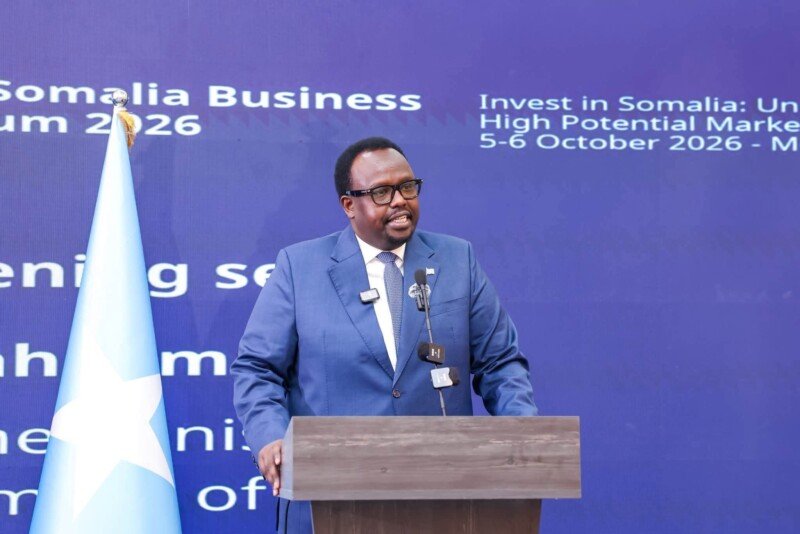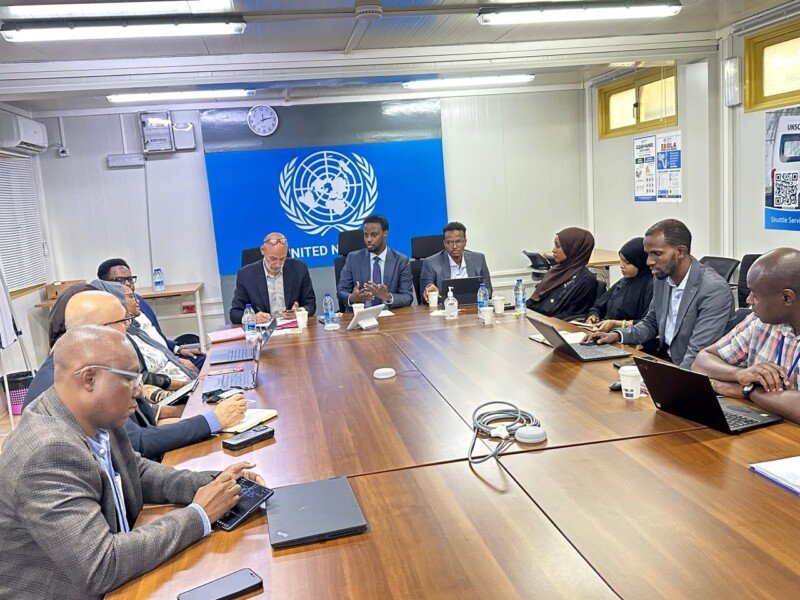
MOGADISHU — The National Economic Council (NEC), chaired by the Council’s Chairman and Senior Economic Advisor to the President, Dr. Hassan Aden Hosow, has met with officials from United Nations agencies in Somalia to discuss the Peace-Economy Enhancement Initiative, which is rooted in the Centennial Vision 2060 (CV2060) and the National Transformation Plan.
The NEC presented key findings from a nationwide public survey and study conducted by the Council. UN Resident Coordinator George Conway reportedly praised Somalia’s progress in peace and the growth of new business activities that peace has enabled.
Peace-Economy Initiative and Economic Transformation
The initiative involves in-depth economic research that will examine critical sectors of the economy to accelerate growth and economic transformation in Somalia.
The meeting reflects growing international engagement with Somalia’s economic reform agenda. The European Union has been a key partner in supporting Somalia’s reforms, with the recent unlocking of €10.7 million in budget support funds following progress on economic governance benchmarks.
This engagement is part of a broader pattern of international support for Somalia’s economic development, with partners recognizing the country’s progress on economic reforms and governance.
The National Transformation Plan 2025–2029 serves as the government’s medium-term development framework, outlining a comprehensive strategy aimed at driving economic growth, implementing governance reforms, and advancing infrastructure development.
Economic growth slowed to 3.1 percent in 2025 amid declining foreign aid and drought impacts, according to the World Bank’s Somalia Economic Update, which highlighted the need for structural reforms to address key constraints.
Somalia’s banking sector continued to expand in 2025, with total assets reaching $2.3 billion and private sector credit growing to $540 million, reflecting sustained confidence in the financial system.
Somalia and the UK have launched a global roadmap to strengthen social protection in fragile and conflict-affected settings, building on months of global consultations with policymakers and humanitarian actors.
Critical Note
The meeting between the NEC and UN officials represents an important step in aligning Somalia’s long-term economic vision with international support. The Peace-Economy Enhancement Initiative, rooted in Vision 2060, signals a shift toward a more strategic approach to economic development.
However, the success of this initiative will depend on translating the research and planning into tangible results on the ground. Somalia’s economic challenges are substantial, including limited productive capacity, a large trade deficit, and high dependence on external assistance. The international community’s continued support will be essential, but the government must also demonstrate progress in creating an enabling environment for private sector growth and investment.
The Peace-Economy Initiative’s emphasis on linking peace and economic development is a welcome recognition of the interconnection between security and prosperity. Yet, sustaining peace requires not just economic growth but also inclusive governance and the rule of law. Without addressing these underlying governance challenges, even well-designed economic initiatives may fall short of their potential.
Recommended Reading On ftlsomalia.com
- Deputy Prime Minister Opens Third Somalia Development Forum, Highlights National Transformation Plan
- World Bank: Only 21% of Somali Households Receive More Than Eight Hours of Electricity Daily
- Finance Minister and World Bank Push Back on Former PM’s Economic Claims
- Somalia Grants First Microfinance Licenses in Landmark Step for Financial Inclusion