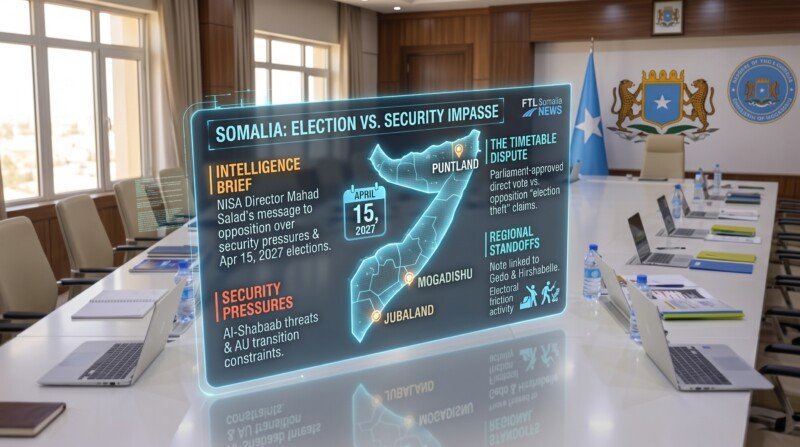
MOGADISHU — Somalia’s political opposition has rejected the federal election timetable announced by the National Independent Electoral and Boundaries Commission (NIEBC) on Wednesday, accusing the government of “election theft” and “power-grabbing” in a sharp escalation of the country’s political crisis.
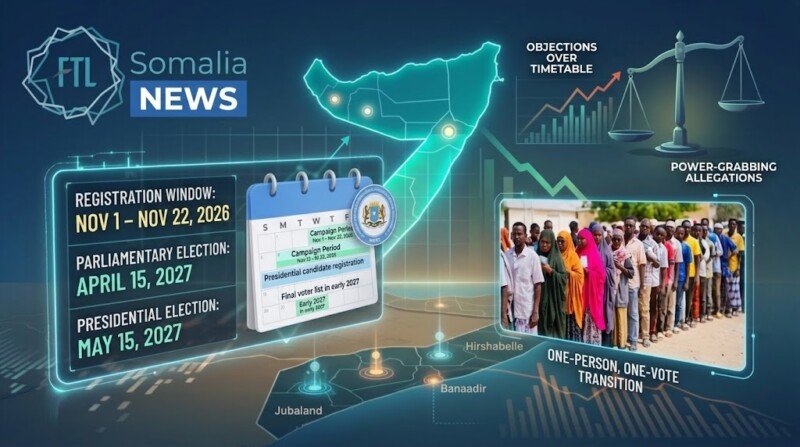
Mohamed Adan Jimcaale (Koofi), the secretary of the opposition alliance known as Madasha Samatabixinta (Somali Salvation Forum), issued a statement condemning the timetable, which schedules parliamentary elections for 15 April 2027 and the presidential vote for 15 May 2027.
“The disease that caused Somalia’s destruction began with a stolen election and the misuse of state power,” Koofi said. “Forty years later, Hassan Sheikh wants to prescribe the same disease as a cure, and it will not happen”.
His statement followed the NIEBC’s formal announcement of the electoral calendar, which includes reopening voter registration from 1 to 22 November 2026, a 22 November deadline for candidate lists, publication of the provisional voter list on 21 January 2027, and the start of campaigning on 27 February 2027.
The full timetable was published by the NIEBC and reported in detail by FTL Somalia’s coverage of the election timetable, which noted that the commission is led by Chairperson Abdikarim Ahmed Hassan.
Government Welcomes the Timetable
Minister of Information Abdifatah Qasim Mohamud responded to the opposition’s criticism by praising the NIEBC’s move, saying Somalia is heading toward one-person, one-vote federal elections.
“Since the first four chapters of the National Constitution were approved and signed by the President, the Federal Government of Somalia has been working to ensure its implementation, putting in place the laws and institutions necessary for holding elections,” the minister said. “One-person, one-vote elections based on a multi-party system have taken place in Mogadishu, and the electoral process is underway in some federal member states.”
“Today, Somalia is heading toward federal-level one-person, one-vote elections, which are an important part of state-building, strengthening democracy, and empowering the people. One-person, one-vote elections are your right and your country’s future. Prepare to participate in the elections.”
The Galmudug Precedent and the Credibility Question
The NIEBC’s decision to schedule federal elections comes amid lingering questions about the commission’s credibility, following the Supreme Court’s annulment of the Galmudug elections in August 2026. As reported in FTL Somalia’s coverage of the Supreme Court ruling, the court found that the July 30 vote had not been administered in accordance with constitutional and electoral requirements for free, fair and impartial elections.
The case had been brought by the Towfiiq political organization, which challenged the July election results. The Supreme Court ordered a rerun, which was held on 30 September 2026. However, the NIEBC subsequently excluded Towfiiq from the list of 12 organizations cleared to contest the rerun, despite the party having successfully challenged the previous election in court. The commission did not provide a detailed public explanation for the exclusion.
The rerun results were ratified by the Supreme Court on 13 October 2026, confirming the allocation of all 89 seats in the Galmudug House of Representatives. The ruling party Cadaaladda iyo Wadajirka secured an overwhelming majority with 67 of the 89 seats.
The sequence of events, a court annulment of an election administered by the NIEBC, followed by the exclusion of the party that brought the successful challenge, has raised questions about whether the same commission can be trusted to administer federal elections. Former Chairperson Halima Ismail Ibrahim has warned that Somalia should not proceed with any national election unless three critical conditions are met: a political agreement on the election model, a mutually agreed electoral commission, and legally recognized competing political parties.
The Political Opposition and the Risk of Parallel Elections
The electoral framework remains deeply contested. The Somali Salvation Forum (Madasha Samatabixinta), an opposition alliance including Puntland and Jubaland, has rejected the one-person, one-vote model as proposed and the constitutional amendments that underpin it. The Forum insists that any electoral framework must be negotiated among all stakeholders and cannot be imposed unilaterally by the federal government.
The opposition has repeatedly threatened to organize parallel elections and form a rival administration if the government proceeds without a negotiated agreement. As reported in FTL Somalia’s coverage of the opposition’s threat, opposition leaders warned of a potential constitutional vacuum if the political deadlock persisted, and the Forum accused President Mohamud’s administration of unilateral decision-making and failing to build consensus.
Puntland has also signaled that it may proceed with independent regional elections if no national agreement is reached, announcing in February 2026 that it could conduct elections under its own constitutional framework to prevent a governance vacuum.
Federal Government’s Limited Reach in Puntland and Jubaland
The federal government’s ability to organize elections in Puntland and Jubaland is severely constrained. Both states have rejected the constitutional amendments and the electoral framework, and they have declined to participate in negotiations mediated by Turkey, questioning Ankara’s neutrality. The opposition alliance has effectively accused Mogadishu of interfering in regional political processes and said relations between the federal government and Puntland and Jubaland had effectively broken down.
This means that the NIEBC’s timetable applies, in practice, only to areas under federal government control. Puntland and Jubaland are unlikely to participate in federal elections scheduled for April and May 2027. If those states proceed with their own electoral processes, Somalia could face a scenario in which two parallel electoral tracks emerge, one administered by the NIEBC in federally controlled areas and another organized by opposition-controlled states.
Critical Note
The NIEBC’s release of a federal election timetable is a procedural step that moves Somalia from a general commitment to hold elections in 2027 to a concrete schedule. But the credibility of that schedule depends on factors that go well beyond the calendar.
The Galmudug precedent is troubling. The Supreme Court annulled an election administered by the NIEBC, citing substantial irregularities. The commission then excluded the party that had successfully challenged the vote from the rerun. Whether the exclusion was justified or not, the commission has not provided a detailed public explanation, leaving the impression that the decision was political rather than procedural. If the NIEBC cannot explain its decisions in Galmudug, how can it be trusted to administer federal elections impartially?
The opposition’s threat of parallel elections is not merely rhetorical. Puntland and Jubaland have both rejected the constitutional framework and signaled their willingness to proceed independently. The federal government has no capacity to organize elections in those states without their cooperation. If the government proceeds with the NIEBC timetable anyway, it risks producing a partial election that lacks national legitimacy.
For Somalia, the 2027 elections represent both an opportunity and a risk. If held credibly and with broad participation, they could mark a historic transition to direct democratic governance. If held amid political division, contested legitimacy, and a compromised electoral commission, they could deepen the divisions they are meant to resolve. The NIEBC has done its part by setting the timetable. Whether the political class can deliver on the promise of free and fair elections remains the central question.
Share your story. FTL Somalia is continuing to investigate Somalia’s electoral process. If you have information or insights to share, contact us at info@ftlsomalia.com. Your identity will be protected.
Recommended Reading On ftlsomalia.com
- Somalia’s Electoral Commission Announces Timetable for Parliamentary and Presidential Elections in 2027
- Somali Cabinet Announces 2027 Election as Constitutional Deadline Passes
- Galmudug Election Finalized as Supreme Court Certifies Rerun Results
- Somalia President Agrees to Opposition Talks to Avoid Parallel Elections