
MOGADISHU — Somalia’s national payment system processed 337,788 transactions with a combined value of approximately US$592.9 million during the first quarter of 2026, according to the Central Bank of Somalia’s Quarterly Economic Review.
This represents a 14 percent decline in transaction volume from 392,103 transactions in the previous quarter and a 26 percent decline in total value from US$798 million. On a year-on-year basis, transaction volumes were broadly stable compared with 339,504 transactions in the first quarter of 2025, while total transaction value increased by 23 percent from US$484.3 million, indicating a higher average value of payments processed through the system.
RTGS Dominates Value, ACH Drives Volume
The Real Time Gross Settlement (RTGS) system processed 10,558 transactions during the quarter with a combined value of approximately US$467.8 million. Although RTGS accounted for less than 4 percent of total transaction volume, it represented around 79 percent of total transaction value, consistent with its role in settling large-value interbank obligations. On a year-on-year basis, RTGS transaction value increased by 31 percent from US$357.9 million in the first quarter of 2025, pointing to stronger high-value payment activity.
The Automated Clearing House (ACH) accounted for most payment activity by volume, processing 327,230 transactions with a combined value of US$125.2 million. ACH transactions represented approximately 97 percent of total system volume, broadly in line with previous quarters. On a year-on-year basis, ACH transaction value declined slightly by 1 percent from US$126.4 million, while volumes declined modestly from 330,251 transactions.
As reported in FTL Somalia’s coverage of the 2025 annual figures, the National Payment System processed 1,409,151 transactions worth approximately US$2.42 billion during 2025, representing a 10 percent increase in volume and a 25 percent increase in value compared with 2024.
SIPS and the Push for Interoperability
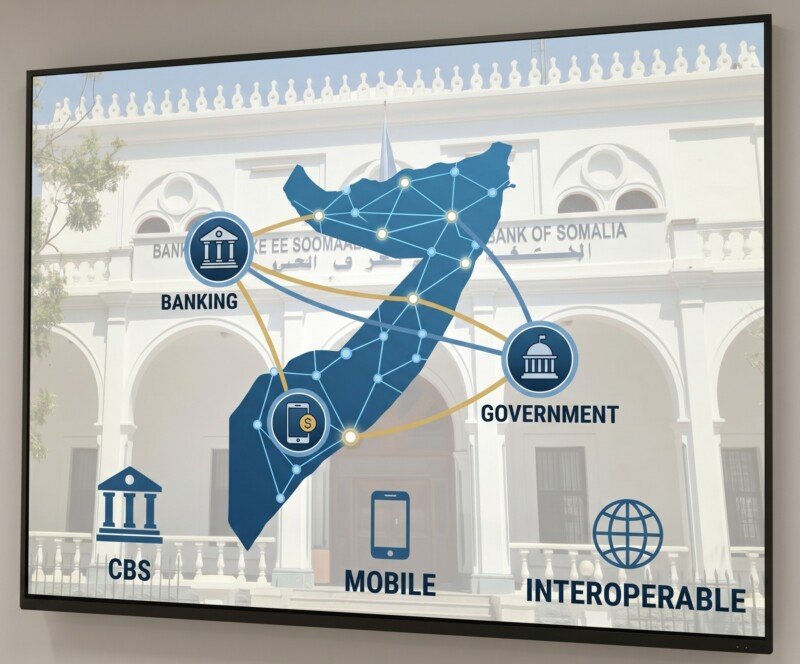
The quarterly figures come as the Central Bank continues to expand the Somalia Instant Payment System (SIPS), launched in January 2025. SIPS enables real-time, 24/7 transfers between banks, mobile wallets, and point-of-sale terminals, allowing seamless Person-to-Person (P2P), Person-to-Merchant (P2M), and Government-to-Person (G2P) transactions regardless of which provider users choose.
SIPS was built on ISO 20022, the international standard for financial messaging, and is operated by the Somalia Payment Switch, a partnership between the Central Bank and 13 commercial banks. As detailed in FTL Somalia’s coverage of Somalia’s regional payments initiative, the Central Bank has also announced readiness to join the Arab Monetary Fund’s Inclusive Instant Payments Initiative (IIPS), a step expected to reduce transaction costs and improve cross-border payment infrastructure.
The next phase of SIPS expansion involves integrating mobile money operators. Mobile wallets rather than bank accounts carry most day-to-day transactions in Somalia, and until those operators are connected to the network, the interoperability SIPS offers remains limited to the banking tier. According to Central Bank plans, the system will eventually connect 14 commercial banks and 8 mobile money and electronic wallet providers.
The Central Bank has also linked SIPS to SOMQR, the national standardised quick response code, which is intended to bring smaller traders and informal businesses into digital payments without requiring them to install specialised equipment.
Legal and Regulatory Framework
In March 2026, the National Payment System Law was enacted, providing a comprehensive legal basis for the regulation, oversight, and operation of payment systems and payment service providers in Somalia. The Central Bank has also announced its participation in the Pan-African Payment and Settlement System (PAPSS), an important step toward improving cross-border payment infrastructure and supporting intra-African trade.
Critical Note
The quarterly decline in transaction volume and value compared with the fourth quarter of 2025 should be interpreted with caution. The fourth quarter typically sees elevated transaction activity linked to year-end settlements and holiday-related transfers. The year-on-year comparison, which shows stable volumes and a 23 percent increase in value, provides a clearer picture of the underlying trend: Somalia’s payment system is processing higher-value transactions than it did a year ago.
The more significant development is the structural transformation underway. Somalia has historically relied on parallel and disconnected payment networks, with mobile money platforms operating in closed loops and banks maintaining separate systems. The expansion of SIPS to integrate mobile money operators represents an attempt to create a single national rail for digital payments. If successful, this would reduce transaction costs, improve financial inclusion, and bring millions of wallet holders into the formal financial system.
However, the timeline for mobile money integration remains unclear. The Central Bank has set targets for connecting PAPSS before the end of 2026, but the mobile money integration has no published date. Given the dominance of mobile wallets in Somali daily transactions, the success of SIPS depends on whether the Central Bank can bring these operators into the network. Until that happens, the interoperability SIPS offers remains limited, and the vision of a unified national payment infrastructure remains a work in progress.
Recommended Reading On ftlsomalia.com
- Somalia’s National Payment System Surges to 1.4 Million Transactions Worth $2.42 Billion
- Central Bank of Somalia Launches Instant Payment System
- Somalia Eyes Digital Leap with Regional Instant Payments Initiative
- Somalia Creates History by Launching Payment Switch
- Central Bank of Somalia Adopts Use of IBAN