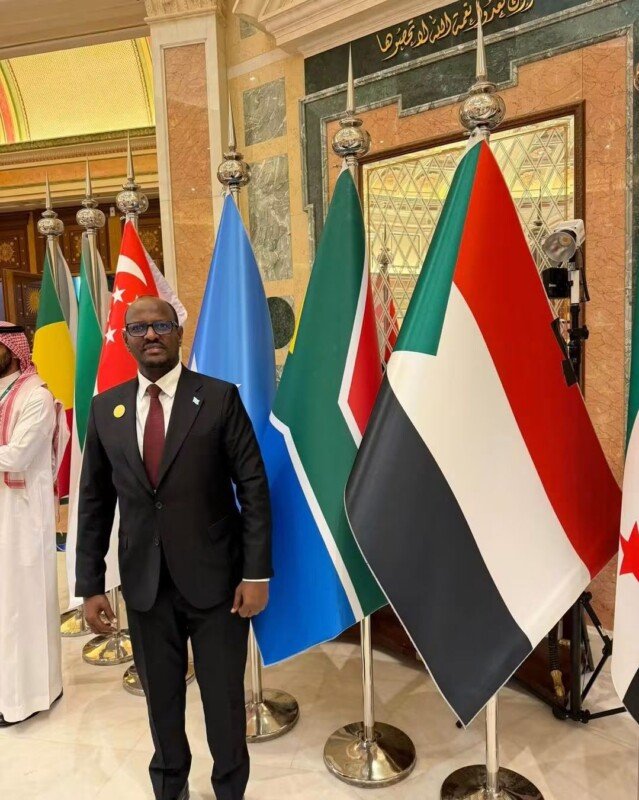
MOGADISHU — Somalia’s Minister of Petroleum and Mineral Resources, Dahir Shire Mohamed, participated in the 17th International Energy Forum (IEF) Ministerial Meeting in Riyadh this week, as Somalia positions itself as an emerging frontier in global oil and gas exploration.
The IEF17, held under the theme “Energy Security and Shared Goals in a New Era,” brought together energy ministers, industry leaders and heads of international organizations from producing, consuming and transit countries. The meeting was inaugurated by Saudi Arabia’s Minister of Energy, Prince Abdulaziz bin Salman bin Abdulaziz, who stressed that delivering energy security is a shared responsibility requiring effective international cooperation.
Somalia’s Emerging Role in Global Energy
Somalia’s participation in the Riyadh forum comes as the country’s first deep-sea offshore drilling campaign, led by Turkey’s state-owned Turkish Petroleum Corporation (TPAO), progresses off its coast. As reported in FTL Somalia’s coverage of the Somali-Turkish energy partnership, the Çağrı Bey drillship is conducting exploration at the Curad-1 well, located approximately 372 kilometers off the coast of Mogadishu, targeting a total depth of around 7,500 meters, one of the deepest offshore wells ever attempted globally.
The drilling operation follows extensive 3D seismic surveys conducted by the Turkish vessel Oruç Reis. As detailed in FTL Somalia’s coverage of the seismic mission, the vessel collected data across 4,464 square kilometers in three offshore blocks, including Blocks 142, 152 and 153, over 234 days. Early results from the seismic surveys raised hopes of substantial oil reserves beneath Somalia’s territorial waters.
A Growing Strategic Partnership
The energy partnership between Somalia and Turkey rests on a formal bilateral framework established in March 2024, when the two countries concluded an intergovernmental agreement and memorandum of understanding covering onshore and offshore oil and gas cooperation. A Production Sharing Agreement was concluded in 2025, creating the legal and commercial structure to guide exploration activities, infrastructure development and profit distribution.
The agreement grants TPAO exclusive rights to explore three offshore blocks, with terms allowing the company to recover up to 90 percent of production after royalties, which are capped at 5 percent. Somalia is accepting lower early revenues to reduce TPAO’s exploration risk and improve the chances of eventual development, a strategy analysts describe as a deliberate effort to attract international investment to a frontier basin.
As reported in FTL Somalia’s coverage of the drilling timeline, Turkish officials have said the operation could produce oil within nine months, though they have cautioned that results will depend on geological conditions and further evaluation.
Somalia’s offshore acreage includes 247 licensable blocks, each covering up to 5,000 square kilometers, with 234 blocks still available for investment. Industry estimates suggest Somalia could hold up to 30 billion barrels of un-risked oil reserves, though these remain prospective resources inferred from seismic data rather than booked commercial reserves.
Governance and Transparency Concerns
Despite the optimism surrounding the drilling campaign, governance watchdogs have raised concerns about resource management. The Somalia Transparency Initiative has warned that while the arrival of the Çağrı Bey indicates tangible progress, severe risks stem from improper resource management, calling on federal authorities to maintain absolute transparency through the immediate public disclosure of oil contracts.
Opposition figures have also criticized the agreement. MP Abdirahman Abdishakur Warsame has characterized the oil exploration pact as “profoundly imbalanced,” warning that it might jeopardize Somalia’s national interests. Senator Professor Abdi Ismail Samatar has alleged that the defense and petroleum agreements between Türkiye and Somalia are “fraudulent” and have not been scrutinized or endorsed by the Somali Parliament.
Critical Note
Somalia’s participation in the International Energy Forum in Riyadh signals its ambition to transition from a peripheral geopolitical position to an active participant in global energy markets. The presence of Minister Dahir Shire at a forum that brings together energy ministers from producing and consuming countries is a diplomatic achievement for a nation that, until recently, had no active offshore drilling operations.
However, the path from exploration to production is long and uncertain. Only two exploration wells have ever been drilled along Somalia’s roughly 1,000-kilometer offshore margin, and none have produced a commercial discovery. The Curad-1 well, if successful, would mark a historic breakthrough, but it is a single well in a vast, underexplored basin. Even a discovery would require appraisal drilling, development planning, export infrastructure, and fiscal and regulatory clarity before Somalia could realize any revenue.
The governance concerns raised by transparency watchdogs and opposition figures are particularly significant. Somalia’s history with natural resource management is limited, and the country faces well-documented challenges with corruption and institutional capacity. The “resource curse” that has afflicted other developing nations, where resource wealth leads to corruption, economic disparity and political instability rather than prosperity, is a real risk if robust accountability mechanisms are not established before revenues begin to flow.
The international energy landscape is also shifting. As Saudi Arabia’s energy minister noted at the forum, energy infrastructure takes years to develop, and the cost of being unprepared can be far greater than the cost of investment. For Somalia, being prepared means not only developing infrastructure and attracting investment but also building the institutions and legal frameworks that will ensure any eventual wealth benefits the Somali people rather than a select few.
Share your story. FTL Somalia is continuing to investigate Somalia’s petroleum sector and the governance of its natural resources. If you have information or insights to share, contact us at info@ftlsomalia.com. Your identity will be protected.