MOGADISHU, Somalia’s Prime Minister Hamza Abdi Barre dismissed two junior government officials on Wednesday, November 4, 2026, the same day President Hassan Sheikh Mohamud removed the Chief Justice of the Supreme Court, in a coordinated exercise of executive authority that unfolded against the backdrop of a contested electoral transition, a looming security vacuum, and a shrinking budget.
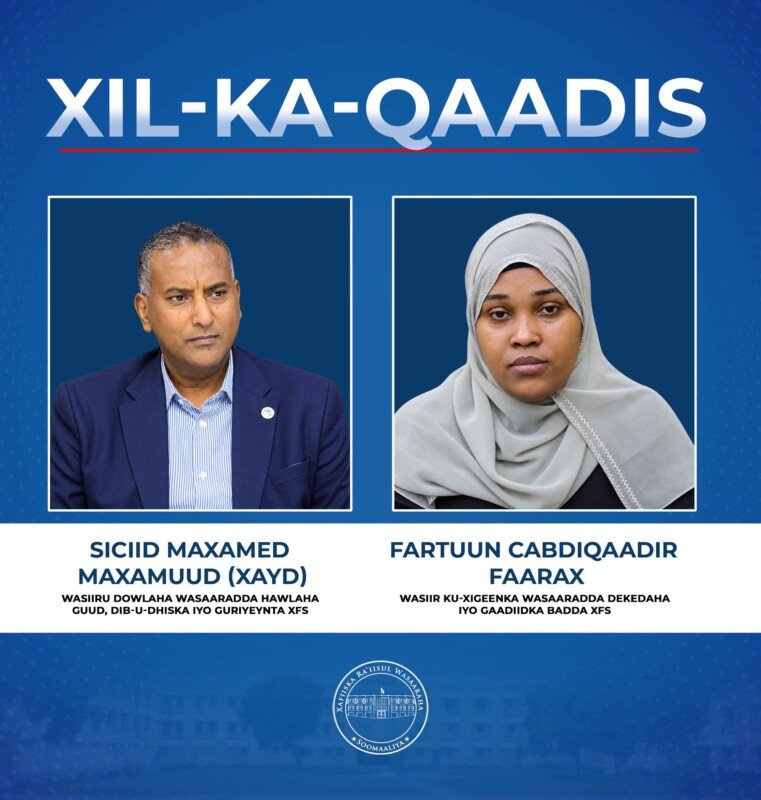
The officials relieved of their duties are Said Mohamed Mahmoud (known as Hayd), State Minister for Public Works, Reconstruction and Housing, and Fartun Abdikadir Farah, Deputy Minister for Ports and Marine Transport, according to a statement from the Prime Minister’s Office. The statement did not provide a specific reason for the dismissals, saying only that the Prime Minister acted under constitutional provisions and in line with principles of transparency and accountability.
Hours earlier, President Mohamud dismissed Chief Justice Bashe Yusuf Ahmed and reappointed Ibrahim Idle Suleiman to lead the Supreme Court. The presidency cited complaints from judges, judicial staff, and legal professionals about the need for a fair and impartial justice system, and announced a sweeping overhaul of the judiciary.
A Judicial Dismissal With Political Implications
The removal of Chief Justice Bashe Yusuf Ahmed is the more consequential of the two decisions. Bashe had recently taken up an opposition petition challenging the government’s new constitution and had ordered the government to submit its defence. He was reportedly on the verge of delivering a verdict on the petition when he was dismissed .
The opposition and several federal member states have denounced the constitutional amendments ratified earlier this year as unilateral and unconstitutional. Analysts have described the President’s move as pre-emptive, removing Bashe before he could issue a potentially damaging ruling against the government.
Bashe had also demonstrated independence in other matters. Weeks before his dismissal, he issued a ruling ordering a rerun of the Galmudug regional elections, compelling the authorities to comply. That decision had already strained relations between the judiciary and the executive, as the Galmudug electoral process had already raised questions about the commission’s credibility.
The new Chief Justice, Ibrahim Idle Suleiman, is a member of the ruling party (JSP) and a close associate of the President. He previously served as Chief Justice from 2016 until his dismissal in May 2018 by then-President Mohamed Abdullahi Farmaajo. After President Mohamud returned to power in 2022, he appointed Suleiman as his special legal adviser.
Why This Looks Like a Purge
The dismissal of a Chief Justice is not, in itself, unprecedented in Somalia. But the timing, the context, and the identity of his replacement point to a broader pattern that goes beyond routine judicial administration.
First, the electoral calendar is contested. President Mohamud has scheduled parliamentary elections for April 15, 2027, and a presidential vote for May 15, 2027, under a new one-person, one-vote system. The opposition has rejected the timetable, accusing the government of “election theft.” Former President Mohamed Abdullahi Farmaajo has warned of parallel elections and renewed conflict, and former President Sharif Sheikh Ahmed has challenged the constitutional amendments in the Supreme Court. The dismissal of the Chief Justice removes the judge who was considering that challenge, and replaces him with a presidential ally.
Second, the security transition is unravelling. Uganda has begun withdrawing its troops, and the AUSSOM mission faces a funding crisis after the United States ended support for the UN logistics office. The unravelling of Somalia’s security architecture has created a vacuum that Al-Shabaab is likely to exploit. A government facing a security crisis has a strong incentive to consolidate control over the judiciary and eliminate potential legal challenges that could paralyze decision-making.
Third, the fiscal situation is dire. The government’s domestic revenue remains among the lowest in the world, and the promise of oil revenue is more than a decade away. The Prime Minister’s dismissal of two state ministers may be linked to budget pressures or to a broader effort to streamline the cabinet. But the absence of a stated reason means the public cannot judge whether the dismissals were driven by competence, corruption, or political calculation.
Fourth, the federal compact is fracturing. Puntland and Jubaland have rejected the federal electoral process. Deni has called on the President to resign, and Puntland has dismissed the federal election plans as “predetermined and undemocratic”. The National Salvation Forum has accepted dialogue, but the absence of the two member states means that any agreement reached in Mogadishu will not represent a national consensus. In this environment, the government’s control over the judiciary becomes a critical tool for managing dissent.
Critical Note
The Prime Minister’s dismissal of two state ministers is a routine exercise of executive authority, and the absence of a stated reason is unfortunate but not unusual in Somali politics. The President’s dismissal of the Chief Justice is a different matter entirely.
The timing is difficult to ignore. Bashe was overseeing a case that challenged the legal foundation of the President’s extended mandate. He had ordered the government to defend its constitutional amendments. He was reportedly close to a ruling. And then he was removed, replaced by a man who had previously served as the President’s legal adviser and who belongs to the same political party.
The presidency’s explanation, that judges and legal professionals had complained about the need for a fair justice system, is vague and unverifiable. It does not address the specific case before the court. It does not explain why the Chief Justice was removed at this particular moment. And it does not account for the fact that the new Chief Justice is a political ally of the man whose constitutional amendments were being challenged.
This is what a purge looks like. It is not a single act of repression. It is a series of moves, taken at a moment of maximum vulnerability, to remove the institutional checks that stand between the executive and its agenda. The government is facing a contested election, a security vacuum, and a fiscal crisis. It cannot afford a judiciary that rules against it. So it has removed the judge who might have done so. The message to any other judge considering a similar ruling is clear. The message to the opposition is equally clear. The courts will not be allowed to stand in the way.
Recommended Reading On ftlsomalia.com
- Former President Farmaajo Rejects Election Timetable, Warns of Parallel Elections
- The First Domino: Uganda’s Withdrawal and the Unravelling of Somalia’s Security Architecture
- Petroleum Promises and Fiscal Realities: The Gap Somalia Cannot Afford to Ignore
- Deni Tells Mohamud to Resign, Dismisses November Forum as a Waste of Time
- Puntland Leader Slams Federal Government’s Election Plans as ‘Predetermined’ and ‘Undemocratic’